“As an entrepreneur, I've learned to surround myself with people who have skills that I lack. FB ads and email funnels were something I knew I wanted to be doing in my business but I had no idea where to start. I put it off for a while because it was outside my comfort zone, and it wasn’t until I found Hailey that I felt confident moving forward with them. Hailey took the reigns and created a system for me that was not only profitable, but really helped me create more space in my day to work on the things that are in my zone of genius!”
Lauren Bongiorno Diabetic Health Coach
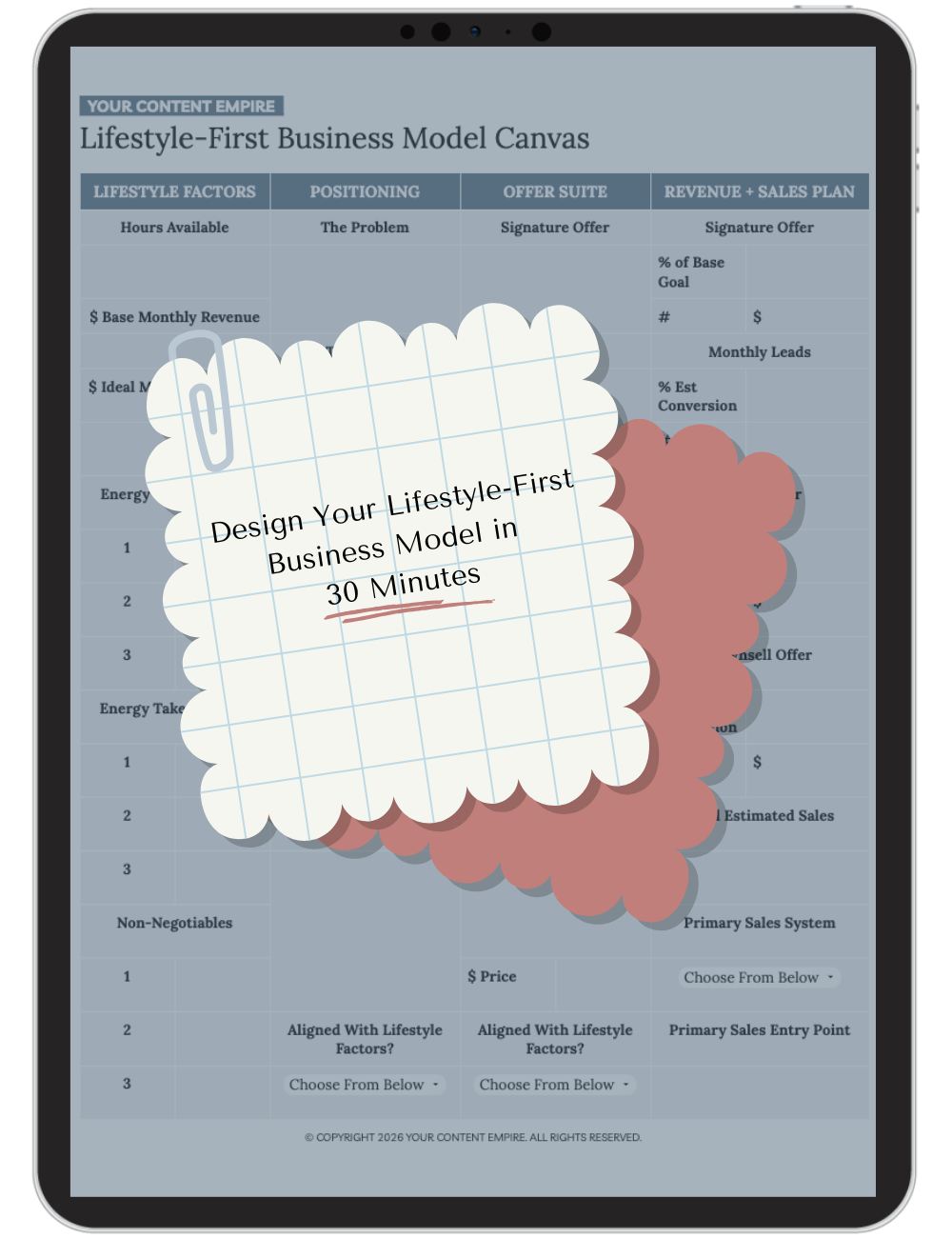
Click Here to Design Your Lifestyle-First Business Model with My Free Template
2026 Guide For Planning Content Like A Business Owner (Not An Influencer)
You’re not an influencer. So why are you planning your content like one?
I’m going to assume that because you’re watching this video, you’re interested in using content as a strategy to grow your business.
But all too often, business owners find themselves influenced into doing content the influencer way, only to end up frustrated, working way harder than they have to and not having a lot to show for all of that effort.
In this video, you’re going to learn the 4 shifts that separate influencer content from business owner content AND how you can start getting better results from your content.
Prefer to watch “2026 Guide For Planning Content Like A BUSINESS OWNER (Not An Influencer)” instead?
Want to listen on the go?
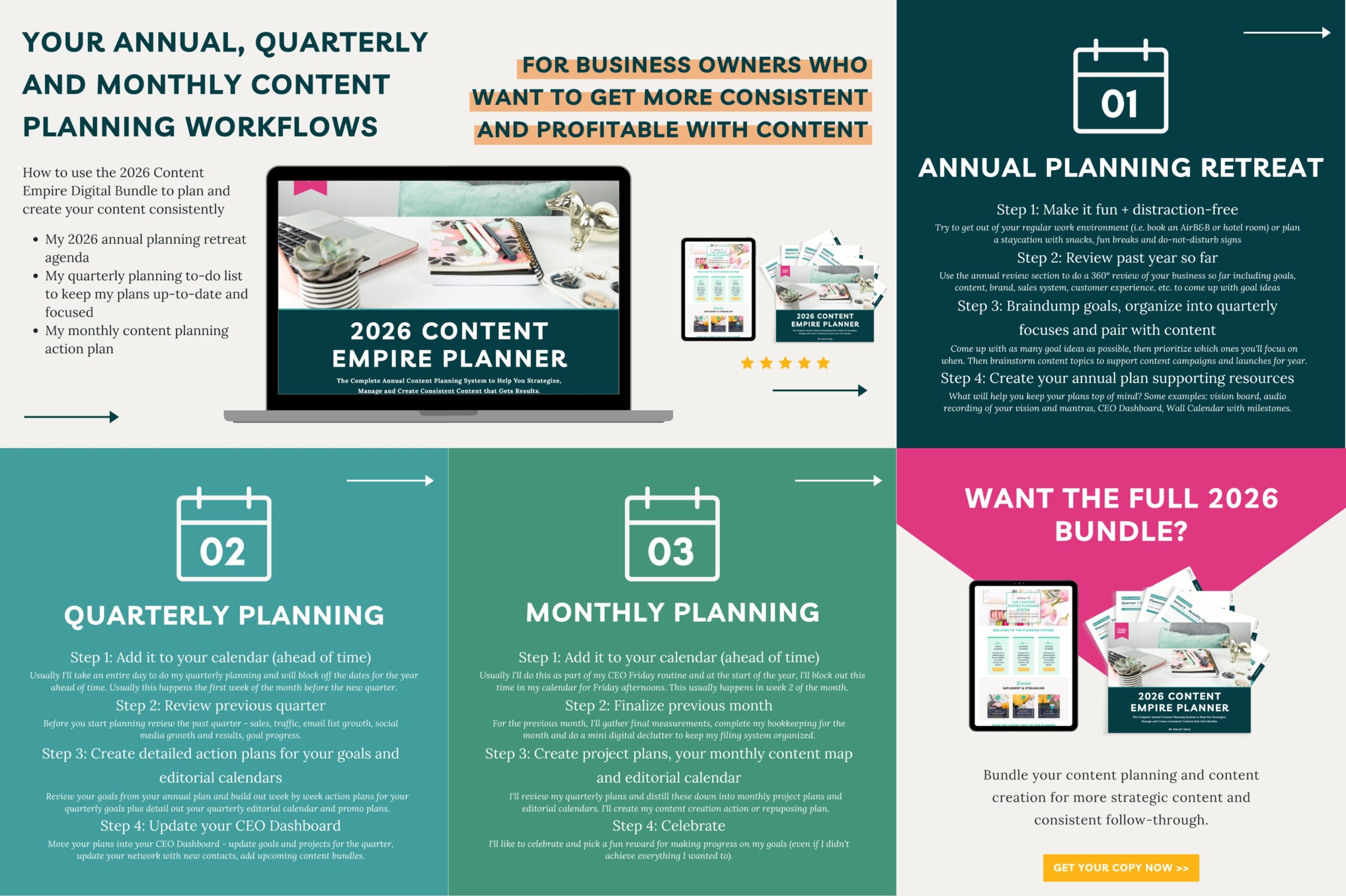
Last week, I shared that I have just launched the 10th edition of the Content Empire Planner. I’ll pop a link down below if you want to check it out. But there’s one BIG thing that really differentiates this planner from other options – while most other content planners are more general in their content focus, others lean hard into helping influencers and capital C content creators plan out their content. Whereas this content planner is created specifically for business owners by a business owner.
This last year, so much has changed with offers, with marketing, with sales, with content. It’s shaken all of us. And as we’ve hunted for things to do, a lot of us have found ourselves influenced by the influencers to start doing content that way.
But here’s the thing: the monetization models are completely different between a business and an influencer. While they’re chasing large follower counts and brand deals, our metrics are geared much more toward attracting and validating leads and converting those into sales.
If you are trying to cosplay or do your content like an influencer, you’re going to end up really frustrated because the metrics and results you see from doing content that way aren’t going to be the things that lead to sales.
And that is where these shifts come in today.
There are 4 big things that I see (especially this year) keeping business owners stuck with content that’s underperforming. And it all comes back to planning your content.
Let’s start with number one.
Shift 1: Make Sure Everything Leads Back to Your Ideal Audience
One of the biggest differences between how influencers plan and use content versus business owners is that influencers influence their audiences on what to care about. Whereas business owners meet their customers where they’re at and tailor what they talk about based on what their customers already care about. Big difference.
What that means for your content planning is that it needs to start with having clear communication channels between you and your audience so they’re giving you cues on what to talk about in your content.
Here are some ways to set up feedback loops with your audience so you have plenty of customer-approved content topics for planning:
You could run a formal survey to your entire audience. I personally run one once a year, give some fun prizes for filling it out and also have a lot of my clients run them prior to big launches so we can anchor all the messaging around what their customers are actually saying.
You can also use more informal or evergreen approaches – like social media question boxes or surveys, questions that people answer before joining a group or even an email that goes out as soon as someone joins your list.
I love having intake surveys for any webinar, event or paid program kick-off. Not only does it let me tailor the content and answer questions, it also gives me some really good insight about why they signed up and I almost always update my messaging based on what I discover.
I’d highly recommend setting up some of inspiration bank where you can store, categorize and easily access these ideas when you need them.
Another thing I do to get more cues on what my customers care about is having a little debrief process after any coaching call, group call or event. I ask myself:
Are there any stories (anonymous or not) that I can share as good lessons or takeaways?
What topics came up?
What questions were asked?
Then I turn all of those things into content ideas for my long-form content, social posts or emails.
The big planning shift here is that your content topics should come from real conversations and market research, not just what’s trending or what you feel like talking about.
Shift 2: Theme Your Content Around an Offer
Where influencers can bounce around within their niche, business owners need to bring a focus to their content. And that focus is your paid offers.
The 4-Week Minimum Focus Strategy: When it comes to planning your content, one of the most strategic things you can do is to focus all of your content around a single offer for a minimum of 4 weeks.
That means that every single piece of content you put out, whether it is:
Long form content topics (podcast episodes, YouTube videos, written blogs)
Social media posts
Stories
Emails
…all lead back to the topic of your paid offer.
Important Note: Even if it’s not a direct pitch or call to action (more on that in the next shift), it still needs to be related thematically to your paid offer.
Why This Works:
Helps you build momentum towards your offer
Gets your audience starting to think about those topics
When you switch into direct sales invitations at the end of 3-4 weeks, they don’t feel like they’re coming from left field
You’ve done your job of warming your audience up to this topic
The 80-90% Rule: One of the best outcomes for your content is that it gets people sold 80 to 90% of the way and does most of the selling for you. Your sales invitations are just what gets them across the finish line
Every content planning session should start with: “What offer am I getting ready to promote next?”
Shift 3: Treat Every Piece of Content Like a Mini Sales Funnel
One of the biggest, most strategic shifts that you can make to the way that you plan your content is to start to visualize every single piece of content you create and the path that someone would take from it to your paid offer.
Real Example: One client of mine structures every single piece of content to lead to a monthly workshop that is then turned evergreen. That workshop builds up and invites people to her paid offer. Every piece of content she creates has a role to play in selling her offer.
The Core Principle: Each piece of content should have a clear next step. And that step should be getting them closer and closer to your offer every single time.
The Bullseye Visualization – Think of this as a top-down view of the traditional funnel—visualize it as a bullseye instead:
Center (bullseye): Your paid offer
Next ring out: Your free or micro-paid offer
Next ring out: Your long-form content
Outer ring: Your social media content
You can clearly visualize people moving from the outside towards the center, and see how each piece plays together to move them closer.
The Shift to Make: Map the pathway of every single piece of content back to your offer. What’s the pathway that they could take?
Shift 4: Treat Your Content Like an Asset (And Leverage It In Your Planning)
While an influencer responds to trends and even sets their own, as an expertise-based business owner—whether you’re a coach, course creator, or service provider—the foundation of your content, your offers, and your work in the world is based on frameworks and processes.
Your Content Has Longevity: Because of that, you shouldn’t always have something new to say. Your frameworks don’t change from day to day. They have longevity. And because of that, by nature, a lot of your content is evergreen and stands the test of time.
Content as a Valuable Business Asset:
This is one of the biggest reasons why content is one of the most valuable business assets that you can create. Not only can you reshare it if you have a hole in your editorial calendar, but it can also be repackaged and repurposed in so many different ways:
Turning it into courses
New products
Freebies
Workshops
Even a book (in my case, even a bestselling book)
Make Sure You’re Treating Content Like the Asset It Is: For me, this looks like building a content bank that is categorized where I can easily find anything.
The Planning Shift: When it comes to your planning, don’t always rush to create something new. Remember that you can shop your content bank too. Where can you pull in a piece of content that you haven’t shared in a while? Maybe you need to update it a little or give it some kind of current-year spin, but the bones will give you such a head start.
Your Advantage Over Influencers: An influencer doesn’t always have that luxury. Their posts and content are fairly expiring—they don’t have a lot of shelf life. So use that to your advantage.
Strategic Content Planning: I’m not saying never create new content. But during busy seasons, where can you lean on your content bank? Then when you have a bit more capacity, that’s the time to restock your content bank with new assets.
The Shift: Build content planning into your regular business rhythm. Plan time to create fresh assets when you have capacity, and plan to leverage existing assets during busier seasons or launches. This approach to planning ensures you’re never starting from scratch and that your editorial calendar can flex with your business needs rather than adding pressure during your most demanding times.
What's Next?
These are the lessons that have completely transformed how I approach content – and how the Content Empire Planner has evolved over the past decade.
If you want a complete system for reviewing your year, planning your content and marketing goals, and a quarterly, monthly, and weekly system for creating a content plan you’ll actually stick with – check out the Content Empire Planner ↓
HEY THERE!
I’m Hailey and I help business owners who are tired of the hustle-harder advice build content systems that actually sell. No performative posting. No chasing algorithms. Just strategic, sustainable growth. More about me + my approach →
Stop guessing. Start scaling. This one-page template helps you design a business model that supports both your revenue goals and your actual life.
Browse By Topic
Scaling
Sales
Content
All Posts
Search The Blog
FREE TEMPLATE
The Lifestyle-First Business Model
Design a business model that supports both your revenue goals and your real life. This one-page template walks you through your lifestyle factors, positioning, offer map, revenue plan, and sales strategies so you can finally stop guessing and start scaling with clarity.
In This Post: How do you get more sales from your sales funnel? The best way to get more sales from your sales funnel is to follow up with the people who didn't buy the first time, since only about 5% of your audience is ready to buy at any given moment. Set up a...
In This Post: How do you reset your business model? You reset your business model by rebuilding it in the right order: lifestyle first, then positioning, offers, revenue planning and marketing. Follow that sequence and you can reset your business model in about 90...
In This Post: What is a monthly business retreat? A monthly business retreat is a full week you block off each month with no meetings, calls or client work so you can focus entirely on the projects that grow your business. Rotating through a few types of monthly...