“As an entrepreneur, I've learned to surround myself with people who have skills that I lack. FB ads and email funnels were something I knew I wanted to be doing in my business but I had no idea where to start. I put it off for a while because it was outside my comfort zone, and it wasn’t until I found Hailey that I felt confident moving forward with them. Hailey took the reigns and created a system for me that was not only profitable, but really helped me create more space in my day to work on the things that are in my zone of genius!”
Lauren Bongiorno Diabetic Health Coach
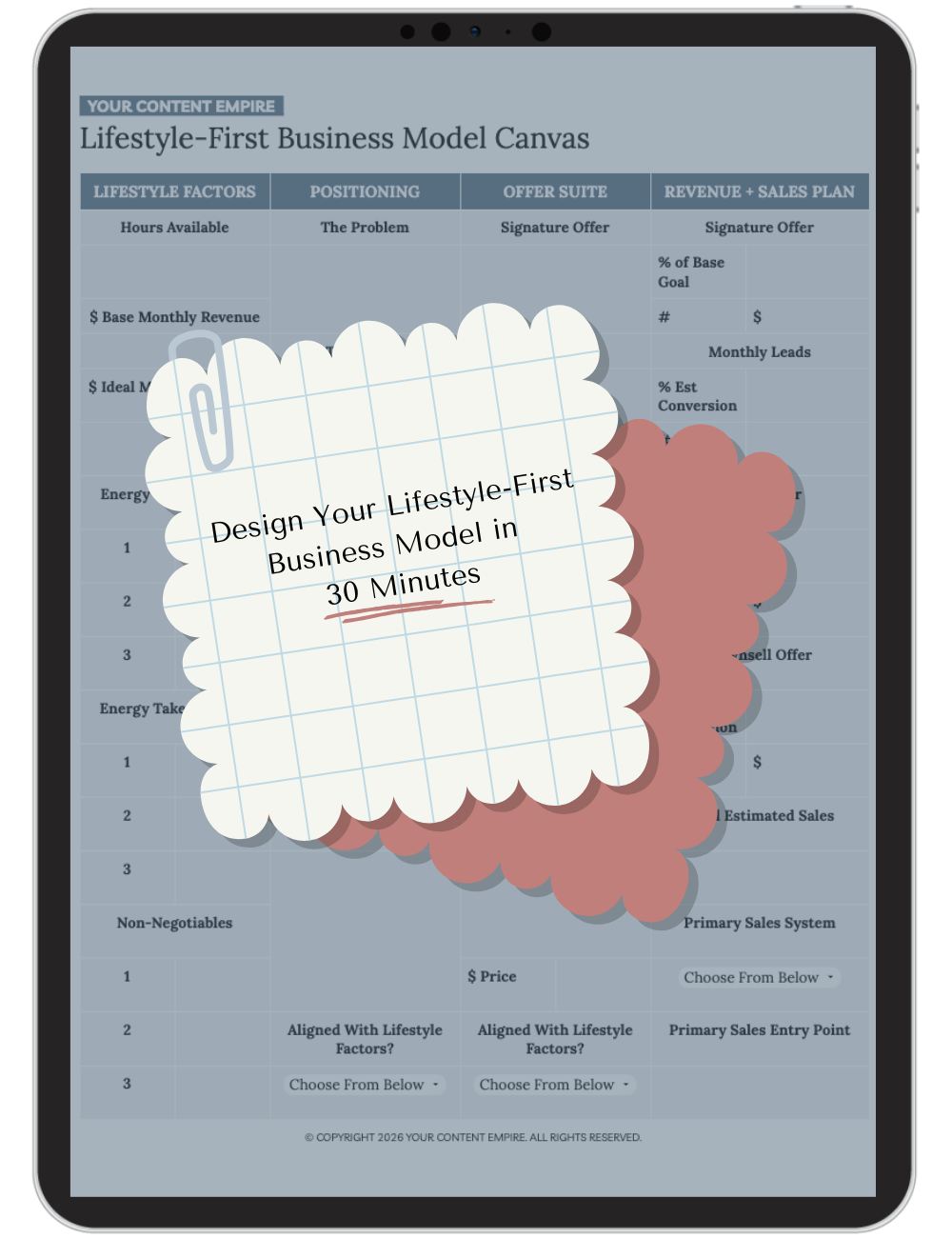
Click Here to Design Your Lifestyle-First Business Model with My Free Template
10 Content Planning Lessons from 10 Years of the Content Empire Planner
What if everything you think you know about content planning is actually working AGAINST you?
I’ve seen more change in content marketing in the last 9 months than in the previous 10 years combined. And if you’re still planning content the old way? You’re already behind.
In this video, I’m sharing 10 lessons that will completely change how you plan, create, and show up with your content.
Prefer to watch “10 Content Planning Lessons from 10 Years of the Content Empire Planner
” instead?
Want to listen on the go?
I cannot believe that I’ve been publishing the Content Empire Planner for 10 years now. The very first version was for 2016, and here I am creating a version for next year. It’s wild to me how much has changed, but also all the lessons this planner has personally taught me – and some of those lessons have been kind of painful.
Like most good product origin stories, I created this because it was a tool that I needed. And it’s evolved to meet the needs of the time. The content planner I needed in 2016 is so different from the content planner I need today.
I recently did a Content Reset Retreat, and one of the things I kept saying again and again is this: I have seen more change in the first 9 months of this year than in the previous 10 years combined. So much has shifted with how we market and how we create content. And if you’re clinging on, white-knuckling, resisting change the way my natural tendency is – it’s really going to come back to bite you.
So in this video, not only am I celebrating the launch of the newest Content Empire Planner, but I’m also sharing with you the 10 biggest lessons I’ve learned after a decade of content planning. These are the things that are going to carry you into next year and beyond.
The first big lesson is a personal one I definitely struggle with – Stop Procrastiplanning
Here's a word I made up that perfectly captures what most of us are doing wrong: procrasti-planning. It's the combination of procrastination and planning, and it's not doing anyone any favors.
Planning for planning's sake isn't helping you – it's actually allowing you to procrastinate and put off creating and publishing your content. And it's definitely not helping your audience, who actually needs the things you want to be talking about.
Here's the thing – I love a fresh plan. That's my natural tendency, and I can find myself falling into this trap too. But what I've learned is that planning without implementation is just a fancy way to avoid the scary part: hitting publish.
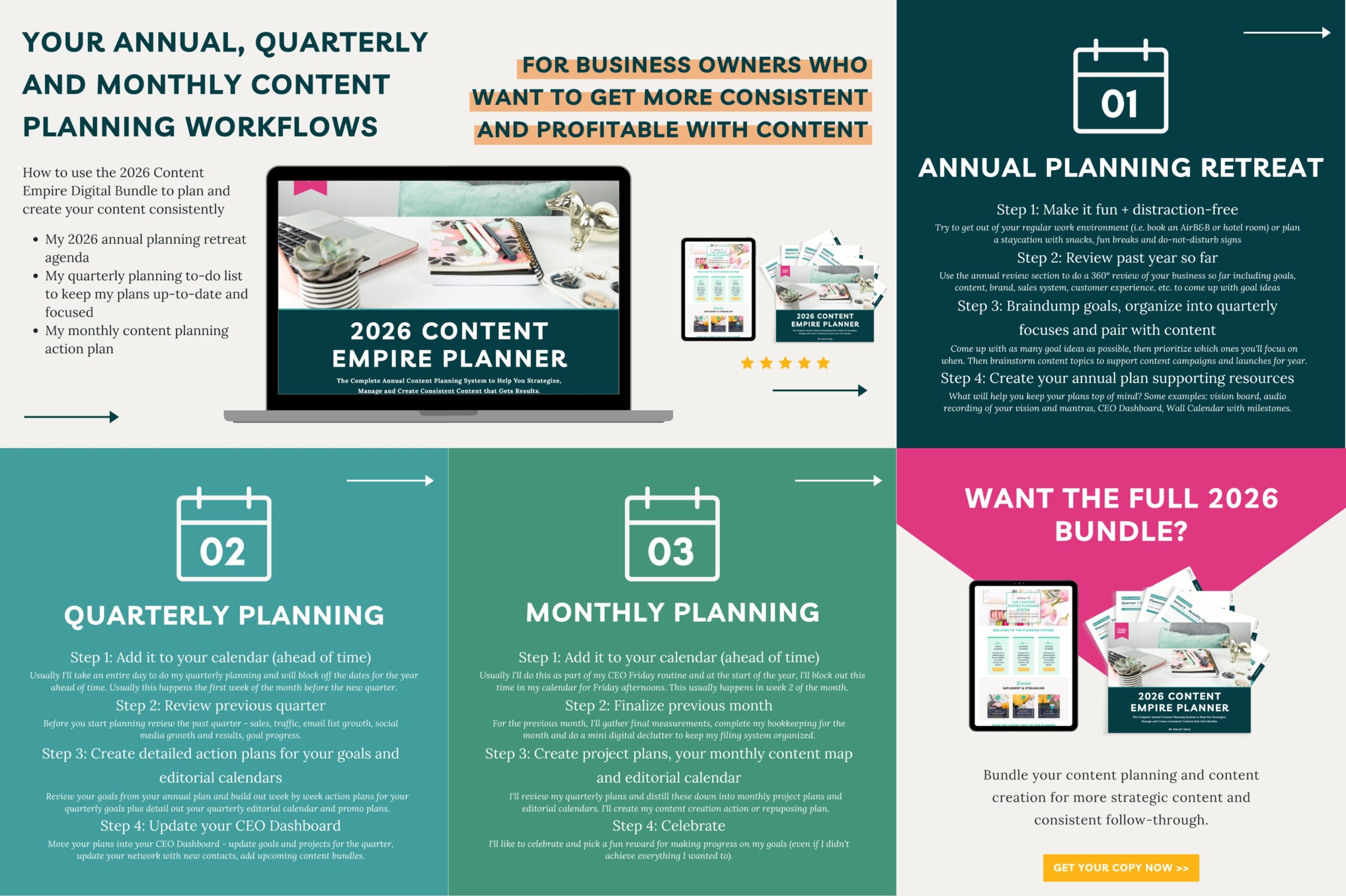
That's why one of the biggest shifts I've made with the Content Empire Planner is making it equally – or even MORE – about following through on that plan. That's where the implementation tools like the batching workflows and creation workflows come in. Because a plan is only as good as your ability to execute it.
Content Planning Lesson #2: Become a (Content) Habit Architect
You might think you need the perfect content strategy, but that's exactly what's going to stop you. What you actually need is to approach your content like a habit architect.
We want to change what we're measuring. Instead of focusing on engagement or leads right away, let's create the smallest version of success – especially if you're getting started or having trouble getting consistent with content.
What's your MVO – your minimum viable output? What's that one thing you could commit to doing each week? Because what I've learned is that it's much easier to master the basics and add on than it is to design the perfect system with all the bells and whistles that you'll never be able to follow through on – especially without the systems and experience to back it up.
Here's how to take a habit architecture approach:
Step one, define your MVO. What's the smallest piece of content you could put out each week? Maybe you start biweekly, maybe monthly – that's totally fine.
Step two, design a simple system around it. What happens first? What do you need to do next? Break it down into bite-sized steps from start to finish.
Step three, when it comes to increasing frequency or quality, focus on getting 1% better each time you run it.
And here's the big part – for the first 90 days, make your metrics about showing up. Make THAT the win. Track the reps you do, not the results they generate. How many times did you follow through on your weekly plan? You'll go much further, faster doing it this way.
Content Planning Lesson #3: Treat Your Content Like an Asset
Here's something that's going to change everything: you can add OLD content to your content plan. You don't always need brand new content.
One of the problems people run into is viewing their content as this one-and-done thing that no longer holds any value after it's published. This leads to a cycle of always needing to create more, when in many cases, you could be resharing the same content.
When it comes to your signature frameworks and your signature expertise, you shouldn't always have something new to say anyway. The repetition is where a lot of the value for your audience lies. You might update it or give it a relevance spin, but you don't need to start from scratch.
My biggest lesson here has been to treat my content like an asset and set up a literal content bank. I organize all my content as assets and categorize them so they're easily findable. When I'm planning my content and I know it's going to be a busy week, I shop my content bank before I create anything new.
There are seasons when you're going to be busy or working on other creative projects – that's the perfect time to pull existing content into your planner. And when things are lighter? That's when you fill up that content bank with new assets and new content.
Content Planning Lesson #4: Embrace Tiny Changes
Next lesson is to think tiny.
We're so focused on big goals that we often ignore the low-hanging fruit opportunities right in front of us for optimizing something we're already doing.
That's one of the big reasons why I open the planner with a 360-degree review of your past year in business before we get into goal setting for next year. There are so many ideas for improvements that are relatively simple and quick to implement.
For example, I found that I wasn't getting a lot of testimonials. When I actually asked myself how I could get more testimonials from clients – because I knew they were happy, they were re-signing up for things – I realized I wasn't really asking for them. I didn't have a system around it.
So I added one automated email to our process for requesting testimonials and feedback. Just from implementing that one thing, now we have almost too many testimonials to work with. This shows how we make things more complicated than they need to be sometimes.
Content Planning Lesson #5: Turn Ideas Into a System
It's often not a lack of ideas that business owners are struggling with. It's not having the right ideas at the right time when you actually sit down to create content.
One of the biggest things I've learned is to create a system around tracking, categorizing, and using my ideas. Having ideas in the shower doesn't help when you're sitting at your computer with a blank screen.
One of my favorite sections in the planner is the 100 Content Ideas Challenge. Come up with 100 ideas and have a spot – whether it's in the planner or a spreadsheet – somewhere you're regularly collecting your ideas as they come to you, organizing them, and storing them so they're accessible when you need them.
Review those ideas regularly, especially when you're creating content. There's nothing like feeling inspired and in flow when creating content, and having an idea you're excited about is a huge component of that. This system has made a huge difference in my business and for my clients who implement it.
Content Planning Lesson #6: Center Your Offer
Speaking of simple shifts, one of the simplest yet most significant changes I've ever made for my content – and a huge light bulb moment in how I work with clients – is centering your offer.
You want to make sure that all the content you put out leads back to your offer. Maybe not in an overtly pitchy way, but it should be so related to your offer that the people you're attracting could potentially be ideal clients.
You wouldn't believe the number of people who are just coming up with ideas for ideas' sake, creating content they can't draw a strong line back to their offer from.
Educational content has gotten a bad rap lately, with many people declaring that educational content is dead. But I think it's this unfocused way of doing educational content that's the problem. We need to theme your content around your offer.
Here's the rule: You should have one theme, one offer chosen to focus on for every single month of the year. It can stay the same, it can change, but you should stick with the same offer for at least four weeks or a month to get traction. And during that month? EVERYTHING you publish is related topic-wise to the topic of your offer.
Content Planning Lesson #7: Going All In on Less Platforms
You can get much, much better results from your content by focusing on doing less and showing up in fewer places.
A core framework in my approach is the EASE content framework: Expertise, Attraction, Sales, and Engagement. In essence, you don't need all the different platforms or strategies at the same time. What you need is one strategy or platform for each of those four things.
You need some way of establishing your expertise – usually long-form content. You need some way of attracting new audience and getting your content in front of new people. You need some method of selling each month. And you need some way of engaging with your audience through two-way conversations.
Where I see people go wrong is trying multiple attraction platforms but having nothing for engagement. That creates an unbalanced strategy. If you're missing expertise, people don't have enough trust to buy. If you're missing attraction, you're not bringing in fresh leads and your sales stagnate – plus you'll see higher audience attrition. If you're missing engagement, people don't have enough relationship with you to say yes. And if you're missing sales, you become that best-kept secret but you're not making any sales.
The monthly content map in the planner makes sure you're covering your bases for each one of those areas.
Content Planning Lesson #8: Create Before You Consume
Here's something I know for myself: I can start getting into trouble and feeling disconnected from my purpose, my business, and my audience if I stop the practice of creating content. That's particularly true when I'm taking in a lot of other people's content.
Don't get me wrong – some of my best ideas come from listening to other people's content and coming up with my spin or application to my specific niche. However, you want to create before you consume.
There's something called morning pages from Julia Cameron's “The Artist's Way”– this idea of getting your thoughts onto the page. I like to make this more purposeful by gearing it toward your business.
One thing I do is open my workday with a 25-minute writing sprint on any topic, particularly something thought-leadery or something I have opinions about. I pull these topics from my idea bank. By doing this practice, I never run out of content to share on social media that I can expand into blog posts or newsletters.
Writing is a skill, and by doing it regularly, you're going to get better at it and quicker at it. The 30-day challenge in the planner is a perfect place to develop this daily writing or content habit.
Content Planning Lesson #9: Constraints Help Creativity
Systems get a really bad rap from creatives, who think having workflows will sap their creativity. But what I've witnessed is actually the opposite.
Having systems and constraints actually frees you up to be more creative and gives you more time for the things that matter most. It's helpful to know that on this day, you're going to write this thing. Any systems you put in place will take experimentation to find what works for you, but having those systems is key to being more creative with your content.
By coming up with your ideas ahead of time, when you sit down to actually create content, you're not wasting any of that creative energy deciding what to write about. This is really important because there are different sides of the brain – the executive planning side versus the creative side.
I have a rule: I will never sit down to write or create a piece of content without already knowing what that thing is. That's why this planning process is so important and why I dedicate time to both planning and creating.
Content Planning Lesson #10: Make Content Planning a Retreat
And finally, here's my final lesson, and it might sound a bit woo-woo, but hear me out: treat your content planning like a retreat at least once a year. Make this a really special event.
Whether you do an at-home retreat, go to an Airbnb, book a hotel, or get completely out of town – make this fun and special. I know that my best ideas come from getting out of my usual space.
Turn your content planning into something you look forward to, not just another business task you have to check off your list.
What's Next?
These are the lessons that have completely transformed how I approach content – and how the Content Empire Planner has evolved over the past decade.
If you want a complete system for reviewing your year, planning your content and marketing goals, and a quarterly, monthly, and weekly system for creating a content plan you’ll actually stick with – check out the Content Empire Planner ↓
HEY THERE!
I’m Hailey and I help business owners who are tired of the hustle-harder advice build content systems that actually sell. No performative posting. No chasing algorithms. Just strategic, sustainable growth. More about me + my approach →
Stop guessing. Start scaling. This one-page template helps you design a business model that supports both your revenue goals and your actual life.
Browse By Topic
Scaling
Sales
Content
All Posts
Search The Blog
FREE TEMPLATE
The Lifestyle-First Business Model
Design a business model that supports both your revenue goals and your real life. This one-page template walks you through your lifestyle factors, positioning, offer map, revenue plan, and sales strategies so you can finally stop guessing and start scaling with clarity.
In This Post: How do you get more sales from your sales funnel? The best way to get more sales from your sales funnel is to follow up with the people who didn't buy the first time, since only about 5% of your audience is ready to buy at any given moment. Set up a...
In This Post: How do you reset your business model? You reset your business model by rebuilding it in the right order: lifestyle first, then positioning, offers, revenue planning and marketing. Follow that sequence and you can reset your business model in about 90...
In This Post: What is a monthly business retreat? A monthly business retreat is a full week you block off each month with no meetings, calls or client work so you can focus entirely on the projects that grow your business. Rotating through a few types of monthly...