Sign up to get instant access to the Monthly Content Planning Kit!
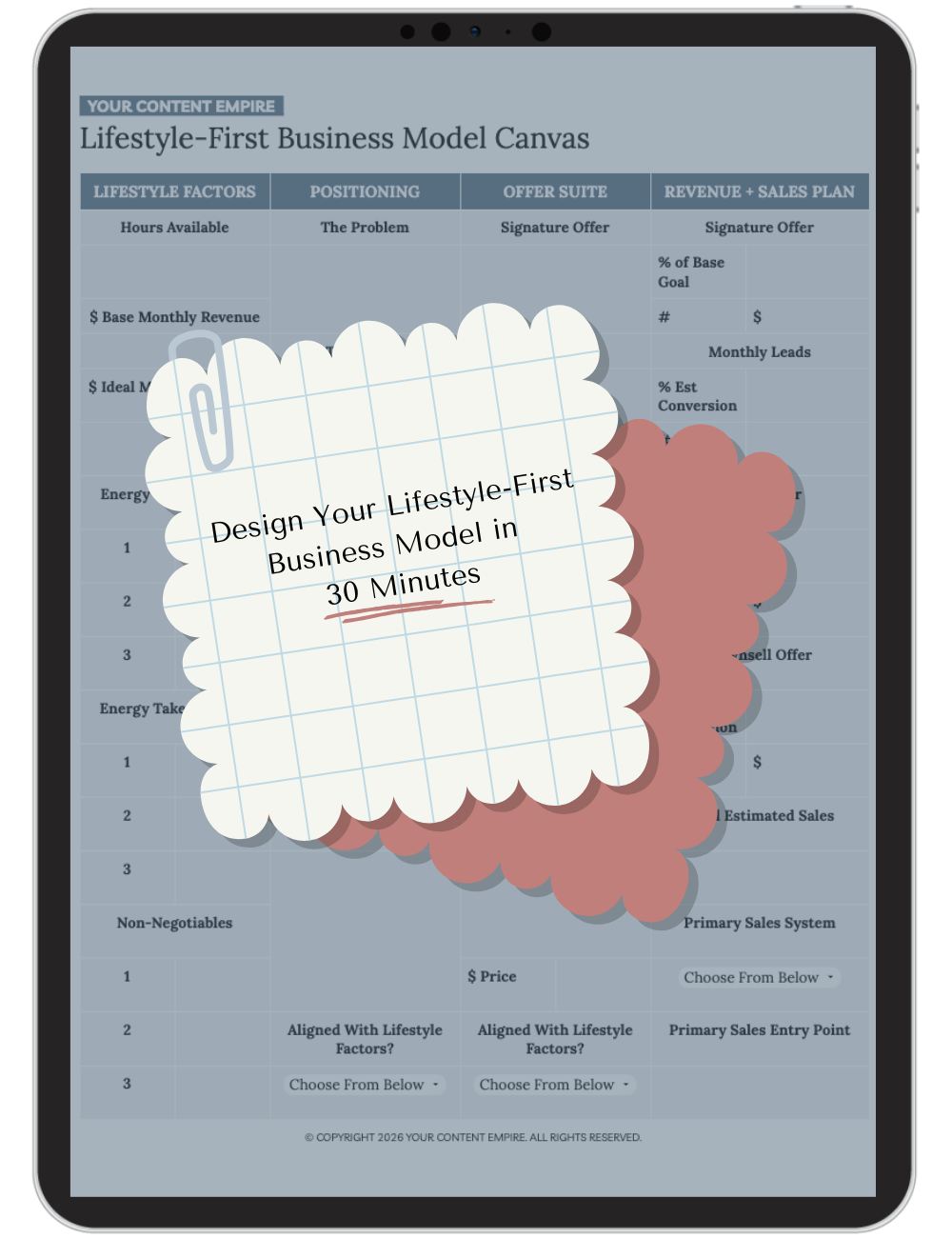
Click Here to Design Your Lifestyle-First Business Model with My Free Template
Getting more sign-ups for your online workshop starts with choosing a topic your audience is already asking for and packaging it with a title that uses their exact language. From there a simple four-step sign-up system including a thank you page questionnaire can start collecting registrations before your workshop content is even finished.
You're wasting your time running workshops or challenges if you only ever run them once.
Think about what goes into building one. The slides, the promotion plan, the email sequences, the tech setup, the run-throughs. That's weeks of work sitting behind a single live event. Run it once, get results that maybe don't quite land the way you hoped and move on to something else, and all of that effort was kind of a waste. The time's gone and you're stuck starting from scratch next time.
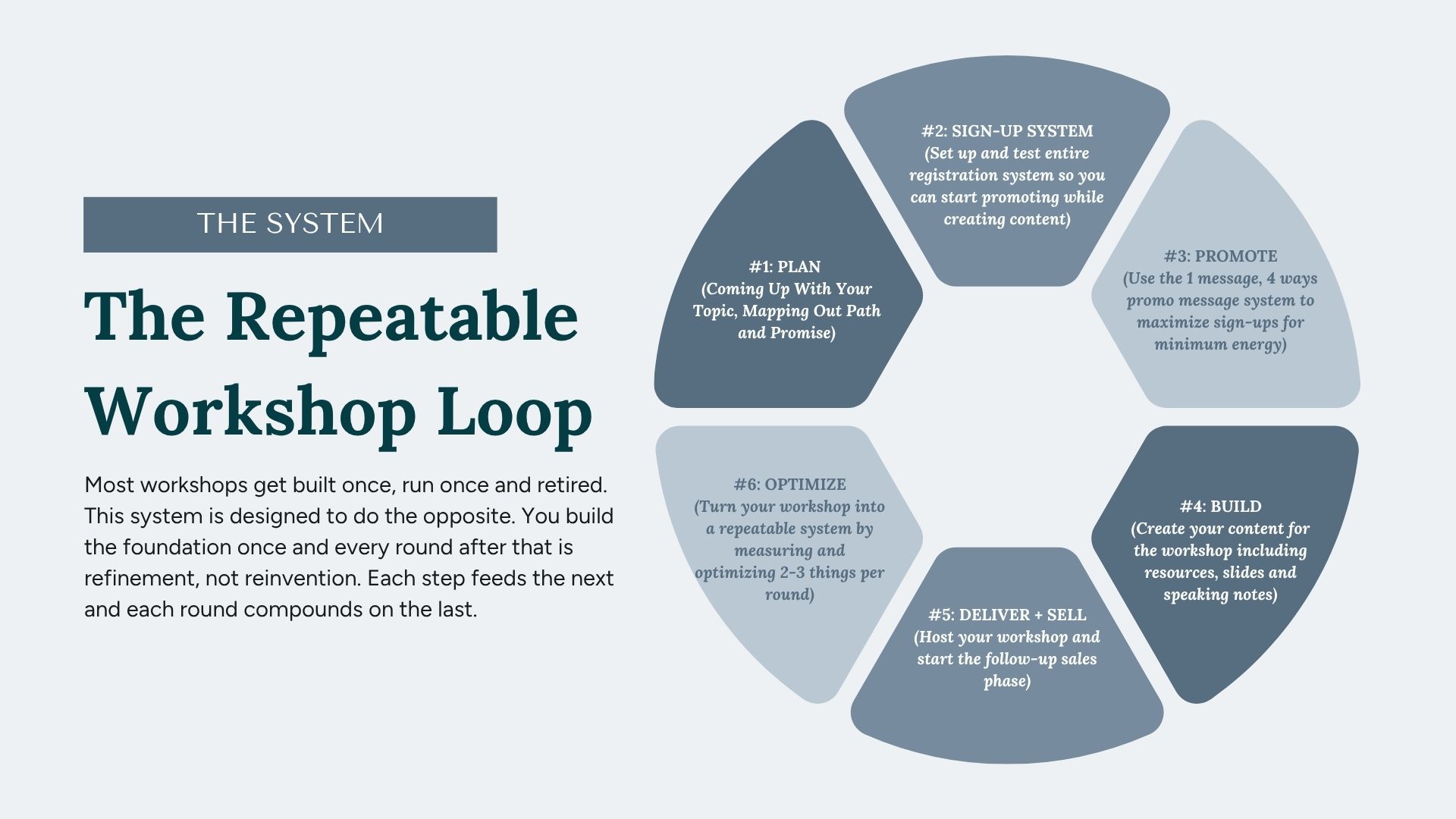
The system I'm walking you through in this episode is built to run on repeat, monthly or quarterly, with the same core workshop improving every single round. It’s not about reinventing it every time, but about refinement.
This repeatable live workshop system is one that I’ve been focusing on with my coaching clients this year – and for good reason. While industry average conversion rates for live launches and evergreen funnels sit at 1 to 3%, what I've consistently experienced from actually running this system, in the trenches with my clients, are conversion rates on average between 12%-18% and climbing up to even 26% for one of them.
THIS is the power of optimization and sticking with one strategy until you figure it out.
So let's talk about what this system actually is.
It's a repeatable monthly workshop that does two things at the same time. It grows your audience and it sells your offer. You run one workshop, on a monthly or quarterly cadence, and each round builds on the last.
It works best with a leveraged offer. Think a course, a group programme or a membership. Something where there's no real cap on the number of people you can take on. If you're selling high-touch one-on-one work, there's a variation of this that works for you too and I'll walk you through it as we go.
Now, this is a three-part series and today we're covering the first two steps: planning your workshop topic and building your sign-up system. Part two is where we get into your workshop content and your full promotion plan. And part three is all about delivering the workshop, following up and then optimizing the whole thing so it runs better every single round. Each part builds on the one before, so if you're watching this first, you're in the right place.
One thing I want to flag before we get into it: we are planning out your content today even though we're not building it until part two. That's intentional. You need to know what you're covering, what your core promise is and what path you're taking people on before you can write a registration page that actually converts. The sign-up system and the content plan have to be built from the same foundation. So we're doing that groundwork now and you'll be ready to hit the ground running in part two.
Let's start with step one: planning your workshop topic, title and format.
The workshop topic you choose shapes everything downstream. It determines who shows up, how warm they are when they get there and how naturally the conversation moves toward your offer at the end. So before anything gets built, this is a decision to really sit with and get right.
The best workshop topics live at the intersection of two things: what your audience wants and what leads naturally into what you sell. When those two things overlap, you get a room full of people who are already primed to hear about your offer before you even make the pitch.
There are 4 angles worth exploring as you brainstorm:
Once you've brainstormed, you're narrowing down to four things: your topic, your title, your subtitle and the core promise of the workshop.
The topic is the subject. The title is what people see when they decide whether to register. The subtitle adds specificity or context. And the core promise is the one clear outcome someone walks away with.
The title is where most people undersell themselves. A title that names a specific, desirable outcome will convert better than a broad topic every time. “Content Strategy” is a topic. “Plan a Month of Content in One Hour” is a title that gets you a sign-up. Your subtitle is where you can add a layer of context, speak to who it's for or address an objection. The core promise is the anchor for everything you teach and it should connect directly to your paid offer so the transition into your pitch feels earned.
A couple of extra tips related to this:
#1 – Starting with repeatability: Repeatability matters more than novelty. A repeatable topic is something your audience could want to come back to more than once, either because it's something they need to revisit regularly or because it functions almost like a routine or a ritual. One of my clients in the PR space runs a pitch sprint workshop and people come back every single time she runs it because pitching is an ongoing job, not a one-time fix. Another client runs a five-day Pilates restart challenge that her audience does again and again because the restart itself is the value. When you're brainstorming, ask yourself: is this a topic someone would do once and be done with, or is this something they'd want to return to? The latter is what makes this system compound without just relying on new sign ups every time.
And #2 – root your messaging in what they actually say they want. This is where market research pays off. The language your audience uses to describe their own problem, pulled directly from survey responses, discovery calls or even DMs, is almost always more compelling than anything you'd write from scratch. If someone tells you “I never know what to pitch or who to send it to,” that's a title. If they say “I start strong and fall off by day three,” that could be a subtitle. The more your title and promise sound like something your audience would say out loud, the better your registrations will be.
Both approaches work. But the right one depends on where you are in your business right now.
Free workshops have a lower barrier to entry. More people sign up. Your cost per lead is lower and you need less ad budget to fill the room. The trade-off is that a free workshop can attract subscribers who are primarily interested in free content so your conversion rate will be lower.
Paid workshops attract more serious buyers. The act of paying creates commitment and a buyer mindset that shows up in the room and in the conversion rate. My own paid workshop converted at 20-25%. The trade-off is a smaller audience and a higher ad budget requirement.
Here are 5 factors in making the right decision for you:
The recommendation I give most clients is to start free. Run the system until it is proven and the conversion rate is consistent. Then shift to paid once you know the workshop converts and you have the data to back it up.
The goal of this step is to build everything once. Every round after this is just updating details and refining what's already there. And you're doing it in a specific order, because you can actually start taking registrations before your content is fully built.
Before you open a slide deck or design a workbook page, the content needs a clear structure. Everything starts with the Promise and Path.
Pull your workshop title, subtitle and core promise from the planning work you just did in Step 1. Then map out three things: where your audience currently is (the problem that brought them to your registration page), where they want to be (the result or desire that made them sign up) and the path you're going to take them on from one to the other. That path is your workshop structure.
For each section of that path, use the Head, Heart, Hands framework to make sure your content is doing three things at once. Head is the concept or idea they need to understand. Heart is the story, the struggle, the moment that makes it land emotionally and builds trust. Hands is the template, the exercise, the tool that lets them apply it right away. A workshop section that hits all three is one people remember, save and talk about.

Once your structure is mapped, build the bridge to your offer. How does this workshop connect to what you sell? Why is your offer the natural next step after someone finishes this workshop? Where can you drop a passing mention or a client example throughout the teaching itself? That's product placement, and it's what makes the pitch at the end feel like a natural continuation of the workshop rather than a hard left turn.
Then draft your workshop messaging. This is what you'll use across your registration page, your promo emails and your social content. Nail down the three to five things attendees will learn or discover, the one unexpected insight or reframe the workshop offers, why now is the right time to attend and what makes you the right person to teach it. Finally, pull it all together into your launch event one-liner: a [event type] for [audience] to help you [transformation]. Simple, specific and something you can repeat anywhere.
This is where a lot of people wait too long. Your sign-up system can go live way before your slides are finished. You don't need the content to be done to start getting sign-ups.
Clients hire me specifically to help them build this workshop system. We do the whole thing together. The build phase, the promo plan, the sales sequence. I am in their corner as they run their first rounds and we optimize together using real data from their actual audience.
That is one of the things we do inside Your Signature Scaling System.
It is a three or twelve month coach-sulting partnership where we build your custom scaling strategy together. We take your offer, your audience and your lifestyle factors and we design a business model that generates consistent revenue without requiring you to work constantly or reinvent the wheel every month.
This is not a group program where you apply generic strategies to your unique situation. It is personalized strategic guidance built around your business, your goals and your capacity.
If you want support putting this system together and someone in your corner as you run your first rounds, you can book a free strategy call here.
A good workshop topic for getting more sign-ups for your online workshop sits at the intersection of what your audience is actively asking for and what leads naturally into your paid offer. The repeatability factor is key: topics that address an ongoing need rather than a one-time fix will fill your room round after round without requiring you to rebuild from scratch.
Whether your online workshop should be free or paid depends on five factors: your goal, your list size, your ad budget, whether your offer is already validated and whether you have upsells ready on your registration page. If you want more sign-ups for your online workshop and your list is under 1000 subscribers, starting free is almost always the right move while you build proof of concept and optimize your conversion rate.
Your workshop thank you page is one of the most underused tools for getting more sign-ups and sales from your online workshop. Adding a short three question questionnaire asking why they signed up, what their biggest struggle is and what they would ask you about your topic gives you the exact language for your sales emails, shapes your workshop content and gives you permission to start real conversations with registrants before the event even happens.

I’m Hailey and I help business owners who are tired of the hustle-harder advice build content systems that actually sell. No performative posting. No chasing algorithms. Just strategic, sustainable growth. More about me + my approach →
You’ve got two options: start small with a one-time strategy session, or go all in with done-with-you scaling support.
Scaling
Sales
Content
All Posts

In This Post: How do you get more sales from your sales funnel? The best way to get more sales from your sales funnel is to follow up with the people who didn't buy the first time, since only about 5% of your audience is ready to buy at any given moment. Set up a...

In This Post: How do you reset your business model? You reset your business model by rebuilding it in the right order: lifestyle first, then positioning, offers, revenue planning and marketing. Follow that sequence and you can reset your business model in about 90...

In This Post: What is a monthly business retreat? A monthly business retreat is a full week you block off each month with no meetings, calls or client work so you can focus entirely on the projects that grow your business. Rotating through a few types of monthly...
