Sign up to get instant access to the Monthly Content Planning Kit!
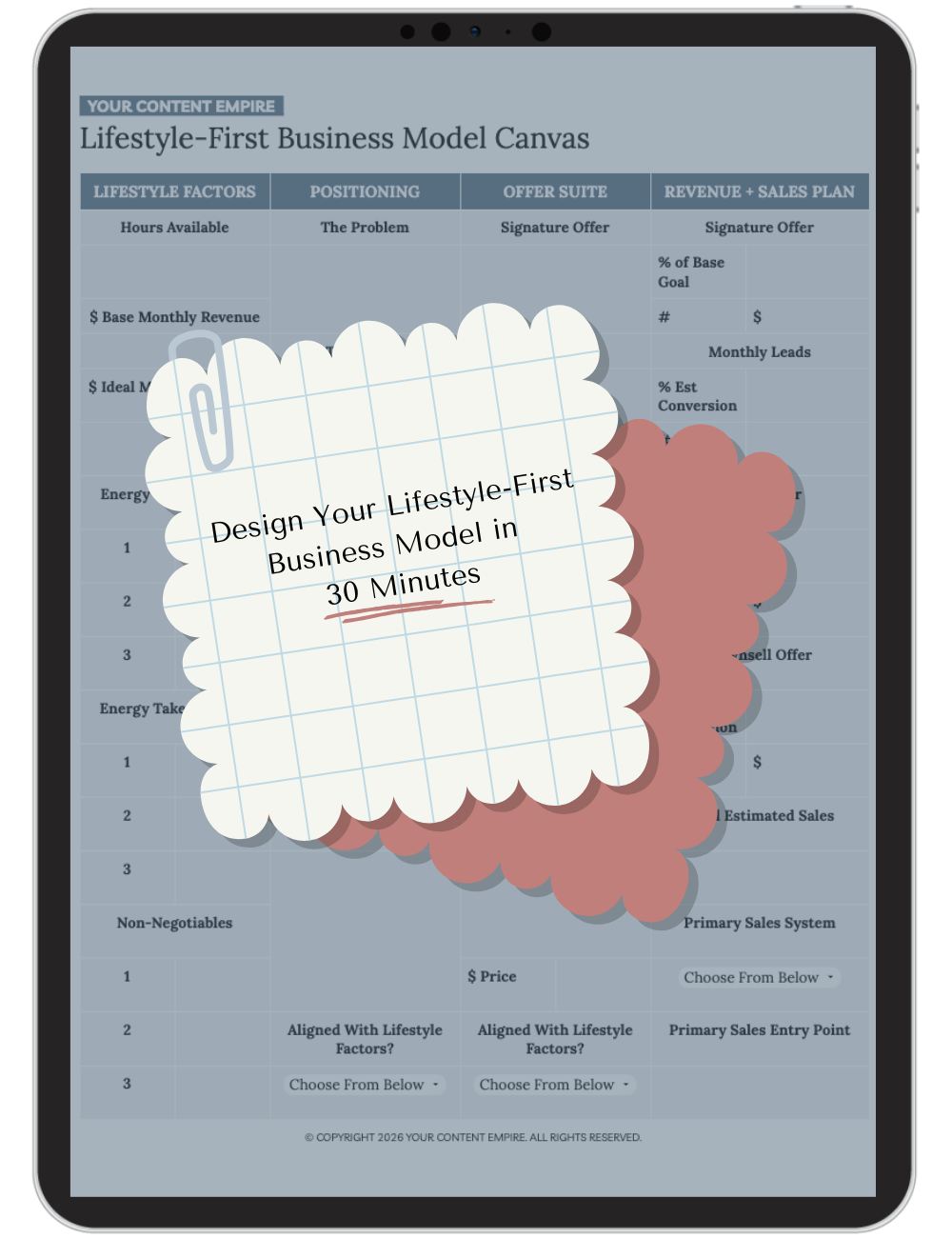
Click Here to Design Your Lifestyle-First Business Model with My Free Template

You reset your business model by rebuilding it in the right order: lifestyle first, then positioning, offers, revenue planning and marketing. Follow that sequence and you can reset your business model in about 90 minutes, so it finally fits your real life and the goals you're actually chasing.
Somewhere along the way we all picked up this idea that fixing your business has to be slow. That it takes months of grinding and testing and second-guessing before anything feels different. I used to believe that too. But some of the biggest turnarounds I've watched a business make didn't take a year, or even a season. They took an afternoon where we take the whole model apart and rebuild it into something that actually fits the person running it.
I do this with clients inside a session I call the Business Model Edit. It works fast – as in people walk in foggy and walk out knowing exactly what they're building and why.
So that's what I want to give you today. I'm taking you inside one of these sessions, start to finish. What we do, the order we do it in, and the thinking behind each piece. If you've ever felt like you're working so hard to get nowhere near your goals, come sit with me for a bit. This is the business model reset.
So let me tell you where this video even came from.
A little while ago, a client booked a Business Model Edit with me, and before she booked, she asked me something completely fair. She wanted to know what actually happens in the session. Like, what are the two of us going to do together.
And I loved the question, because as I started writing her back, I realized this was worth making into its own thing. So if you've been curious about the Edit, or you've been circling it for a while wondering if it's for you, consider this me answering that question properly. Out loud for all of us.
Before we get into it, one quick aside, and this one's for you if you run any kind of offer of your own. Steal this format. If you have an intensive, a service package, a done-with-you anything, go make this exact piece of content for it. Walk people through what it's actually like to work with you, step by step. Because now, every single time someone asks me what happens in a session, I get to send them here instead of typing it all out again. It's a little meta, I know. Me making a video about a session by walking you through the session. But that's kind of the whole point. Really good content does the explaining for you, so you're not answering the same question a hundred times.
Okay so let me take you through what actually happens in a Business Model Edit, start to finish. And I'll pull in some real examples from recent sessions along the way, so you can see how it plays out with actual businesses ↓
The first thing that happens actually isn't the session at all. It's the brief.
I call it the Business Model Brief, and think of it as our fact-finding mission. This is where you hand me all the under-the-hood happenings of your business. And it matters so much more than people expect, because it's what lets me do a ton of research before we ever sit down together. Your business, your industry, the specific model you're running. By the time we meet, I already have a rough outline of the direction I’m thinking is going to work best for your business.
I want to know from you the good, the bad and the ugly here. I want to know what's working, because those are the things we want to protect in the redesign. And I want all the friction too. The numbers, if you have them. But also how the business feels right now. How each part of it feels to run. And what you actually want out of all of this.
And there's no question too embarrassing or too small to put in that brief. That's the real gift of having someone come into your business with completely fresh eyes. So don't hold back. Give me everything.
Here's the part that still gets me every time. I had a client fill out her brief before her session, and she messaged me right after. She said something like “Don't get me wrong, I'm still so excited for our session. But I already feel like I know exactly what I want to do just from filling out this form. Even if nothing else happens, thank you for the clarity. I have never been so clear on exactly what I want.”
That's before we've even met. That's how much the right questions can do for you, even on their own.
Then we get to the session itself. 90 minutes, just the two of us.
And because you did such a good job on the brief, big pat on the back in advance for that, and because I've already done my research and started sketching out your redesign, we get to hit the ground running. There's no warming up, no you spending half the time catching me up on your business. We already know each other. We're ready to build.
Here's how those 90 minutes actually break down:
We start with a quick overview of the Lifestyle-First Business Model. Nothing heavy, I just want us on the same page and speaking the same language before we start moving pieces around.
It's also your chance to ask me anything about the model itself. Because this is one of the things I love most about it. It works across so many different business types, and it's still completely customizable. Your goals, your life, your specific design specs, we build the whole thing around those. And everything you want from both your lifestyle and your business is an input we need to work from.
Then we get clear on your lifestyle factors. And this is where a lot of the magic actually starts.
Because a business model that ignores your real life isn't really a model.
Let me give you an example. One of my recent sessions was with a client launching a mentorship for photographers. She had a pretty limited calendar, because she's caring for her aging parents, and that time is precious and spoken for. So we looked at her revenue goal, which was ambitious, and then we worked the actual math. And what we found was that at her current pricing, she simply didn't have enough hours in her calendar to reach that number. It wasn't going to happen because the model itself didn't fit the time she had.
And that's the moment things open up. Because now we've got levers to play with. The pricing lever. The deliverable lever. We start adjusting those until the goal and the calendar finally agree with each other.
This happens all the time. Someone has a big revenue goal and a specific offer they love, and nobody's ever sat down to check if the path between the two is even possible. Sometimes it is, and that's wonderful. And sometimes it's a pie-in-the-sky number they've just been carrying around, feeling bad about themselves for not hitting.
Next we move into positioning. And this really comes down to four things.
Your primary person. The primary problem you solve for them. Your primary process (meaning how you solve it and what makes that yours). And the payoff, what life looks like for them on the other side of working with you.
I say primary on purpose because so many of my clients are serving a few different types of people at once, and that's completely okay. But even when you have different offers for different folks, we still name the primary one. Because that single decision brings a wave of simplicity to your whole business model and the work it takes to actually run it.
Here's a recent example I loved. I had a client whose audience was people who make pottery as a hobby and also those who want to turn it into a real business. So really, two types of people. There's the professional, the one who's ready to build something serious because she can see a path to a return on her investment. And then there's the hobbyist, who's in it more for the love of it. We chose that professional potter as the primary, because that's where the biggest payoff was for my client's business. But here's the part that made it click. She's been at this a long time, and she told me the hobbyists so often turn into the professionals, because she teaches them so well that they catch the bug and decide to go for it. So choosing a primary didn't leave anyone out. It just gave the whole business a center of gravity to build around.
Then we get to the part everyone's always waiting for. The offer suite ecosystem.
And this is always where people want to start. They come in ready to talk offers on day one. And I gently pull them back and say, not yet. We can't touch your offers until your positioning and your lifestyle factors are locked in. Hopefully by now, after those last couple of examples, you can feel why. Your offers get built on top of that foundation. Skip it, and you're just guessing with pretty packaging that’s incredibly difficult to both sell and deliver.
This is also the section that's hardest for me to teach in a video like this, because it's the most tailored part of the whole thing. It bends completely around your specific business. So this is the moment where I'll say, bring in the pros for this one. Don't try to design your entire offer suite alone in a vacuum, because we all have blind spots we simply can't see in our own businesses. This is your single most powerful lever for actually reaching your goal, whether that's 10k months or 25k months. And how we package it all matters just as much as what's inside it.
There are usually four offers we're mapping out together.
First, your signature offer. This one simplifies everything, because all roads lead here. You don't need a website with a hundred different offers pulling in a hundred different directions. Everything in your world points back to this one.
Second, your upsell offer. This is for the people who finish the signature offer and are ready for the next step. Ideally this is something with monthly recurring revenue built in, so you're not starting from zero every single month trying to hit your number all over again.
Third, your downsell offer. This is for the people who aren't quite ready for the signature offer yet. So we ask, what do we have for them, so they still have a way in (and as a way of getting them even more ready for your signature offer).
And fourth, your entry offer stack. This is a low-priced entry product, think somewhere around 27 dollars, with an order bump sitting on top of it, usually between 7 and 47 dollars. Something small that makes the whole thing easier or more customized for them.
And here's a rule I give almost every client, so write this one down. Take at least 50% of everything you make from that entry offer stack, and pour it right back into growth. That's the engine. A minimum of half goes back into ads, if ads are part of your particular puzzle. That reinvestment is a huge part of how my clients grow as fast as they do.
Once your offers are clear, we move into revenue planning.
People hear the word revenue and they go straight to, I want to make 10 grand. And that's a lovely goal. But on its own, that's a wish with a dollar sign on it. Real revenue planning works backward from that number.
We take the revenue goal and break it down into the sales you'd need to actually make it.
Then we take those sales and break them down into the leads you'd need to get them.
And then we take those leads and break them down into the traffic you'd need to generate in the first place.
And this is the moment that changes everything, because now you're looking at real numbers. Sometimes you look at that traffic number and it feels completely doable, and you get this rush of, oh, I can actually do this. And sometimes you look at it and it scares you a little. That's not a bad thing. That's the plan being honest with you early, while there's still time to adjust, instead of six months in when you're worn out and wondering why it isn't working.
Once the revenue plan is done, we build your marketing plan. I call it the TLC plan, and TLC stands for traffic, leads and conversions.
We already know your numbers from the revenue plan, so now it's really just three questions:
And we keep our focus on the next 90 days. You might have five different platforms you want to be on eventually, and that's fine. But I'm going to challenge you to commit to one thing per platform for at least 90 days, so you're not spreading yourself thin across all of them at once. We get really specific here. Which platform. What the strategy is. What you're actually doing on a daily and weekly basis. What you're building along the way.
This is where so many of my clients feel this big wave of relief wash over them. That feeling of, oh my gosh, I've been trying to be everywhere at once this whole time. This is where they win back a huge chunk of their time. And we always check it against your lifestyle factors from earlier, so the plan actually fits inside the hours you really have.
Finally, we take this whole beautiful plan and turn it into a 12-week year. If you know me at all, you know how much I love that book by Brian Moran and Michael Lennington.
We build out six two-week sprints. And inside each sprint, we're moving three things forward at once.
The first is a piece of the business model system itself. Maybe it's a new sales page, maybe it's building out that new upsell offer, whatever piece of your business model isn’t built yet.
The second is a piece of your marketing and content plan. We take that TLC plan and pick one part of it to actually put into motion.
And the third is a capacity-protecting system. This is the one I talk about all the time, because it's the one that compounds. We look at something you're spending time on every single month, and we ask, where can we systemize this, automate it, delegate it, or just streamline it so it stops taking up so much of your time. And every single time you do that, you get a little more of your time back.
So by the end of the 12 weeks, you haven't just built out your model. You've also built six systems that are each handing you back more and more time. That compounding effect is honestly one of my favorite things in the whole world to watch happen.
After the session, you don't just walk away with a full head and a page of scribbled notes and a good luck from me.
I take everything we built and deliver it to you in a beautiful PDF blueprint. Your whole redesigned model, laid out clearly, so you can walk straight out of our session and start putting it into your business right away.
And then, inside that very first two-week sprint, we have an implementation check-in. This is your chance to come back to me with questions, give me updates, and tell me what's actually happening now that you're building in real life. We adjust the plan where it needs adjusting, we talk through the roadblocks, because there are always a few that pop up. I never want to just hand you a blueprint and disappear. This check-in is where we make sure the whole thing holds up once you're actually living it.
And then there's my favorite piece of the whole thing. The one I swear by. It comes with your blueprint, and it's a custom cash injection campaign built just for you.
Here's why I love it so much. A redesigned model is exciting, but building it out often takes a little capital. A new offer, a new page, maybe some ad spend to get things moving. So along with your blueprint, you get a short, focused promotion, mapped to your exact business, designed to bring that capital in fast using the offers and the audience you already have.
There are four things that make it work.
Let me tell you what that can look like in real life. I had a client go through the course version of this work, and she identified a brand new coaching offer, built it out, and within 3 days of doing the work, she landed a $10K dollar client. Just 3 days. That's what becomes possible when the plan is finally clear and the money to build it is already on its way in.
So that's the Business Model Edit, from start to finish.
It starts with the brief, where the clarity begins before we've even met. Then the 90-minute session, where we build your model in the right order. Your lifestyle first, then your positioning, then your offers, then your revenue plan, and then your marketing. Then you walk out with a 12-week plan and a blueprint you can actually use, a check-in so you're never doing it alone and a cash injection campaign so you've got the capital to build.
If you've been working so hard for numbers that just aren't moving, and some part of you has been wondering whether the problem is you, I really want you to hear this. It's almost never you. It's the model. And the model is something we can fix together.
So if you want me to take you through yours, the link to book your Business Model Edit is right below this video. Come tell me the good, the bad and the ugly, and let's rebuild the whole thing into something that finally fits you.
The right order to reset your business model is lifestyle, positioning, offers, revenue, then marketing. You start with your lifestyle so the business fits your real hours and energy, get clear on who you help and what makes your process yours, build your offer suite on that foundation, work backward through your revenue numbers, and finish with a focused 90-day marketing plan.
You can reset your business model in about 90 minutes when the prep work is done first and you follow the right sequence. Inside a Business Model Edit, a short brief lets the redesign begin before the session even starts, so those 90 minutes go toward rebuilding your model instead of gathering information.
When you reset your business model, you set a realistic revenue goal by working backward from the number. You break the revenue goal into the sales it takes to hit it, then the leads, then the traffic, so you can see whether it's doable and adjust your pricing, packaging or marketing if the numbers don't line up yet.

I’m Hailey and I help business owners who are tired of the hustle-harder advice build content systems that actually sell. No performative posting. No chasing algorithms. Just strategic, sustainable growth. More about me + my approach →
You’ve got two options: start small with a one-time strategy session, or go all in with done-with-you scaling support.
Scaling
Sales
Content
All Posts

In This Post: How do you get more sales from your sales funnel? The best way to get more sales from your sales funnel is to follow up with the people who didn't buy the first time, since only about 5% of your audience is ready to buy at any given moment. Set up a...

In This Post: What is a monthly business retreat? A monthly business retreat is a full week you block off each month with no meetings, calls or client work so you can focus entirely on the projects that grow your business. Rotating through a few types of monthly...

In This Post: How do you create a business vision? To create a business vision, start with your ideal life, design the business that supports it, then combine the two into one cohesive plan. The most reliable way to create a business vision you'll actually use is to...
