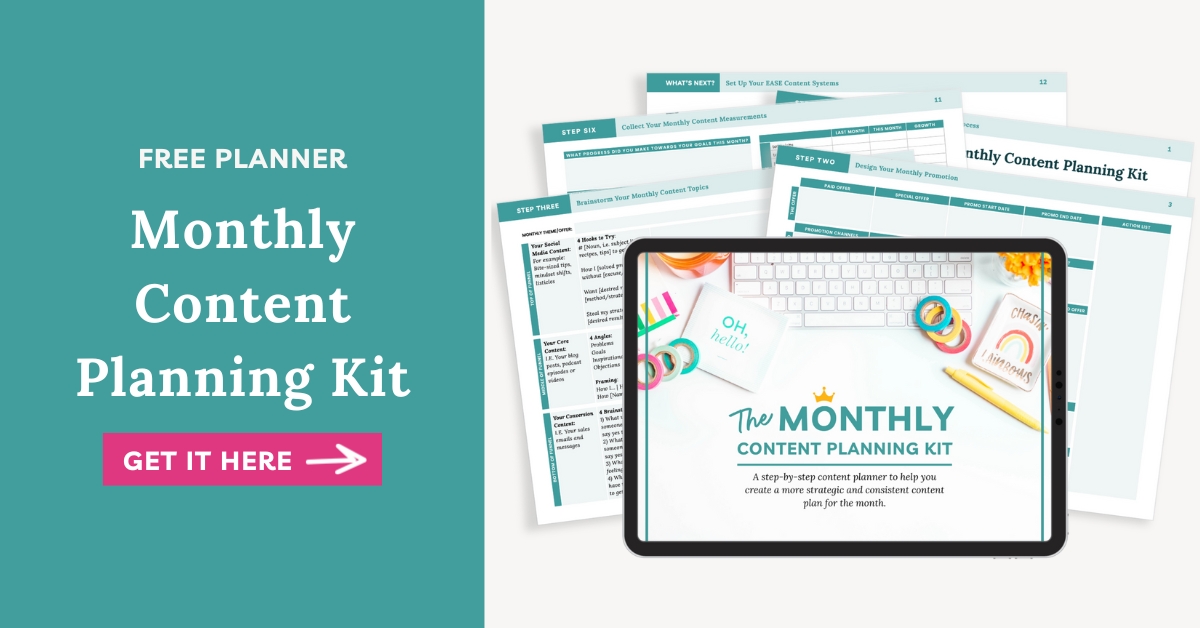
Sign up to get instant access to the Monthly Content Planning Kit!
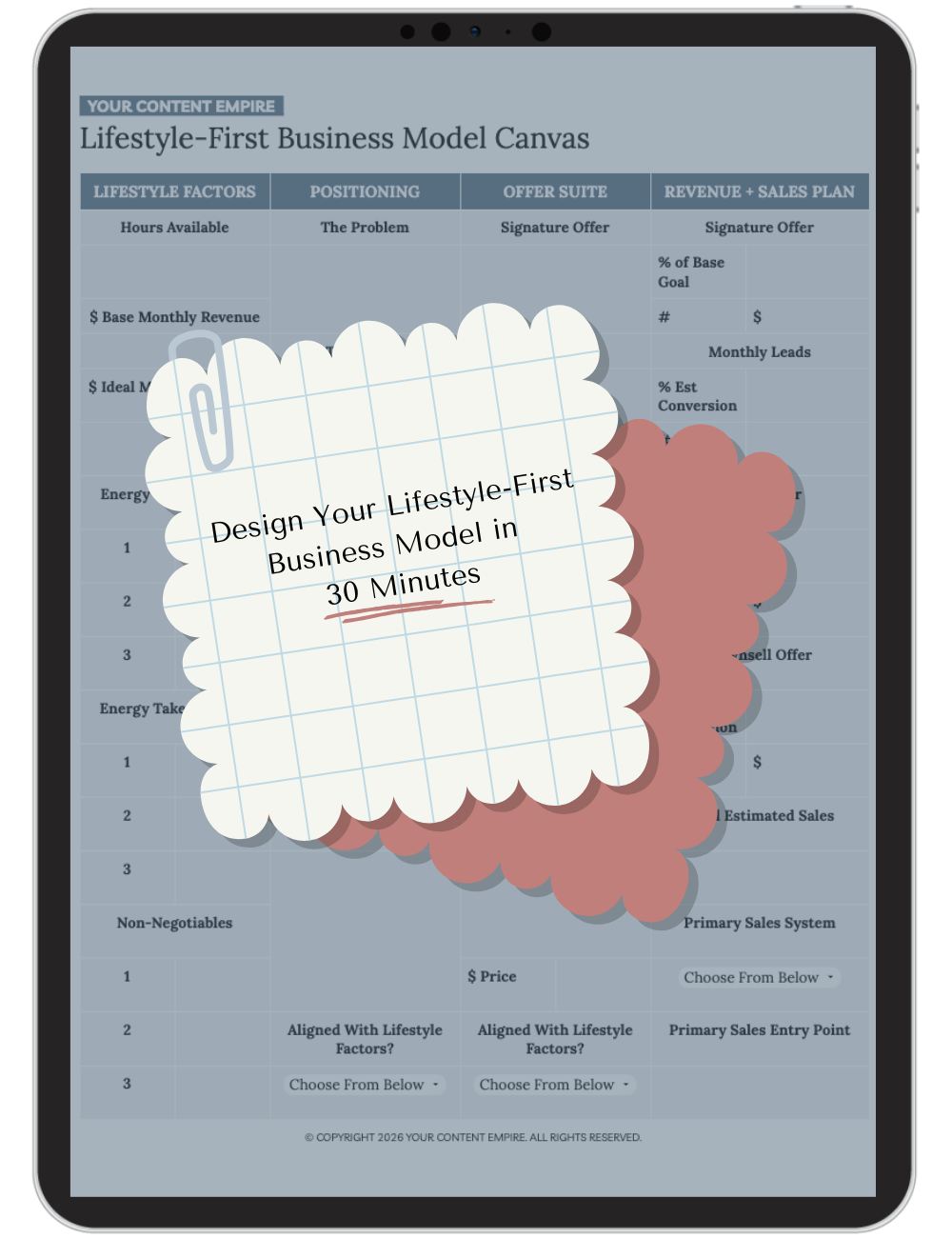
Click Here to Design Your Lifestyle-First Business Model with My Free Template


To create a business vision, start with your ideal life, design the business that supports it, then combine the two into one cohesive plan. The most reliable way to create a business vision you'll actually use is to turn it into a short present-tense story and revisit it for five minutes a day.
I have a 5-minute practice I do most mornings that's done more for my business than any planner, any goal-setting framework or any productivity system I've ever tried. I do it with my coffee, before I open my email, before anything reactive gets a chance to pull me off track. And over the last nearly two years it's been the thing that's kept me focused, kept me motivated and kept me moving toward the business I actually want to be running.
I'm going to walk you through that exact practice in this video so you can steal it for yourself.
I teach something called lifestyle-first business model design. And the whole thing rests on one idea. There's no outworking a bad business model, and there's no making a business model work if it doesn't fit the time and energy you actually have available.
So before you get to your marketing, before you design your offers, you need a foundation. A business model that's built to reach your revenue goals and built to fit your real life at the same time.
The very first piece of that foundation is your vision. Your life vision and your business vision, together. Once you have it, it becomes the filter for every future business decision you make, and it simplifies all of those decisions too.
This is also where I watch business owners go really really really wrong, in four pretty predictable ways. The first is skipping vision altogether, which leaves you making decisions in the dark and reacting to whatever feels urgent that day. The second is treating it as busywork. You did the exercise once at a retreat in 2022 and it's been sitting in a Google Doc you haven't opened since. The third is building a vision and then never connecting to it, because even a great vision becomes pretty much forgotten and invisible if you don't actively look at it. It needs to be present, not just stored somewhere. And the fourth is the big one this whole approach fixes. Building your vision around the business and forgetting your life.
The reason that order gets people into trouble is because a business designed first gets built around a version of you that doesn't exist. You map the revenue, the offers and the calendar around the capacity you wish you had instead of the time and energy you actually have. Then your life becomes the thing that has to squeeze in around the business, and that's the wrong way round.
Starting with your life vision gives the business a clear job. It exists to make that life possible. Your business vision stops being a standalone wishlist and turns into the engine for the life you actually want.
That's what makes it a cohesive lifestyle-first business model with your life setting the boundaries and your business funding and supporting it. Plus every decision you make after that gets easier, because you know exactly what you're building and who it's for.
My business went through a lull from 2022 into the start of 2024. Then over the last couple of years things really turned around, and a lot of that came down to getting clear on this vision and connecting with it every single day.
What made the difference is the connection part. A vision sitting in a document doesn't do much for you. It starts working when you revisit it often enough that it shapes your small daily decisions, the little yes-and-no calls that add up over months. That's what kept me on track when it would've been easy to drift toward whatever felt urgent that particular day.
The part I love most is how small it is. It's a 5-minute micro habit I do in the morning before I’ve even had my coffee. That tiny daily practice is what I'm walking you through in this video, and it works because the vision underneath it is built in the right order, life first and business second ↓
I'll admit I used to look at vision work as fluff. Early on in business I'd take a little course, get told to do my vision, roll my eyes a bit, maybe do it once and check it off. What changed my mind was watching it work, in my own business and in my clients'.
There's a clear difference between the ones who buy into this process and the ones who skip it. The ones who do it make decisions that pull them closer and closer to the life they're building, often so steadily that they're living it before they even stop to notice. Skip it and you stay stuck reacting instead of deciding.
A fuzzy vision creates its own problem. When you're not clear on what you're actually working toward, you won't recognize the life you wanted even when you're standing in it. And a clear vision you wrote once and never look at does the same thing. You forget the specifics and stop steering by it, so you end up making it up as you go. Clarity and connection are what make the vision actually work.
So when you actually sit down to build your vision, there are three parts to it:
Start with the life, because the whole point is building a business that supports it. Picture your ideal life one to three years out, or three to five years out, whatever timeframe lets you stretch into the version you're working toward. Write it in present tense, like it's already happened, and be specific.
What you're mapping:
Quick tip: when you read your answers back, notice what comes up. Excitement, grief, surprise, all of it is information. The places that stir something are likely pointing at what matters most to you.
Once the life is clear, zoom into the business that makes it possible. Same timeframe, same present tense, same level of detail. This is where the business gets a specific shape instead of staying a vague goal you can't quite picture.
What you're mapping:
Quick tip: once you've filled these in, write the whole thing as one paragraph describing the business you're running three years from now. Make it feel real. That paragraph becomes the version you read back to yourself later, which matters a lot for the practice I'm about to show you.
This is the step most people skip, and it's the one that makes the whole thing work. You can have a beautiful life vision and an ambitious business vision, but if the two don't fit together, one of them will always end up giving. This part is where you make them cohesive.
What you're mapping:
Quick tip: pay the closest attention to that last one. Naming what your business can't require of you, the dealbreakers, is where your real boundaries come from. Even naming one thing in your current business that clashes with your life vision counts as progress.
This whole thing is step 1 of my Lifestyle-First Business Model Mini Course. Inside it, I take you through all three parts with the complete set of prompts and a lot more depth than I can fit here. For this video, these three parts and a few of these prompts are plenty to get you started.
Now the part you came for – my actual daily vision routine. Once you've written your vision, the practice is what turns it into something you actually use, instead of something that collects digital dust in a Google Drive folder.
There are two parts to it. A one-time setup, and a daily ritual that takes about 5 minutes.

A quick word on the binaural beats:
Combining binaural beats with visualization is something athletes have been doing for a while, and there's some interesting research behind it. Visualization, or mental imagery, is one of the most studied tools in sport psychology. Athletes use it to stay focused and motivated, and to hold onto a clear picture of what they're working toward, which is exactly what we're doing here.
The binaural beats piece has some support too. In one study, young elite soccer players who listened to binaural beats during sleep reported better sleep quality and higher motivation when they woke up. In another, amateur kickboxers who added binaural beats to their music between rounds saw better striking performance and faster recovery than music alone. I'll link both of those studies, plus the imagery research, in the description if you want to dig in.
Real talk though. I layer the beats in to help me drop into that relaxed-but-focused state the research connects with better mental rehearsal. I'm not claiming the audio is some magic shortcut. I also like listening to mine with music underneath, because it makes the whole thing more enjoyable. And the more enjoyable it is, the more likely I am to actually do it. That's probably a big reason I've kept this practice up as long as I have. Even if the science turned out to be a wash, I'd still press play, because it works for me.
I know how new practices go. They sound lovely in a video and then never quite make it into your actual routine. This one sticks because it asks so little of you. 5 minutes and a pair of headphones is all it takes. Give it a couple of weeks, like 21 days, and just see what a difference it makes to you. That was about the point for me when it started to feel really easy and something I looked forward to but also where I could see areas where I’d moved closer to my actual vision.
If the vision piece resonated, it's just the first step of a bigger process. The full thing is my Lifestyle-First Business Model Mini Course, built for coaches, course creators and service providers who are tired of being told to pick between their income goals and their real life.
It's 10 steps, with a short walkthrough video and a template for each one. Step 1 is the vision work from today, in a lot more depth. From there it moves into your lifestyle factors and the boundaries that protect your calendar. Next comes your positioning, so one clear offer does the work of five scattered ones. You build your offer suite and pressure-test the revenue math behind it. And it wraps with a marketing plan that takes care of your sales, leads and traffic requirements for actually hitting your goals.
If you're ready to design the whole thing on purpose instead of patching it together, check out the Lifestyle-First Business Model Design mini course!
Knowing how to create a business vision matters because it becomes the filter for every decision you make, which keeps you from reacting to whatever feels urgent that day. A 2016 TD Bank survey found that 76% of entrepreneurs who visualize their goals say their progress lines up with the vision they set.
When you create a business vision, it has three parts: your life vision, your business vision and the combined way the two fit together. That third part, connecting your life and your business into one cohesive plan, is the step most people skip and the one that makes the whole thing actually work.
Once you create a business vision, the simplest way to stick with it is a five-minute daily practice: write it as a present-tense story, record yourself reading it, add binaural beats and play it back each morning while looking at a vision board. Doing this before email keeps you connected to your vision before the day pulls you elsewhere.

I’m Hailey and I help business owners who are tired of the hustle-harder advice build content systems that actually sell. No performative posting. No chasing algorithms. Just strategic, sustainable growth. More about me + my approach →
You’ve got two options: start small with a one-time strategy session, or go all in with done-with-you scaling support.
Scaling
Sales
Content
All Posts

In This Post: How do you get more sales from your sales funnel? The best way to get more sales from your sales funnel is to follow up with the people who didn't buy the first time, since only about 5% of your audience is ready to buy at any given moment. Set up a...

In This Post: How do you reset your business model? You reset your business model by rebuilding it in the right order: lifestyle first, then positioning, offers, revenue planning and marketing. Follow that sequence and you can reset your business model in about 90...
In This Post: What is a monthly business retreat? A monthly business retreat is a full week you block off each month with no meetings, calls or client work so you can focus entirely on the projects that grow your business. Rotating through a few types of monthly...
