Sign up to get instant access to the Monthly Content Planning Kit!
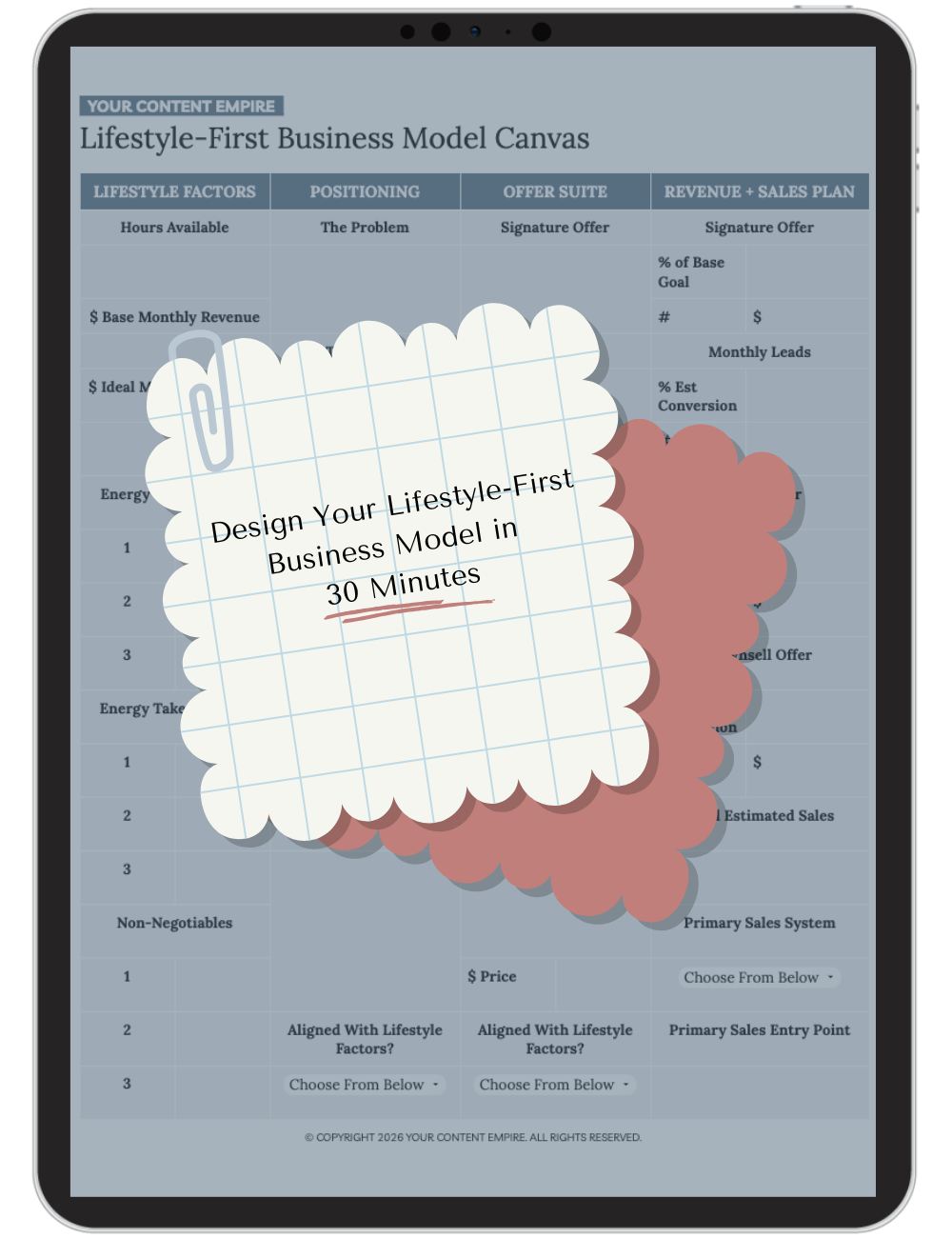
Click Here to Design Your Lifestyle-First Business Model with My Free Template
The secret to how to sell after a workshop is the 5 to 7 days right after it ends, where most of your sales actually get made. Run a daily follow-up plan of emails, posts and real conversations, sell to your warmest leads first and offer a same-day bonus to mobilize buyers in the first 24 hours.
You can run a workshop that goes perfectly and still make almost no sales from it. Full room. Great energy. People telling you in the chat how helpful it was. But then no sales come through or way way less than you were hoping for.
This episode is about how to deliver your workshop so people leave ready to buy, how to follow up in a way that converts and how to turn the whole thing into a system that gets stronger every round you run it.
Click here to watch part 1 of the series
Click here to watch part 2 of the series
This part of the process is about everything that happens once and after you go live. Delivering your workshop, selling in the days that follow and turning the whole thing into a repeatable system that gets optimized over time and compounds fast.
Let's quickly recap my monthly workshop system:
Step 1 was planning your workshop and nailing down your topic.
Step 2 was setting up your workshop sign-up system.
Those two were covered back in Part 1. If you haven't watched it yet, definitely start there, since you'll be missing a huge part of the foundation this system is built on without it.
Step 3 was promoting your workshop.
Step 4 was creating your workshop content.
Those two were covered in Part 2. Same goes for that one. Go back and watch it first if you skipped ahead, because everything we're doing today builds on the room you filled and the content you prepared.
Which brings us to this episode. This is Part 3, the final part of the series, and we're covering the last two pieces of the system. Delivering your workshop and following up to make sales, then turning all of it into a repeatable system that gets better every single round.
This is the part where the work you've already done starts paying you back. Everything you've built so far, the sign-up page, the promo content, the workshop itself, gets reused and refined from here. Next month you're running a system you've already built and making it better each time (instead of exhausting yourself with creating a new workshop from scratch…again)
Let's start with delivering your workshop and the window that opens the moment it ends ↓
Workshop day has its own energy. The session ends, the adrenaline settles and then comes the window that most people underplan.
The 5 to 7 days after your workshop is where your conversion rate is actually made. The emails you send, the conversations you have with warm leads, the consistency of showing up even when it feels like nothing is happening. That's what determines whether the workshop pays off the way it should. Most people do this for a day or 2 and let the window close before it's done its full job.
There are 5 things that have to happen here. Let's go through each one.
Hosting a workshop can take a lot out of you. Even a session that goes really well leaves you socially spent. When you wrap up and finally close your laptop, the last thing most people feel like doing is sitting down to create content, come up with angles or figure out what to send next.
Having your post-workshop sales plan fully mapped before even you go live is exactly what prevents that. When the workshop ends, everything is already waiting and ready to go out.
Here’s what to do: Set your promo start date, end date and count your total promo days. Map out how many emails, posts and stories you'll publish across the sales window. Usually, this is daily emails with more in the last 48 hours and in the first 24 hours if you're doing a same-day bonus just for workshop attendees.
Your sales emails shouldn't all go out to your full list. The method I recommend is called the interest list strategy, and it's one of the ways my clients protect their list while still selling consistently.
The replay and same-day bonus emails go only to workshop attendees. Your first broader announcement email or 2 go to your interest list: the people who engaged with your pre-workshop content, clicked through to the sign-up page or signalled interest in some way during the promo period even though they didn’t end up registering. It's worth creating a tag for anyone who interacts with your pre-workshop content so that list is ready when the sales window opens.
This is especially worth considering if you're running this workshop monthly. Sending a full sales sequence to your entire list every single round creates fatigue over time. The interest list lets you sell more frequently to the people who are actively raising their hand, while keeping the rest of your list for the moments they're actually ready. Anyone who clicks through those first 2 announcement emails gets tagged and added to the full sequence from there.
Your offer promo content follows the same principle as your workshop promo: 1 strong base message adapted into 3 formats. A sales email. A social post. An Instagram story. Each one starts with an angle, transitions to the offer and closes with a tailored CTA.
The angles that tend to land in a post-workshop sales window are less about the offer itself and more about the framework behind it. This is one of the biggest mentality shifts my clients make and it's the one that tends to unlock everything for them conversion-rate-wise. Your job during the follow-up window isn't to hard pitch. It's to sell people on the problem and on the idea that your signature process is the solution to it, the gateway to the results they came to the workshop for. When you do that well, the offer pretty much sells itself.
So the question to ask isn't what objections do people have about buying. It's what “yes, buts” do they have about solving this problem at all. The reasons they think it won't work for their specific situation. The excuses they're holding onto about why it's not possible for them. Those are your angles.
Some questions to brainstorm from:
Pull from your thank you page questionnaire here too. The language people used to describe their problem when they registered is often the exact copy that moves them to buy. Brainstorm more angles than you need and then choose the strongest. Each day of the sales window gets a different angle which stops the sequence from feeling like one long pitch and gives people a new reason to continue opening, reading and clicking.
A few things that make a real difference in the room.
Brainstorm your engagement prompts before you go live: an opening prompt to settle the room and learn who's in it, prompts between sections to keep people active, a specific prompt going into your pitch that re-grounds people in the problem they came to solve and a closing prompt at the end. Planning these in advance means you're not improvising them in the moment while trying to manage everything else.
Let’s talk about bonuses quickly. Most people approach bonuses by adding more: more modules, more resources, more content. What you actually want is a bonus that helps people get results faster, get better results or get to the result more easily. That's what makes a bonus feel genuinely valuable rather than like padding. Keep this in mind for all of your bonuses but in particular the same-day bonus strategy is great way to mobilize buyers within the first 24 hours after the workshop. What works particularly well here is a personalization element. A small done-for-you deliverable, a coaching call or a mini intensive that's exclusive to same-day buyers. This matters especially when you're selling a leveraged offer, because most people buying a course or a group programme won't get direct access to you. A personalization bonus tells them that even though the offer is built to scale, their experience of it can still feel tailored to them. That assurance increases the likelihood they'll actually follow through and get results, which is of course what you want.
Immediately after the workshop ends, share the same-day bonus link with attendees. Then get the replay out as quickly as possible.
Download, transcribe and upload your recording with captions. Send the replay and a recap to all workshop attendees. Then follow up personally with anyone who registered but didn't attend live. They opted in. They raised their hand for this topic. A personal note from you, not just the automated replay email, can be what moves them from interested to buying. Reach out for the purposes of not only checking in, but also opening the doors to questions they have.
Save the chat and the questions that came up during the session. These become future content angles and messaging gold you'd otherwise lose.
The daily system for this phase is simple. You want: at least 1 email scheduled and sent, at least 1 post or story and at least 1 to 3 personal conversations with warm leads. Having a clear daily checklist for this window matters because it removes the decision fatigue of figuring out what needs to happen each day. You work through it and the day's selling is done.
Here’s the thing about tipping points: You won't always know which email made someone buy. It could be email 4 that finally moves them, but without emails 1 through 3, email 4 would never have done its job. Every touchpoint is building toward a tipping point you can't predict in advance. That's why consistent daily presence matters even when the sales notifications aren't coming in yet.
It's also why keeping the cart open too long works against you. The longer the window stretches, the harder it is to maintain the energy behind it. 5 to 7 days is the sweet spot. Long enough to reach people at different moments in their decision. Short enough to keep the urgency genuine and your momentum up.
The most valuable thing you can do alongside your daily emails and posts is personally touch base with your workshop attendees. I call this the Conversation System and it's one of the highest-converting power moves you can leverage in the post-workshop sales phase.
The magic to this system? It gets better every single time you run it. Round 1 is almost never your best round. It's the round where you're building everything from scratch, getting a feel for what your audience responds to and learning what actually lands in the room. Round 2 is where you refine based on what you learned. Round 3 is where the system starts to show what it can actually do.
That’s why committing to at least 3 consecutive rounds before evaluating whether this is working is one of the most important decisions you can make going into this. 1 round isn't enough data. 2 rounds gives you a trend. 3 rounds gives you a system.
After every round, there are 3 things to do.
One of the simplest things that makes this system easier to maintain over time is having every asset linked in one place. So after (or during) your first round, build a master document with all of the following: your workshop sign-up page, thank-you page, workshop tag, form or checkout page, slides, invitation emails, nurture emails, social posts and stories, access link, replay and sales page, your offer checkout page and offer thank-you page.
When everything is in one place, updating between rounds takes minutes instead of a morning spent hunting through your tech stack.
The goal of this isn't just to collect numbers. It's to build a clear picture of where the system is working and where it has room to move. Think of each metric as a lever. When you can see all the levers laid out across multiple rounds, you stop guessing about what to change and start making decisions based on what the data is actually telling you.
Building out your Workshop Results Model is how that picture starts to take shape. It maps each stage of the system as a flow with the conversion rate between each one, so you can see at a glance exactly where people are moving through and where the system needs attention.
Fill it in after this first round and keep it updated after every round from there. The metrics you're tracking: sign-up page views and registration conversion rate, live attendance and show-up rate, ad spend and cost per lead if you're running paid traffic, total sales and earnings per lead and your sales page and checkout page conversion rates.
The data builds as you go. A single round gives you a starting point. 3 rounds gives you a pattern, and the pattern is what tells you whether the changes you're making are actually working.
Each metric also points to a specific part of the system. Low sign-up page conversions point to the messaging or the promo. A low show-up rate points to the onboarding and reminder emails. A low sales conversion points to the pitch, the offer positioning or the follow-up. The numbers give you a diagnosis before you start deciding what to fix.
Alongside the numbers, sit with 3 reflection questions: what worked this round, what didn't and what 2 to 3 things will you test or change next time?
Your reflection questions and results model will point you toward where the system needs attention.
The max 2 to 3 changes rule exists for a specific reason. If you change more than that between rounds, you won't be able to tell what actually moved the needle. The goal is to go into round 2 with a hypothesis: I changed X so I expect to see Y improve. That only works when the changes are targeted and isolated.
A useful way to organize your thinking is by area of the system. There are 5 areas to consider:
The sign-up system: Your registration page, thank-you page and sign-up automation. If your registration conversion rate is low, this is the first place to look. A headline test, a stronger outcome statement or a clearer call to action can all move this number.
Some things to test or optimize:
The promotion system: Your promo calendar, your angles and your invite and nurture content. If registrations were lower than expected, look here. Were the angles connecting? Was the ramp-up consistent? Was the promo window long enough?
Some things to test or optimize:
The workshop: Your content, your engagement prompts, your resource and your pitch. If attendance was strong but sales were low, the workshop experience or the pitch is likely where the work is.
Some things to test or optimize:
The follow-up: Your replay delivery, your personal outreach and how quickly you moved people into the sales window. If you had warm leads who didn't convert, look at what happened in the 24 to 48 hours after the session ended.
Some things to test or optimize:
The offer and salespage: Your sales sequence, your bonus structure and your email angles during the sales window. If your sales page conversion rate was low, the offer positioning or the bonus is the place to start.
Some things to test or optimize:
The area your results model is pointing to most clearly is where to focus first. One change there. If there's room for a second, choose a different area. The rest stays the same. That's what makes round 2 a real test.
I hosted a workshop on this exact system recently. One of the attendees kept stopping me throughout to say “I didn't do that. I didn't do that.” Every section we covered, another thing she hadn't yet implemented.
My response: that's actually a wonderful position to be in. It's way worse to finish a round with no idea what you could improve than to finish it with a full list of things to roll out. The second means you have a roadmap. The first means you're hoping next round goes better for reasons you can't explain.
The temptation after a round that underperformed is to overhaul everything. Resist that at all costs. Pick 2 to 3 things, maximum. The reason: if you change more than that between rounds, you won't know what actually moved the needle. You want to look at your numbers after round 2 and say with some confidence that the specific change you made is what produced the improvement. That only works if you're isolating your variables.
A useful way to think about it is 1 main change per section of the system. The sign-up system. The promotional content. The workshop itself. The follow-up and offer sequence. That gives you clear areas to work in and stops you from changing everything at once and learning nothing from it.
The results compound because your understanding of what works for your specific audience compounds. Every round you run it, you know more than you did the round before.
Clients hire me specifically to help them build this workshop system. We do the whole thing together. The build phase, the promo plan, the sales sequence. I am in their corner as they run their first rounds and we optimize together using real data from their actual audience.
That is one of the things we do inside Your Signature Scaling System.
It is a three or twelve month coach-sulting partnership where we build your custom scaling strategy together. We take your offer, your audience and your lifestyle factors and we design a business model that generates consistent revenue without requiring you to work constantly or reinvent the wheel every month.
This is not a group program where you apply generic strategies to your unique situation. It is personalized strategic guidance built around your business, your goals and your capacity.
When figuring out how to sell after a workshop, keep your sales window to 5 to 7 days. It's long enough to reach people at different moments in their decision and short enough to keep the urgency genuine and your momentum up.
No. The smarter approach to how to sell after a workshop is the interest list strategy. Send the replay and same-day bonus to attendees, your first announcements to people who engaged but didn't register, and the full sequence only to those who click through. This protects your list while letting you sell consistently.
When working out how to sell after a workshop, a same-day bonus works best because it mobilizes buyers in the first 24 hours while the energy is high. Make it a personalized element like a small done-for-you deliverable or a quick call, which keeps a scalable offer feeling tailored to each buyer.

I’m Hailey and I help business owners who are tired of the hustle-harder advice build content systems that actually sell. No performative posting. No chasing algorithms. Just strategic, sustainable growth. More about me + my approach →
You’ve got two options: start small with a one-time strategy session, or go all in with done-with-you scaling support.
Scaling
Sales
Content
All Posts

In This Post: How do you get more sales from your sales funnel? The best way to get more sales from your sales funnel is to follow up with the people who didn't buy the first time, since only about 5% of your audience is ready to buy at any given moment. Set up a...

In This Post: How do you reset your business model? You reset your business model by rebuilding it in the right order: lifestyle first, then positioning, offers, revenue planning and marketing. Follow that sequence and you can reset your business model in about 90...

In This Post: What is a monthly business retreat? A monthly business retreat is a full week you block off each month with no meetings, calls or client work so you can focus entirely on the projects that grow your business. Rotating through a few types of monthly...
