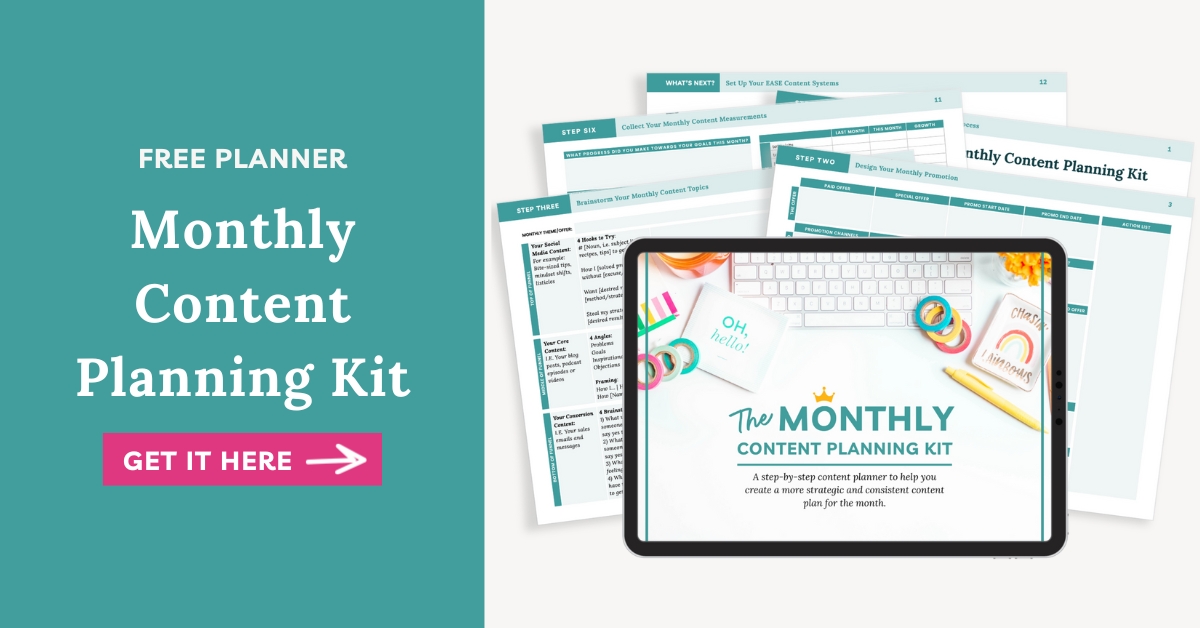
Sign up to get instant access to the Monthly Content Planning Kit!
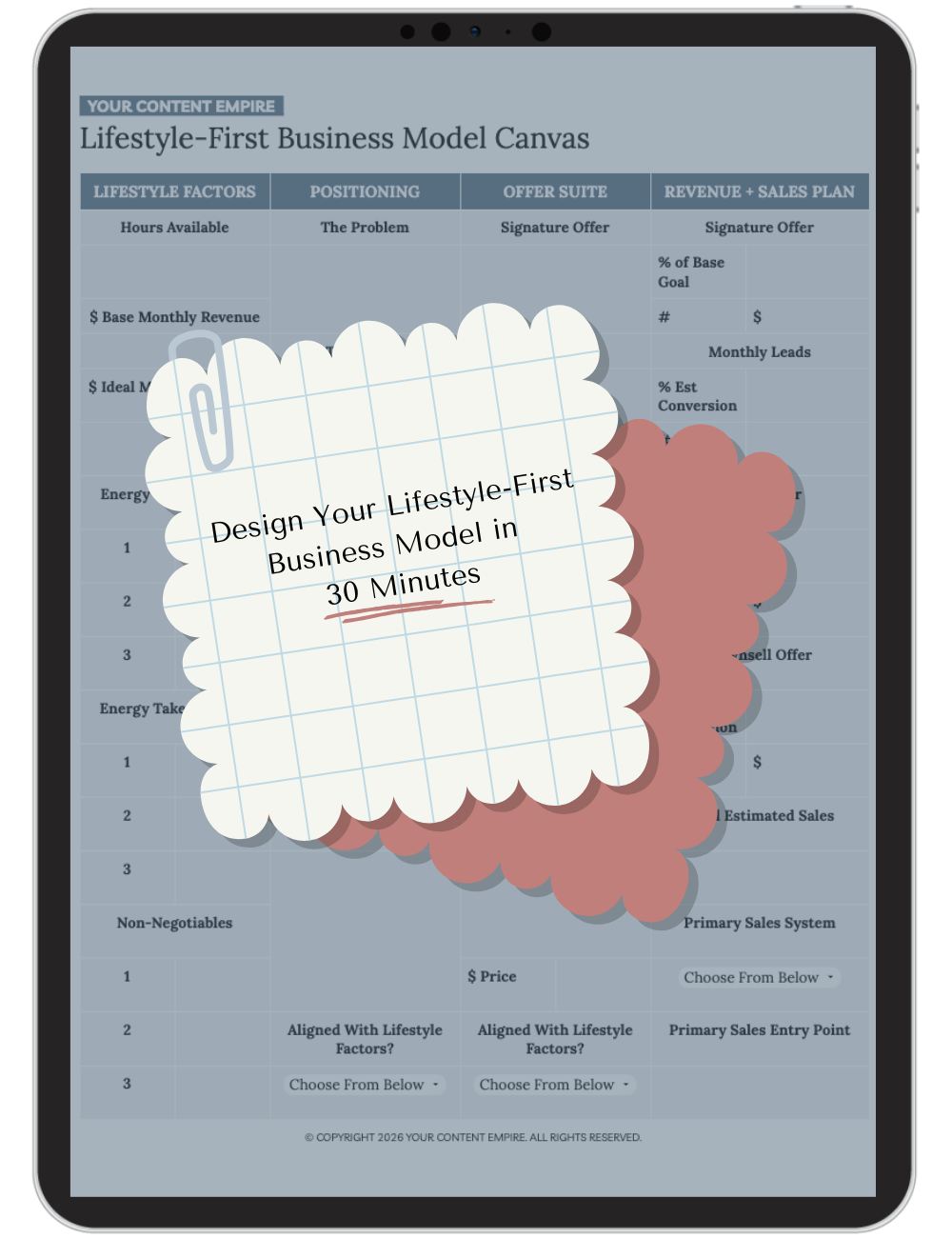
Click Here to Design Your Lifestyle-First Business Model with My Free Template

The most effective workshop promotion plan for coaches and course creators is a 3 to 4 week promo ramp that builds momentum gradually, paired with the 1 Message 4 Ways system that turns one base message into four pieces of content. This approach ensures coaches and course creators never run out of things to say during their promo period and consistently fill their seats without scrambling in the final 48 hours.
The hardest part of running a workshop isn't building it. It's watching the registration numbers and wondering if enough people are going to show up. You refresh the page. You second-guess your topic. You wonder if you should be doing more.
In this episode, we’re covering part of my monthly workshop system that’ll cover promoting the workshop and getting your content ready for go-time.
Click here to watch part 1 of the series
There's a window between the moment your sign-up page goes live and the day your workshop runs. And what you do inside that window determines whether you're delivering to a full room or an awkward handful of people.
This part of the process is about balancing the promotion and preparation part of your workshop process.
Let’s just quickly recap my monthly workshop system:
And if you ever find yourself dreading the work in this part, remember it’s an investment. Since we’re focused on the repeatability of this workshop, everything you create (the workshop AND the promotion content) will be used again and get better and better through the refinements you make in part 3.
Let’s start with promotion ↓
Promotion is where most workshop strategies fall apart. The effort is usually there. The plan isn't. People promote sporadically when they remember, run out of things to say by week 2 and then wonder why registrations were low. The workshop itself was great. The promo period just didn't do its job.
This step is 3 structured weeks of intentional promotion built around a simple principle: 1 message done well across multiple formats beats creating something new from scratch every single day. When the promo plan is mapped in advance and the content has a clear structure, the whole period becomes manageable instead of overwhelming.
There are 5 priorities here. Let's go through each one.
Before writing a single word, map out the calendar. Set your promo start date, count your total promo days and decide how many invite emails you want to send and on what dates. This one step removes a huge amount of friction from the promo period. When the plan is mapped in advance, you're never scrambling to figure out what to send or realizing you haven't promoted in a week.
The weekly ramp follows a consistent pattern. At least 1 message in week 1. At least 2 messages in week 2. At least 3 in week 3. And daily during the week of the workshop right up until the morning of the event. Planning the calendar first means nothing falls into a dead zone and you're not front-loading all your energy into the final 48 hours.
Every piece of promo content starts with an angle. The angle is what makes someone stop and actually read before they even know there's a workshop to register for. It's the real entry point. The workshop is where it leads.
The best angles come from a genuine place. What frustrates you about how this topic is commonly handled? What's the biggest mistake people keep making? What myth shows up again and again in your client conversations? Is there a personal story or a turning point in your own experience that connects directly to what you're teaching? What do you wish people already knew walking in? What's the real cost of leaving this problem unsolved?
Brainstorm more ideas than you think you need. The strongest ones become your promo emails and posts and having extras gives you somewhere to go if a particular angle isn't landing or you need to extend the promotional window. Quick tip here: review your thank you page questionnaire for more ideas too.
Most business owners have a pre-launch phase problem. They jump straight into “sign up for my workshop” without building any real interest or activating the part of their list that's most likely to register. The promotion starts and there's no runway behind it.
This priority is about building that runway. For the 3 to 4 weeks leading up to your workshop, you're publishing long-form content connected directly to your workshop topic alongside your promo emails. Whatever your long-form channel of choice is, whether that's written blog posts, YouTube videos or podcast episodes, plus your newsletter. Each one sharing something interesting and including an invite to the workshop. A PS invite in your regular newsletter each week keeps the event visible without turning every email into a pitch.
The advantage here is that you're not creating 2 separate content tracks, 1 for your editorial calendar and 1 for promotion. You're merging them. Your pre-workshop content pulls double duty. The same video that builds your authority on the topic also points your audience to the sign-up page. The same newsletter issue that delivers value has a PS invite at the bottom. By the time someone lands on your registration page, they've already spent real time in your world. They know how you think. The workshop feels like the natural next step.
A Quick Note on Evergreen Concerns:
A logistics question that comes up a lot here is what happens to all of that content between rounds. You've published 3 to 4 videos or blog posts pointing to your workshop. What happens when the round ends?
A client of mine handles this really well. She hosts a monthly workshop, promotes it through her YouTube videos and newsletters and has a dedicated URL that always points to the current live registration page. Every round, all she updates is the date and the details. The URL never changes and all the content she's already published keeps sending traffic to the same place.
Another client of mine takes a different approach. When she wraps up a workshop, she turns it into a mini course and updates the page with those details instead. The evergreen content that was pointing to the workshop now points directly to something people can buy and watch on demand. Every video she published, every newsletter, every blog post still leads somewhere useful and still converts.
Worth building into every piece of pre-workshop content you create: leave the specific date out of the content itself. Just mention that you have a workshop on this topic and point people to the link. Keep the date and the live details in your episode description or your show notes where you can update them easily between rounds without touching the content itself.
This is where the 1 Message, 4 Ways system does its work. For every angle you're promoting, you're creating 4 pieces of content from 1 base message rather than writing everything from scratch.
Start with the base message: the angle, how it connects to the workshop and the call to action. Everything else gets adapted from that. An invite email for people who haven't registered yet. A nurture email for people who have, which becomes a reminder and a value-add rather than another pitch. A social post in whatever format fits the angle best, a reel, a carousel or a static post. And an Instagram story that's visual and fast.
And when a post is performing well organically, that's your signal to put a small ad budget behind it. Your top-performing organic content almost always makes the best paid ads.
Every piece follows the same base 3-part structure: open with the angle, transition to the workshop, close with the tailored CTA. Once that structure is in your head, the whole promo period becomes a lot more manageable.
Planning the promo is one thing. Sustaining the energy to actually run it for 3 weeks is another. This priority is about the daily practice of keeping the momentum going.
Set a simple goal for yourself: at least 1 conversation about the workshop every single day. A reply to someone who commented on your post, a personal follow-up with someone who mentioned the topic in your DMs, a response to a questionnaire answer. The promo calendar handles the broadcast content. The daily conversations handle the warmth.
The ramp-up in the final week is where the biggest lift in registrations happens. Most people sign up in the last 48 to 72 hours before an event, so go daily with your emails, your stories and your posts. This is when the consistency pays off the most.
The goal of this step is to build everything once. Every round after this is just updating details and refining what's already there. And you're doing it in a specific order, because you can actually start taking registrations before your content is fully built.
This is the part where perfectionism shows up uninvited. You know what you want to teach. You have the outline. But suddenly you're staring at a blank slide deck wondering if it's good enough, detailed enough, clear enough.
It's also the part that's easiest to put off. The promo feels urgent because the deadline is visible and the registration numbers are staring back at you. The content feels like it can wait. Until it can't.
Here's the thing about having a live date on the calendar with real people registered: that first registration that comes through has a way of making this very real very fast. That commitment is actually a gift. Use it. Because that date will sneak up on you faster than you think.
And while you're in the promo phase, you're also getting real-time intel from your audience. That thank you page questionnaire you set up in Part 1 is already filling up. Check it. The questions and answers coming in are telling you exactly what your audience needs from this workshop. You don't have to guess what to include. They're telling you directly.
The good news is you already did the hard work. Your outline is done. Your pathway is mapped. Now it's just about building what you already know.
There are 2 things to build here: your workshop resource and your slides.
Your workshop resource is where attendees get their win. And the win matters, especially in a paid workshop. Someone who walks away having actually accomplished something in your workshop has proof that your approach works. That's what makes your paid offer feel like an obvious next step rather than a leap of faith.
Design the resource to be completable during the session itself. A workbook that follows your workshop flow, a template they fill in as you teach or a checklist they work through in real time. The goal is a tangible result they can point to by the time you wrap up.
For your slides, the pathway you mapped out in Priority 1 is your teaching outline. Each section of the path becomes a section of your slides, and each section follows the same structure: introduce the step, explain why it matters, teach how to do it, share a story or example connected to that step and then move into the work session where they apply it. That's Head, Heart, Hands built directly into your slide structure.
Your slides and speaking notes are the last things to build here. Once those are done, your foundation is set.
Clients hire me specifically to help them build this workshop system. We do the whole thing together. The build phase, the promo plan, the sales sequence. I am in their corner as they run their first rounds and we optimize together using real data from their actual audience.
That is one of the things we do inside Your Signature Scaling System.
It is a three or twelve month coach-sulting partnership where we build your custom scaling strategy together. We take your offer, your audience and your lifestyle factors and we design a business model that generates consistent revenue without requiring you to work constantly or reinvent the wheel every month.
This is not a group program where you apply generic strategies to your unique situation. It is personalized strategic guidance built around your business, your goals and your capacity.
If you want support putting this system together and someone in your corner as you run your first rounds, you can book a free strategy call here.
The most effective workshop content for coaches and course creators follows the Head Heart Hands framework, where every section includes the teaching, a story that makes it land and an implementation activity attendees complete during the session. This structure ensures your workshop promotion plan pays off because attendees walk away with a real result rather than just notes, making your paid offer feel like the natural next step.
Coaches and course creators should start their workshop promotion plan 3 to 4 weeks before the event, using a gradual ramp that increases in frequency each week. Most workshop registrations come in the last 48 to 72 hours, so a consistent workshop promotion plan that builds early momentum is what earns that final surge of sign-ups
Coaches and course creators can use the 1 Message 4 Ways system as part of their workshop promotion plan, which turns one base message into an invite email, a nurture email, a social post and an Instagram story. This approach cuts workshop promotion work down to a fraction of what it usually takes while ensuring your audience hears your message consistently across multiple formats without it feeling repetitive.

I’m Hailey and I help business owners who are tired of the hustle-harder advice build content systems that actually sell. No performative posting. No chasing algorithms. Just strategic, sustainable growth. More about me + my approach →
You’ve got two options: start small with a one-time strategy session, or go all in with done-with-you scaling support.
Scaling
Sales
Content
All Posts

In This Post: How do you get more sales from your sales funnel? The best way to get more sales from your sales funnel is to follow up with the people who didn't buy the first time, since only about 5% of your audience is ready to buy at any given moment. Set up a...

In This Post: How do you reset your business model? You reset your business model by rebuilding it in the right order: lifestyle first, then positioning, offers, revenue planning and marketing. Follow that sequence and you can reset your business model in about 90...

In This Post: What is a monthly business retreat? A monthly business retreat is a full week you block off each month with no meetings, calls or client work so you can focus entirely on the projects that grow your business. Rotating through a few types of monthly...
