“As an entrepreneur, I've learned to surround myself with people who have skills that I lack. FB ads and email funnels were something I knew I wanted to be doing in my business but I had no idea where to start. I put it off for a while because it was outside my comfort zone, and it wasn’t until I found Hailey that I felt confident moving forward with them. Hailey took the reigns and created a system for me that was not only profitable, but really helped me create more space in my day to work on the things that are in my zone of genius!”
Lauren Bongiorno Diabetic Health Coach
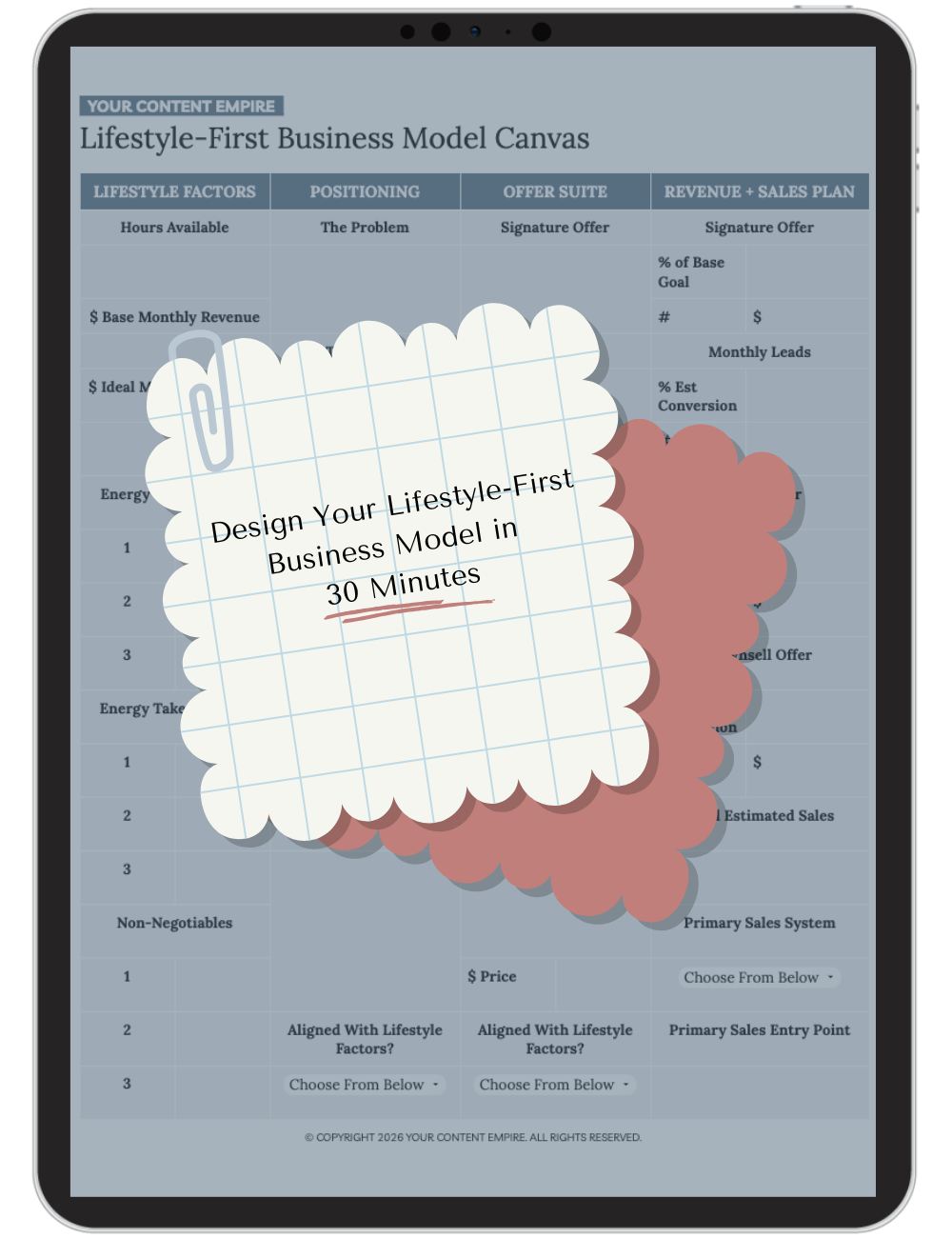
Click Here to Design Your Lifestyle-First Business Model with My Free Template
My client hit 7 figures. She had the team, the systems, the packed calendar. From the outside, her business looked like everything you're supposed to want.
And then she walked away from all of it.
Not because the business failed. Not because she didn't know what she was doing. But because she realized she'd built something that was costing her everything that actually mattered.
What nobody tells you about scaling is that you can hit every revenue milestone, check every box and still be drowning. You can look successful on paper and feel completely trapped in real life.
We'd been working together for 5 years when this happened. And her story proves something really important: her hustle was never the secret. The right business model was.
In this post, I'm walking you through what happened, what we did to give her an exit plan and how she rebuilt from scratch with her lifestyle as the foundation instead of the afterthought.
Prefer to watch instead?
Want to listen on the go?
Before I tell you the full story, I need you to understand something.
This client is brilliant. She's one of the smartest, most capable business owners I've ever worked with. We'd been working together for five years at the point she walked away. I watched her grow from maybe $100K a year to well over seven figures.
And from the outside? It looked incredible. She had a team. She had systems. She had clients who loved her. Her launches worked. Her programs filled. By every external metric, she was winning.
But here's what I was seeing behind the scenes: she was exhausted. She was working all the time. Her calendar was completely booked. She had no space to think, no room to breathe and every time we got on a call I could see the resentment building.
Not resentment toward her clients. Not even resentment toward the work itself. But resentment toward the business model she'd built. Because it required more of her than she had to give.
She built her business the way most of us are taught to build: start with the revenue goal, reverse-engineer the offers, fill your capacity and sacrifice whatever you need to sacrifice to deliver.
That's the model. That's what we're taught. Revenue first. Lifestyle later. Maybe.
Except “later” rarely ever comes. Because once you build a business that requires you to be available all the time, work at full capacity and push through no matter what, it doesn't just magically get easier when you hit the next milestone.
The Success Illusion
Let me tell you about what her 7-figure business actually looked like before she walked away.
She was running a high-ticket 1-1 coaching program. It was incredibly successful. She had a waitlist. Her clients got amazing results.
But here's what that required of her:
She was on live coaching calls for over 30 hours a week. She was creating new content constantly. She was managing a team. She was answering Voxers and DMs and client questions at all hours because that's what came with the “premium, high-touch experience” she'd built her reputation on.
And every single piece of that? It required her to be present, available and performing.
From the outside, this looked like the dream. She was making great money. She had demand. People loved working with her.
From the inside? She felt trapped.
She couldn't take a vacation without her business grinding to a halt. She couldn't step back without letting people down. She couldn't say no to new clients because she had team members depending on her to keep revenue coming in.
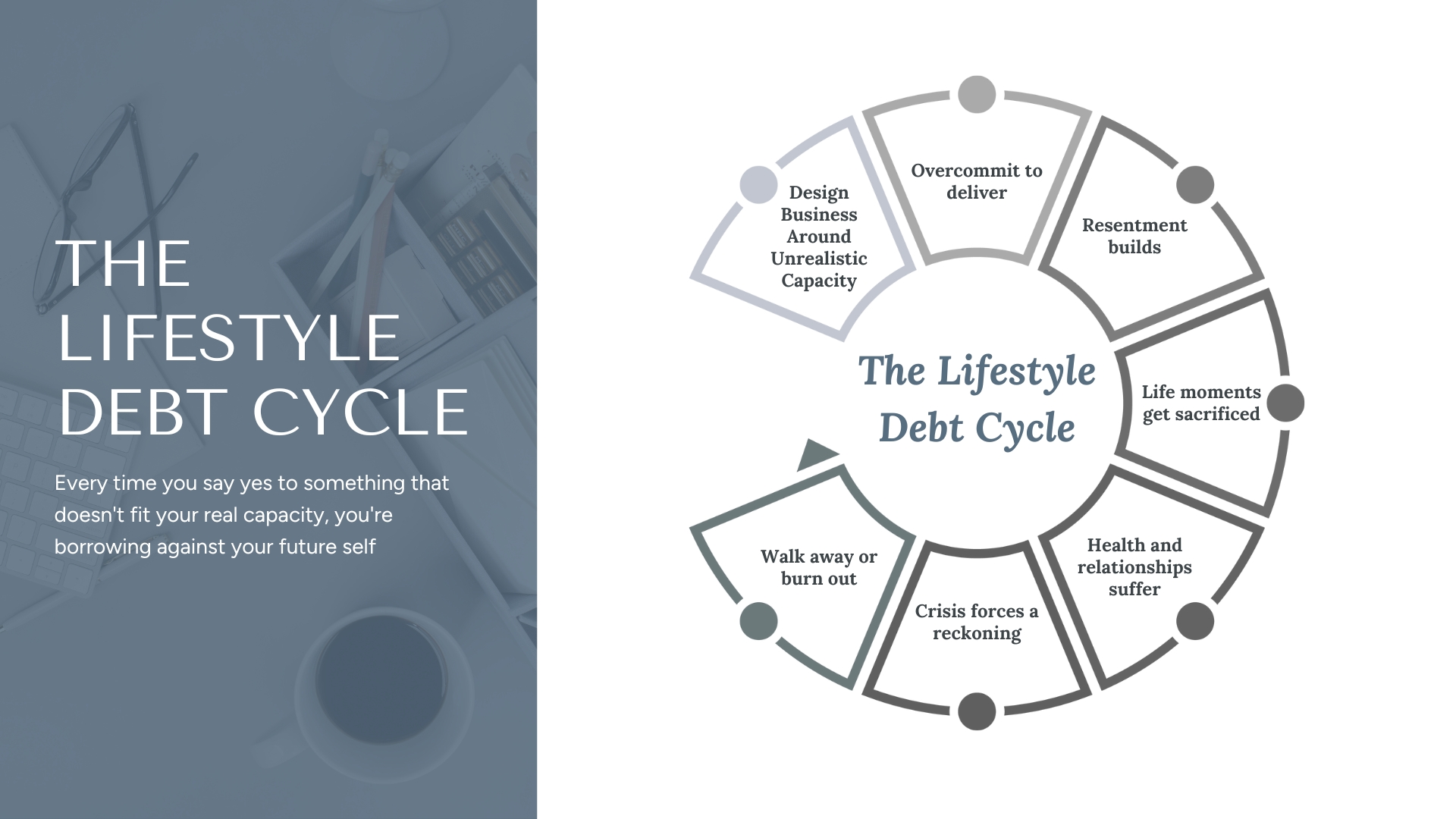
This is what I call lifestyle debt. Every time you say yes to something that doesn't fit your real capacity, you're borrowing against your future self. And eventually, that debt comes due. For her, it came due when her mom got sick.
The Crisis Point
When her mom's health took a sudden turn, she had a choice to make.
She could get on a flight immediately. Or she could finish her commitments for the week and fly out a couple days later.
And here's the thing: this wasn't a selfish decision. She wasn't choosing work because she cared more about money than her mom. She was choosing work because her business model had conditioned her to believe that she couldn't let people down. That she had to show up no matter what. That her clients were depending on her and she owed them her presence.
So she finished her calls. She delivered what she'd promised. And then she got on a flight. And she didn't make it in time.
I'm sharing this with her permission but anonymously here because I think it's one of the most important wake-up calls any of us can hear.
The Realization & The Sabbatical Bandaid
After her mom passed, she came to me and said: “I don't know if I can keep doing this.” And we had to have a really honest conversation about what “this” actually meant.
Was it the work itself? No. She still loved what she did. She still believed in the transformation she created for her clients. She was still great at it.
Was it the business idea? No. The offer worked. People wanted it. It was profitable.
So what was the problem? The business model.
And that's when we started talking about what it would take to step away, catch her breath and figure out what she actually wanted.
She couldn't just shut everything down overnight. But she also couldn't keep showing up the way she had been.
So we built her what I call a sabbatical plan using the Minimalist Content System.
Here's how it worked:
We took all the content she'd already created over the past five years. All the trainings, the frameworks, the coaching call recordings, the workshops, the resources. Everything she'd built.
And we turned it into automated sequences.
We built email nurture sequences pulling from her best content. We created evergreen sales funnels using webinars she'd already recorded. We turned her offers evergreen and lowered the prices to reflect this.
Everything she needed to keep her business running was already there. She didn't need to create anything new. She just needed to leverage what she'd already built.
And here's the key insight I want you to take from this: your content is an asset. It has value beyond the moment you first publish it.
Most business owners treat content like it's disposable. You create a post, it goes out, it gets a few likes and then it's gone. You record a training, deliver it once and then it sits in a folder somewhere collecting digital dust.
But if you treat your content like an asset, you can build systems that generate revenue without requiring you to show up and create something new every single time.
That's what we did for her. We turned her content library into a business that could run without her being live and present all the time.
And it worked.
For six months, her business kept generating revenue. Not at the same level as when she was fully active, but enough to cover her expenses while she took the space she needed.
That's what bought her the breathing room to make a real decision instead of a desperate one.
The Rebuild
After 7 months, she made her decision. She wasn't coming back to the old business because she finally had the clarity to see that the business model itself was never going to give her the life she wanted.
So she decided to start over. But this time, we did it differently.
This time, we started with her lifestyle first. Before we talked about offers, pricing, funnels or marketing, we started with one question: What are your non-negotiables? And here's what she told me: “I never want to owe anyone anything on a specific deadline again.”
That might sound like a small thing, but for her, it was everything. Because what she'd realized was that the moment her work became obligation, the moment it had to be delivered on someone else's timeline no matter what was happening in her life, it turned into resentment. And resentment kills the joy in the work.
So we designed her entire business model around that one constraint.
Here's what we built:
A group program where everything is created ahead of time. No live teaching that has to happen on a specific date. No custom one-on-one work that depends on her being available in real time.
She records all the curriculum in batches when she has the energy and inspiration to do it. It's done. It's complete. It lives in the program portal.
Then she shows up for live sessions twice a month. Contained. Scheduled. But not requiring extensive prep because the teaching is already handled.
And then here's the part she loves: she batches “surprise and delight” content for her clients. Little bonuses, extra trainings, creative resources. The stuff she's genuinely excited to make. And she delivers it on her timeline, when she feels inspired, not because someone's expecting it by Friday.
No deadlines. No owing. No resentment. Just her showing up to the work she loves, in a container that protects her life.
And here's what's happening: this business is growing in a way that feels controllable and sustainable. Same expertise. Same ability to create transformation. Same person. But a completely different business model. One designed around her constraints instead of ignoring them.
A little secret about constraints: they don't limit success. They create clarity. And clarity is what makes growth sustainable.
The Bigger Pattern
And guess what? She's not the only one.
In the last couple of years, we've seen a pattern emerging. More and more business owners are making the hard choice to walk away from businesses that look successful on paper but don't feel sustainable in practice. They're choosing to close doors, sunset offers and completely rebuild because they've realized that revenue without alignment isn't actually success.
And it's not just entire businesses. We're also seeing people step back from major platforms they've built their brands on.
Amy Porterfield stepped away from her podcast after 12 years and over 700 episodes. Jenna Kutcher just did the same thing with her massively successful podcast.
These are people who built empires. Who have names everyone in the industry knows. Who hit every milestone we're told to chase.
And here's what I think that tells us: if the most “successful” people in our industry are stepping back from what they built, maybe it's time we question what “success” actually means.
Because revenue doesn't mean freedom. A big platform doesn't mean fulfillment. Scale doesn't mean sustainability. Success is only success if it supports the life you actually want to live.
The Journaling Questions
If any part of this episode made you feel seen, or uncomfortable, or like maybe your business is carrying more lifestyle debt than you realized, I want to give you some questions to work through that.
These are questions to ask yourself when your business feels heavy and unaligned. I'm going to go through them slowly. You can pause and journal on them now, or come back to them later. But don't skip this step.
Question 1: If someone looked at your business from the outside, what would they think? And how does that compare to how it actually feels to run it? Be honest. Because a lot of us are running businesses that look good on paper but feel heavy in practice. And we think that's just the cost of success. It's not. It's the cost of misalignment.
Question 2: What are you sacrificing right now to keep your business running? And is that sacrifice one you're willing to keep making? This isn't about guilt. It's about clarity. Because if your business model is requiring you to sacrifice the things that matter most to you, that's not a time management problem. That's a business model problem.
Question 3: What does my business currently require of me (time, energy, availability) that I resent? Be specific. Write down the actual tasks, commitments or responsibilities that make your work feel heavy.
Question 4: If I could redesign my business model with zero guilt or external pressure, what would I change first?
Question 5: What lifestyle boundaries have I compromised in the name of growth? Think about the things you used to protect that you've let slip. Time with family. Movement. Rest. Creative hobbies. What did you give up to keep growing?
Question 6: What would it look like to build a business that protects the things that matter most to me? Flip the question. Instead of asking what you're willing to sacrifice, ask what you're not willing to compromise. And build from there.
Question 7: If I only had 15 hours a week to work, what would I keep and what would I let go? This question forces clarity. When capacity is limited, you have to get honest about what actually matters and what's just noise.
Question 8: What am I afraid will happen if I prioritize my life over my business growth? Name the fear. Because often, the thing we're most afraid of isn't actually true. We're just operating from old beliefs about what success requires.
And finally, question 9: What does “success” actually mean to me? This is the most important question. Because if you don't know what you're building toward, you'll just keep chasing someone else's definition of success. And that's how you end up with a 7-figure business that makes you miserable.
Take your time with these. Come back to them when you need to. Because clarity comes from honest reflection, not from pushing through and hoping things get better.
What Is Your Next Move?
If any of these questions made you realize that maybe your business model needs to change, you're not alone. And you don't have to figure it out by yourself.
It's a free resource that walks you through the exact process my client and I used to rebuild her business with her life as the foundation.
You'll map out your lifestyle factors first – your real capacity, your revenue requirements, your non-negotiables. Then you'll design your positioning, your offer suite and your revenue plan around those constraints instead of ignoring them.
You can grab the free template down below ↓
HEY THERE!
I’m Hailey and I help business owners who are tired of the hustle-harder advice build content systems that actually sell. No performative posting. No chasing algorithms. Just strategic, sustainable growth. More about me + my approach →
Stop guessing. Start scaling. This one-page template helps you design a business model that supports both your revenue goals and your actual life.
Browse By Topic
Scaling
Sales
Content
All Posts
Search The Blog
FREE TEMPLATE
The Lifestyle-First Business Model
Design a business model that supports both your revenue goals and your real life. This one-page template walks you through your lifestyle factors, positioning, offer map, revenue plan, and sales strategies so you can finally stop guessing and start scaling with clarity.
In This Post: How do you get more sales from your sales funnel? The best way to get more sales from your sales funnel is to follow up with the people who didn't buy the first time, since only about 5% of your audience is ready to buy at any given moment. Set up a...
In This Post: How do you reset your business model? You reset your business model by rebuilding it in the right order: lifestyle first, then positioning, offers, revenue planning and marketing. Follow that sequence and you can reset your business model in about 90...
In This Post: What is a monthly business retreat? A monthly business retreat is a full week you block off each month with no meetings, calls or client work so you can focus entirely on the projects that grow your business. Rotating through a few types of monthly...