“As an entrepreneur, I've learned to surround myself with people who have skills that I lack. FB ads and email funnels were something I knew I wanted to be doing in my business but I had no idea where to start. I put it off for a while because it was outside my comfort zone, and it wasn’t until I found Hailey that I felt confident moving forward with them. Hailey took the reigns and created a system for me that was not only profitable, but really helped me create more space in my day to work on the things that are in my zone of genius!”
Lauren Bongiorno Diabetic Health Coach
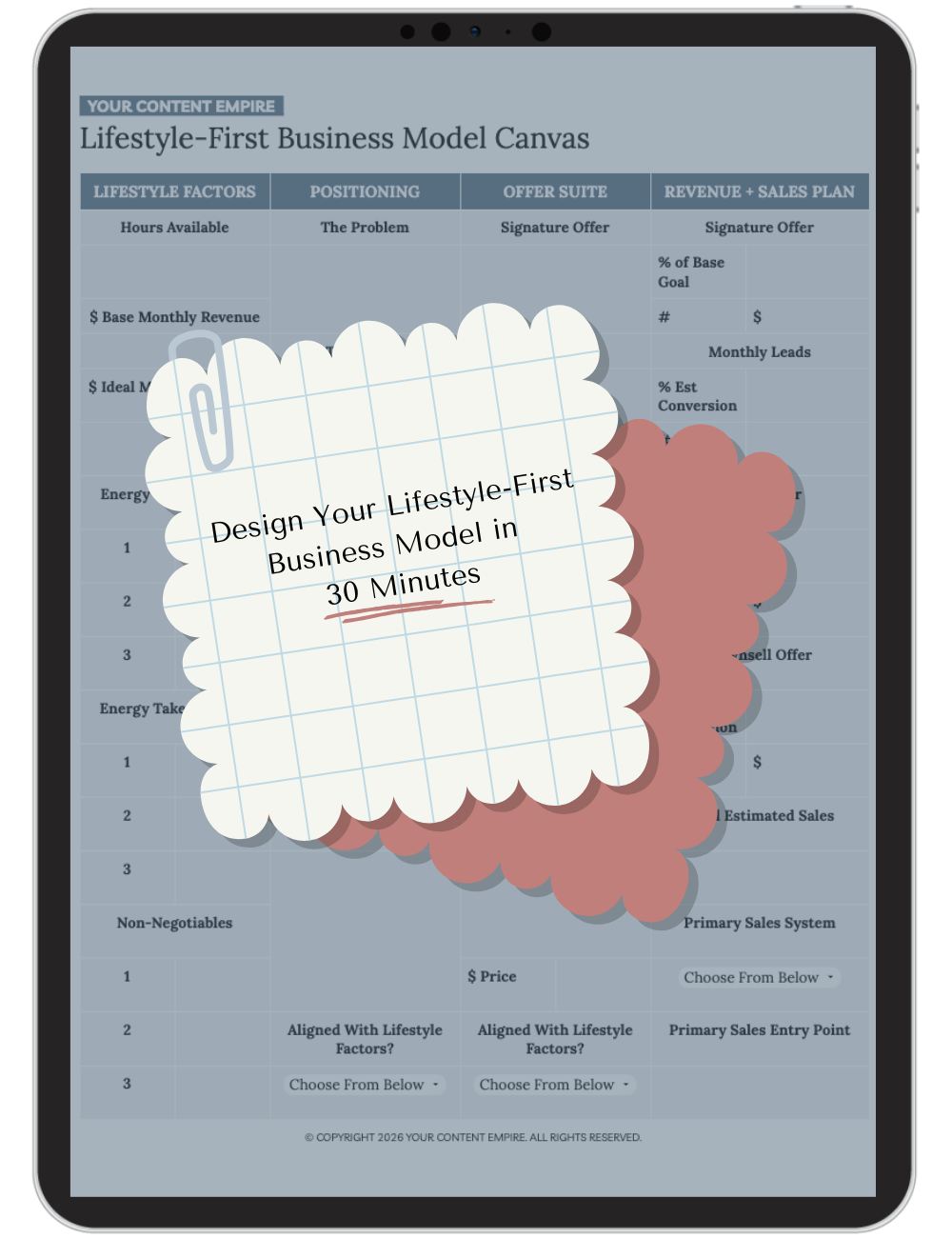
Click Here to Design Your Lifestyle-First Business Model with My Free Template
Is It Possible To Scale A Business With Boundaries?
Something that might surprise you is I grew my business faster in my first two years when I had a full-time job and only 15 hours a week than I did in the next two years when I went full-time and suddenly had 40 hours or more available.
Wait, what?
You'd think more time equals more growth, right? But here's what actually happened. When I had limited hours, every decision mattered. I couldn't afford to waste time on things that didn't move the needle. I had to be ruthlessly strategic about what I said yes to.
Then I went full-time and suddenly I had all this space. And you know what I did? I filled it with busy work. I said yes to everything. I lost my discernment because I thought I had time to spare.
That experience taught me something most business owners get backwards: boundaries don't limit growth. They focus it.
So today we're tackling the question I hear constantly from business owners who want to scale but have real time and capacity constraints: Is it actually possible to grow a business when you've got limited hours, capacity boundaries and non-negotiables you won't compromise?
The answer is yes. But only if you approach it strategically.
Prefer to watch instead?
Want to listen on the go?
“Just work harder.” “Show up everywhere.” “Post three times a day.” “Be consistent.” These are all examples of what most business advice sounds like when you have boundaries.
And you're sitting there thinking, “Cool, but I have 20 hours a week, a chronic condition and a kid who needs me to focus on them by 3pm. So how exactly does that work?”
Most scaling advice is built for people with unlimited capacity. It assumes you can just add more. More content, more clients, more offers, more hours.
Scaling with boundaries requires next-level discernment and intentional choices about where your limited time and energy actually go.
After 11 years of running this business and working with hundreds of clients, I've learned that the business owners who scale sustainably aren't the ones working 70-hour weeks. They're the ones who've gotten crystal clear on three things.
First, what actually makes a difference in their business. Not everything. Just the highest-leverage activities that create real momentum.
Second, whether their current business model actually works within their capacity. Not just in theory but in reality.
And third, which strategic levers they can pull when the math doesn't line up.
So if you've been wondering whether it's possible to scale without sacrificing your boundaries, I'm going to show you exactly how the math works and what your options are when it doesn't.
#1 Boundary = Time (Capacity)
The first boundary we need to talk about is time. Because everything else in your business flows from how many hours you actually have available.
And I don't mean “once things calm down” capacity. Not “if I could just get more organized” capacity. But right now, in this season, with everything else going on in your life, how many hours do you realistically have for your business each week?
For some of you it's 10 hours. For others it's 25. Maybe you're at 40. There's no perfect answer. Just your answer.
But here's where most business owners get stuck. They look at their available hours and immediately think, “That's not enough to scale.” So they either push past their boundaries and burn out, or they stay stuck at the same revenue level convinced they can't grow without more time.
Both of those are wrong.
Because the question isn't “Do I have enough time to scale?” The question is “Does my business model work within the time I have?”
And if it doesn't, you have strategic options. You're not stuck. You just need to make intentional choices.
So let's break this down into two parts. First, whether your offers work within your capacity. Then whether your lead generation works within your capacity.
Making Offers Work With Current Capacity
Let's start with your offers because this is where most people discover their business model is broken.
They're trying to hit a revenue goal that requires more delivery hours than they have available. And they wonder why they're constantly overwhelmed.
So we're going to run some capacity math.
Part 1: Capacity Math Basics
Here's what you need to know. Every business sits somewhere on what I call the Work Distribution Spectrum:
On one end, you've got one-to-one models where most of your time goes to delivery. Think coaching, consulting, done-for-you services.
On the other end, you've got scalable one-to-many models where most of your time goes to marketing and lead generation. Think courses, memberships, digital products.
Neither is better. But they require very different time investments. And if you don't understand where your business sits on this spectrum, you'll constantly feel like you're doing something wrong.
Let me break down both sides.
For One-to-One Offers
If you're selling one-to-one offers, here's your formula:
Take your monthly revenue goal and divide it by your offer price. That tells you how many clients you need.
Then multiply that number of clients by how many hours each client takes to deliver. That's your delivery hours.
Then add your marketing time and your admin time. That's your total hours required.
Let's look at an example.
Say your revenue goal is $10,000 per month. Your coaching package is $2,000. That means you need five clients.
Each client takes 2 hours a week to deliver. So that's 10 hours just for delivery.
Add 15 hours for marketing and admin. Now you're at 25 hours total.
But you only have 20 hours available per week. The math doesn't work.
This is the moment most business owners just push through and burn out. But you have options.
For One-to-Many Offers
Now let's look at the other side. One-to-many offers.
With scalable offers, your formula changes. Because you're not adding delivery hours for every new student or customer.
Instead, you've got base delivery hours for content creation plus your marketing hours.
Same revenue goal: $10,000 per month. But now your offer is $500.
You need 20 students to hit your goal.
Your base delivery time is 5 hours a week to create and maintain the content, plus provide customer support and engagement. Then marketing is 15 hours a week. And admin is around 5. Total: 25 hours.
One-to-many offers don't mean less work. They mean different work.
With one-to-one models, you're usually spending 70% of your time on delivery and 30% on lead generation.
With scalable models, that flips. You're usually spending around 30% on delivery and 70% on lead generation.
If you hate marketing, a premium one-to-one model might actually be more sustainable because it requires far less leads for you than a course that requires constant lead generation.
So the question isn't which model is better. The question is which model fits your capacity and your energy.
When the Math Doesn't Work
Okay, so you've run your numbers. And maybe you're realizing your current model doesn't fit your available hours.
Now what?
You have three strategic levers you can pull. These are your Scaling Levers.
Lever #1: Pricing
Raise your prices so you need fewer clients to hit your revenue goal.
Going back to our earlier example: if you raised that $2,000 package to $2500, you'd only need four clients instead of five. That's 2 fewer delivery hours a week.
Suddenly your 25-hour model becomes a 23-hour model. Still doesn't fit perfectly in 20 hours a week, but we're getting closer.
If pricing feels hard to change, that's usually a positioning issue.
Lever #2: Offer Design
Change your delivery format without changing the transformation.
Maybe you take that one-to-one coaching program and turn it into a small group program. Same transformation, less one-to-one time.
Or you turn your done-for-you service into done-with-you or a VIP day format.
Or you take something you're delivering live and create an evergreen version.
There are dozens of ways to restructure how you deliver your offers to reduce the time investment without reducing the impact.
Lever #3: Marketing Strategy
Make your lead generation more efficient.
If you're spending 15 hours a week creating organic content, what if you invested some of that time into paid ads that bring in leads while you sleep?
Or what if you built strategic partnerships that send qualified leads your way without you having to create content constantly?
This is where the time versus money decision comes in. If you have more money than time, invest in systems or support that reduce your marketing hours.
The key is this: when your capacity and your revenue goals don't line up, you're not stuck. You just need to make an intentional choice about which lever to pull or ease up on.
Making Lead Generation Work With Current Capacity
Now let's talk about the other side of capacity: lead generation.
Because even if your offers fit beautifully within your delivery capacity, you still need a way to consistently bring new people into your world. And that takes time too.
Where I see a lot of business owners get overwhelmed is when they're trying to be everywhere. Instagram, LinkedIn, TikTok, Pinterest, a podcast, a blog, a YouTube channel.
And when you have limited hours, that strategy is a recipe for burnout.
So let's bring that Discernment Matrix I mentioned earlier into this.
The Discernment Matrix
This is my remixed version of the Eisenhower Matrix. But instead of urgent versus important, we're looking at impact versus investment.
Draw a simple grid. Your horizontal axis is Investment (how much time and energy something requires). Your vertical axis is Impact (how much revenue or growth it actually creates).
That gives you four quadrants.
Top left: High Impact, Low Investment. These are your quick wins. The things that move the needle without consuming all your time. This is where you want to spend most of your energy.
Top right: High Impact, High Investment. These are strategic projects. They matter, but they need careful planning because they'll take significant time.
Bottom left: Low Impact, Low Investment. These are things you can delegate, automate or eliminate. They're not worth your time even if they're easy.
Bottom right: Low Impact, High Investment. This is the burnout zone. Stop doing these immediately.
Here's what I've noticed with almost every client I work with: they're spending 60% of their time in that bottom-right quadrant. High investment, low impact.
They're creating content that doesn't convert. They're on platforms where their ideal clients aren't. They're doing busy work that feels productive but doesn't actually create revenue.
When you have boundaries, you can't afford that. You need to ruthlessly focus on the top-left quadrant.
How to Apply This to Lead Generation
Look at all the ways you're currently trying to generate leads. Put each one on this matrix.
Where does it sit? High impact, low investment? Or high investment, low impact?
For most business owners with limited capacity, the answer is to pick one or two high-leverage lead generation strategies and go deep instead of trying to be everywhere.
Maybe that's a weekly newsletter that nurtures your audience and drives them to your offers.
Maybe it's strategic partnerships with people who already have your ideal clients.
Maybe it's paid ads that bring in qualified leads while you focus on delivery and sales conversations.
Maybe it's a simple content system where you create one long-form piece per week and repurpose it across three platforms.
The specific strategy matters less than the discernment. You need to know what actually works for your business and double down on that instead of spreading yourself thin across a dozen half-executed tactics.
And if you have more money than time, this is where you invest.
Hire someone to help you create content. Invest in ads. Bring in support so you can focus on the highest-leverage activities only you can do.
Because the fastest path to scaling with boundaries isn't doing more yourself. It's building systems and getting support that multiply your capacity.
What Is Your Next Move?
So here's where you might be thinking, “Okay Hailey, this all makes sense. But I need help actually figuring out my numbers and deciding which levers to pull.”
It's a free resource that walks you through the exact process we just talked about. You'll map out your capacity constraints, run your offer math, figure out your revenue requirements and identify where your business model needs to shift.
It's not a generic business plan template. It's specifically designed for business owners who want to scale without sacrificing their boundaries.
You'll get the Canvas, the workbook and a full podcast series that walks you through each section step by step.
And the best part? It takes everything we talked about today and turns it into a clear plan you can actually use to make strategic decisions about your business.
I'll put the link in the description if you want to check it out.
This is the foundation for everything else. Because if you don't know whether your business model actually works within your capacity, you're just guessing. And guessing leads to burnout.
So go grab the template. Work through it. And get the clarity you need to scale sustainably ↓
HEY THERE!
I’m Hailey and I help business owners who are tired of the hustle-harder advice build content systems that actually sell. No performative posting. No chasing algorithms. Just strategic, sustainable growth. More about me + my approach →
Stop guessing. Start scaling. This one-page template helps you design a business model that supports both your revenue goals and your actual life.
Browse By Topic
Scaling
Sales
Content
All Posts
Search The Blog
FREE TEMPLATE
The Lifestyle-First Business Model
Design a business model that supports both your revenue goals and your real life. This one-page template walks you through your lifestyle factors, positioning, offer map, revenue plan, and sales strategies so you can finally stop guessing and start scaling with clarity.
In This Post: How do you get more sales from your sales funnel? The best way to get more sales from your sales funnel is to follow up with the people who didn't buy the first time, since only about 5% of your audience is ready to buy at any given moment. Set up a...
In This Post: How do you reset your business model? You reset your business model by rebuilding it in the right order: lifestyle first, then positioning, offers, revenue planning and marketing. Follow that sequence and you can reset your business model in about 90...
In This Post: What is a monthly business retreat? A monthly business retreat is a full week you block off each month with no meetings, calls or client work so you can focus entirely on the projects that grow your business. Rotating through a few types of monthly...