“As an entrepreneur, I've learned to surround myself with people who have skills that I lack. FB ads and email funnels were something I knew I wanted to be doing in my business but I had no idea where to start. I put it off for a while because it was outside my comfort zone, and it wasn’t until I found Hailey that I felt confident moving forward with them. Hailey took the reigns and created a system for me that was not only profitable, but really helped me create more space in my day to work on the things that are in my zone of genius!”
Lauren Bongiorno Diabetic Health Coach
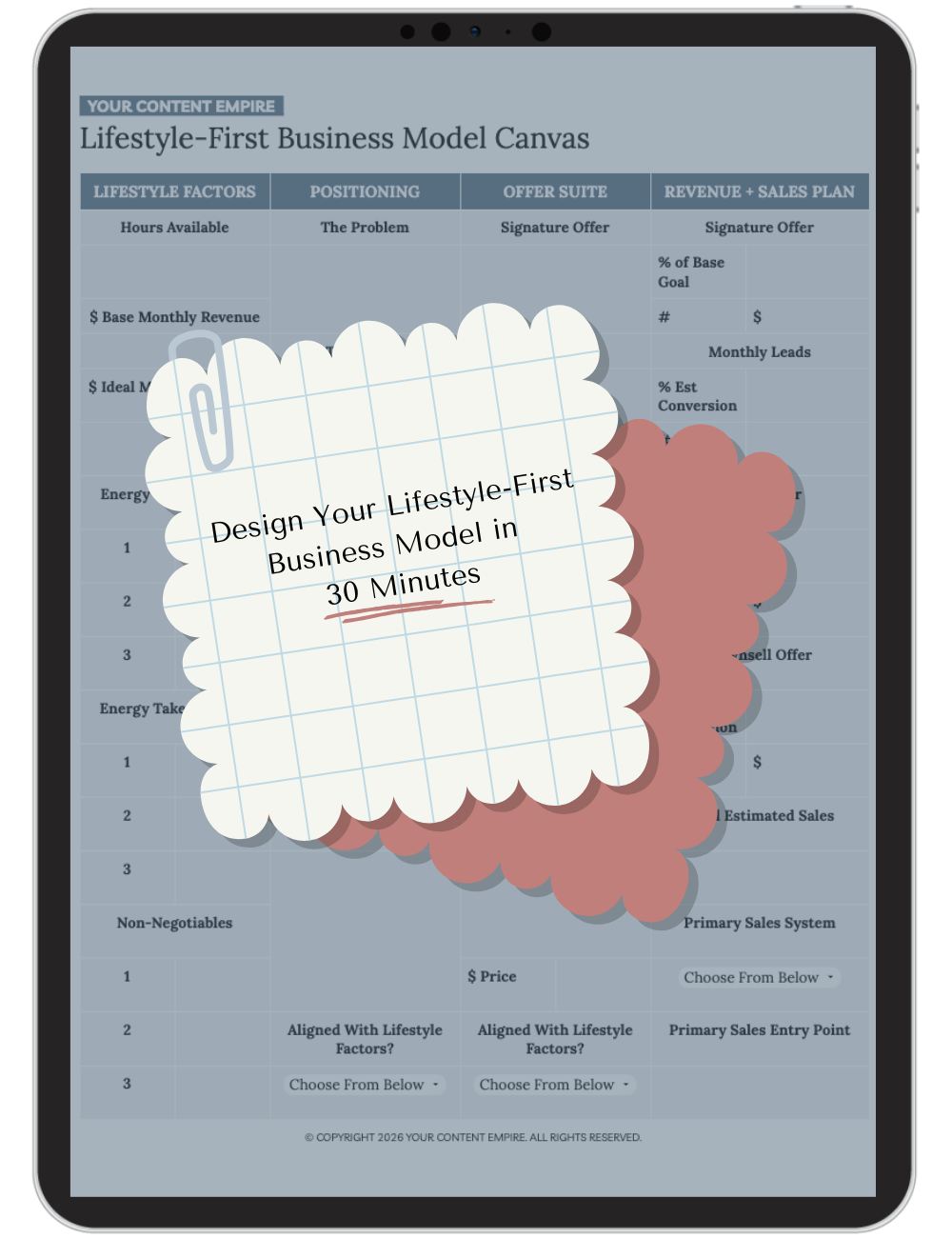
Click Here to Design Your Lifestyle-First Business Model with My Free Template
You're not exactly in crisis. Your business is technically working. Revenue is coming in. Clients are showing up. But something feels off and you can't quite put your finger on what it is.
Maybe it's a low-grade dread on Sunday nights. Maybe it's the fact that your calendar is full but nothing on it excites you. Maybe you keep saying “once I get through this launch” or “once things calm down” but things never calm down because the model itself is the problem.
This is what misalignment feels like. A slow, non-dramatic drift. And most business owners don't catch it until they're deep in burnout or resentment because the signs are subtle and easy to rationalize away.
Today I'm going to help you figure out whether your business model actually still fits your life. We're going to run a quick diagnostic, walk through the biggest reasons business models fall out of alignment and then I'll point you toward the exact tools to fix it.
Prefer to watch instead?
Want to listen on the go?
Business models are built for a specific version of your life, your market, your energy and your goals. And all of those things change over time.
Most business owners treat their business model like it's set in stone. They designed it once – if at all, maybe two or three years ago, and they've been trying to make it work ever since. Even when their life looks completely different. Even when the market has shifted. Even when they've changed as a person.
That's how you end up in this weird middle ground where nothing is technically broken but nothing feels right either. You're making money but you're exhausted. Your offers sell but delivering them drains you. Your calendar is full but you dread most of what's on it.
That's a misalignment problem.
If something has felt off in your business lately but you can’t quite put your finger on why, let’s start by figuring out what it is.
The Realignment Diagnostic
I'm going to give you 12 yes-or-no questions. Grab a pen or keep a mental tally. Answer based on what's true for you and your business right now:
Do you regularly work more hours than you planned to or want to?
Have you missed personal events, workouts or time with people you love because of work in the last 90 days?
Does creating content for your business feel like pulling teeth?
Do you dread delivering your current offers even though they sell?
If you ran the actual math on your offer suite right now, could you hit your revenue goal within the hours you actually have available?
Are you saying yes to clients or projects that don't light you up just to keep revenue coming in?
Has your life changed significantly since you designed your current business model? Think health, family, energy, priorities.
Do you feel guilty when you take time off or step away from your business?
Are you avoiding looking at your numbers because you already know something doesn't add up?
Do you keep starting and stopping your marketing because the system you've built doesn't fit your real capacity?
Have you lost interest in the specific topic or problem your business is built around?
Does your business require more of your daily presence than it did a year ago even though it should be getting easier?
Tally up your yeses.
If you got 1 to 3 yeses: You're probably in a season, not a crisis. Keep paying attention though. Seasons become patterns if you don't course-correct.
If you got 4 to 6 yeses: You've got misalignment brewing. Your model was likely designed for a different version of your life or a different version of you.
If you got 7 or more yeses: Your business model needs a serious redesign. Not just a tweak. The good news is that's exactly what the lifestyle-first approach is built for and I'm going to point you toward the tools at the end of this video.
Whatever your score, this diagnostic is giving you information. You can't fix what you haven't honestly assessed and awareness is more than half the fix.
The 4 Big Reasons Your Business Model Falls Out Of Alignment
If you scored higher than you expected, let's talk about why. Realignment is a sign that something changed. And in business, things are always changing.
There are four big categories of reasons your business model stops fitting.
Reason 1: The Market Has Evolved
This is the external one. The one that feels like it's happening to you.
I experienced this firsthand. I ran a funnel agency for years. Our clients got amazing results. We were overbooked. And then AI showed up and the market shifted underneath us. Part of it was me not wanting to run a team anymore, which we'll get to. But a huge part was the landscape evolving faster than the model could keep up.
This happens more than people admit. The platform you built your visibility on changes its algorithm. The offer format your audience used to buy stops converting. The industry you serve shifts its priorities. Your competitors start offering something that makes your positioning less clear.
Your skills are still valuable. The container you put them in needs to be redesigned.
Here are the signs this is your reason:
Your conversion rates are declining even though your audience and traffic are stable
You're hearing different objections from potential clients than you used to (or you’re hearing nothing)
The way people find you or buy from you has fundamentally shifted
You're working harder to get the same results you used to get with less effort
Reason 2: You've Evolved
This is the internal one. And it's the one people feel the most guilt about.
Your interests have changed. What you want to talk about has changed. The work that used to light you up now drains you. I always say this: if you hate creating content, you're in the wrong business. You should not want to shut up about your topic. So if content feels like pulling teeth, that's a misalignment problem.
There's something really interesting I've seen people talk about online. The idea that the more healed you become, the less ambitious you become. I experienced this. I still have big goals. But I need way more balance when it comes to work now. The intensity that used to feel like drive now feels like a pattern I've outgrown. That's when we want to upgrade the model to match the person you've become.
Here are the signs this is your reason:
You avoid creating content or find yourself with nothing to say about your current positioning
The clients you're attracting are no longer the clients you want to work with
You've done personal growth work and your tolerance for how you used to work has dropped significantly
You daydream about a completely different version of your business
Reason 3: Your Life Has Changed
This is the capacity one. And it's the one the lifestyle-first approach is most specifically designed to catch early.
You had a baby. You developed a chronic illness. You became a caregiver. Your partner's job changed. Your kids started a new school schedule. You moved. Your mental health shifted. Your energy patterns and time constraints are different than they were when you built this model.
Your business model was designed for a version of your life that no longer exists. And instead of redesigning the model, most people try to squeeze their new life into the old container. That never works. Something always breaks. Usually you.
Here are the signs this is your reason:
Your available hours have changed but your business model hasn't
You're consistently exhausted even though you're technically not working “that much”
Your non-negotiables keep getting negotiated away
You designed your current model during a season with completely different constraints
Reason 4: Your Business Has Outgrown Its Model
This is the growth one. And it's the most counterintuitive because everything looks like it's technically working.
You hit your revenue goal. Your offers sell. But the delivery model that got you here can't take you to the next level without burning you out. You've hit a ceiling because of capacity. You're maxed out on one-to-one clients. Your pricing doesn't leave room for the profit margin you need. Your systems are held together with duct tape and your memory.
This is the success trap. The model works on paper but it's consuming your life to maintain it. And scaling it as-is would only amplify the problem.
Here are the signs this is your reason:
You're fully booked but still not hitting your revenue goals
You can't take time off without revenue dropping
The idea of adding more clients makes you feel sick instead of excited
You know you need to change your pricing or delivery model but you keep putting it off
What The Research Says
I want to bring in some data here. Because this is a real, measurable problem. And it's more widespread than you’d think:
The scale of the issue:
Nearly 88% of entrepreneurs struggle with at least one mental health issue. Over half deal with anxiety. About a third experience burnout. That's from a 2026 Founder Reports survey of 227 entrepreneurs across 46 countries.
Over 1 in 5 small business owners work more than 50 hours a week. More than 80% have lost sleep worrying about their business. About a third have missed important family events because of work. That's from Adobe's 2025 Work-Life Balance Report with over 1,000 respondents.
We've normalized this. And we really shouldn't have.
Here’s the boundary data:
A 2025 study from Lehigh University and the Nasdaq Entrepreneurial Center surveyed 308 entrepreneurs globally and found that entrepreneurs who set work-life boundaries were almost 7 times more likely to report low burnout than those who didn't. 45% of boundary-setters reported low burnout compared to just 6% of people who struggled to maintain boundaries. Non-boundary-setters were nearly 3 times more likely to experience high burnout. 67% versus 23%.
Boundaries are the single biggest predictor of whether you burn out or not. And boundaries can be designed right into your business model.
The performance connection:
A study published in Frontiers in Psychology found that entrepreneurial wellbeing accounts for about a quarter of the variance in business performance. Your satisfaction as the founder was a stronger predictor of how well the business performed than almost anything else they measured.
A separate study in Review of Managerial Science found that entrepreneurs' satisfaction with work-life balance is positively associated with business growth. Happier founder equals growing business.
So redesigning your model around your life doesn't cost you revenue. The research shows it actually supports revenue.
This is all a massive argument for being intentional about how you grow. Scaling without intention strips out the autonomy and alignment that made entrepreneurship sustainable in the first place. A lifestyle-first business model is designed to protect exactly that.
A Few Things to Keep In Mind
#1 – Misalignment is information.
Recognizing that your business model no longer fits is a sign you're paying attention. The business owners who get stuck are the ones who refuse to acknowledge that something needs to change. The ones who scale sustainably catch the drift early and redesign before it costs them their health, their relationships or their love for the work.
#2 – You might be dealing with more than one reason.
Most people don't fall neatly into one category. Maybe the market shifted AND your life changed too. Maybe you've evolved AND your business has outgrown its model. That's normal. You don't need to pick just one. Identifying which reasons are at play helps you prioritize what to address first.
#3 – The diagnostic works best as a recurring check-in.
Come back to those 12 questions every quarter or at least once a year. Your answers will change as your life and business change. Catching misalignment early is always easier and less expensive than catching it late.
#4 – Start with the model.
It's tempting to try to fix the symptoms. Create a new content strategy. Launch a new offer. Rebrand. But if the underlying model doesn't fit your life, none of those surface-level changes will solve the real problem. Redesigning your business model is the highest-leverage move you can make. Everything else flows from there.
What's The Next Step? Start Here ↓
If you're thinking “something definitely needs to change but I don't know where to start with the actual redesign,” that's exactly what Your Signature Scaling System is for.
It's a 3 or 12-month coach-sulting partnership where we take everything I've talked about in this video and build it out for your specific business, your specific life and your specific revenue goals.
We identify the misalignment and then we redesign the model. We look at your capacity, your offers, your pricing and your systems. We rebuild the parts that aren't working so you have a business that actually fits the life you're living now.
If you're ready for a model that actually fits, book a free strategy call. You can book at yourcontentempire.com/coaching or check the show notes for the link.
HEY THERE!
I’m Hailey and I help business owners who are tired of the hustle-harder advice build content systems that actually sell. No performative posting. No chasing algorithms. Just strategic, sustainable growth. More about me + my approach →
Stop guessing. Start scaling. This one-page template helps you design a business model that supports both your revenue goals and your actual life.
Browse By Topic
Scaling
Sales
Content
All Posts
Search The Blog
FREE TEMPLATE
The Lifestyle-First Business Model
Design a business model that supports both your revenue goals and your real life. This one-page template walks you through your lifestyle factors, positioning, offer map, revenue plan, and sales strategies so you can finally stop guessing and start scaling with clarity.
In This Post: How do you get more sales from your sales funnel? The best way to get more sales from your sales funnel is to follow up with the people who didn't buy the first time, since only about 5% of your audience is ready to buy at any given moment. Set up a...
In This Post: How do you reset your business model? You reset your business model by rebuilding it in the right order: lifestyle first, then positioning, offers, revenue planning and marketing. Follow that sequence and you can reset your business model in about 90...
In This Post: What is a monthly business retreat? A monthly business retreat is a full week you block off each month with no meetings, calls or client work so you can focus entirely on the projects that grow your business. Rotating through a few types of monthly...