“As an entrepreneur, I've learned to surround myself with people who have skills that I lack. FB ads and email funnels were something I knew I wanted to be doing in my business but I had no idea where to start. I put it off for a while because it was outside my comfort zone, and it wasn’t until I found Hailey that I felt confident moving forward with them. Hailey took the reigns and created a system for me that was not only profitable, but really helped me create more space in my day to work on the things that are in my zone of genius!”
Lauren Bongiorno Diabetic Health Coach
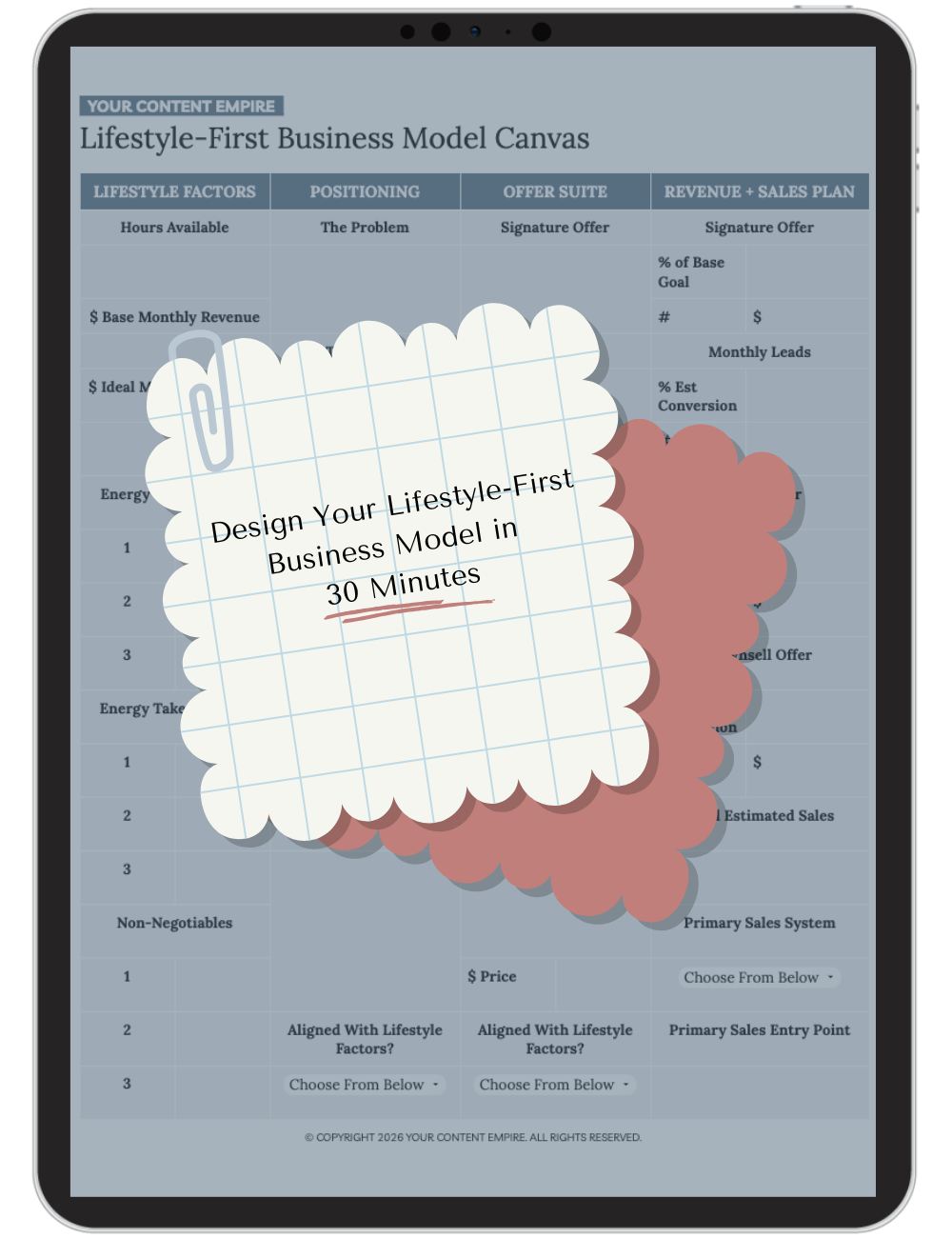
Click Here to Design Your Lifestyle-First Business Model with My Free Template
Can You Have Big Business Goals and a Lifestyle You Love?
“If your business gets bigger but your life gets worse, that's not success.” Daniel Priestley said that and I think about it constantly.
A lot of really incredibly capable people hit their revenue goals all the time …. and are completely miserable. They're working 60-hour weeks, delivering offers that drain every ounce of energy they have, building businesses that technically work on paper but lead you further and further away from the life you actually want.
The reason this keeps happening is a design problem. The myth that big goals require big sacrifice is so deeply embedded in business culture that most people never stop to question it. They pick a side: the goals or the lifestyle but then feel guilty about whichever one they're not prioritizing.
Today we're digging into the lifestyle-first philosophy and I'm sharing two diagnostic frameworks that will help you spot exactly where your business model might be broken. I've covered the full step-by-step lifestyle-first process in other episodes and I'll link those below. Today is about the big picture and the two tools I keep coming back to again and again to really answer the question: Is it possible to have big business goals without blowing up your life to achieve them?
Prefer to watch instead?
Want to listen on the go?
The story goes like this: big goals require big sacrifice. If you want seven figures, a full client roster and real visibility, something has to give. Usually it's your life.
The flip side of that same myth: if you want to work fewer hours, take real time off and actually enjoy your days, you're being unrealistic about growth. You're playing small. You're not serious enough.
This false choice sits at the center of most business culture. You can have the goals or the lifestyle. Most people never question it. They just start optimizing for one side or the other.
And it makes sense that we absorbed this as the template. The most visible success stories (the ones held up as proof) almost always include a sacrifice narrative. The grind years. The 80-hour weeks. The “I gave everything to build this.” The entire language of ambition frames rest and boundaries as liabilities.
The sneakiest part of this myth is that it maps onto real experience. Most people have had a season where growth felt like it cost them something: time, rest, relationships and health. So the myth feels true. The problem isn't the experience. It's the conclusion we drew from it: that the sacrifice was the reason for the growth, instead of a flaw in the model.
Deconstructing The Myth
The myth assumes sacrifice is the mechanism for growth. Correlation isn't causation. People who built big businesses while grinding didn't grow because of the sacrifice. They grew in spite of a model that was costing them more than it needed to. Strip out the inefficiency and you don't need the suffering.
The Daniel Priestley quote is worth coming back to here: “If your business gets bigger but your life gets worse, that's not success.” That's a design problem. A business that scales by consuming your life isn't a successful business. It's a badly built one.
The data backs this up too. A 2025 survey of solopreneurs and small business owners published in Inc. Magazine found that nearly a quarter work more than 50 hours a week, over 80% lose sleep worrying about their business and about a third have missed important family events because of work. I'll link the full article in the show notes. We've normalized this. And we really shouldn't have.
Some of the most constraint-driven entrepreneurs have been proving this for decades. Women with caregiving responsibilities, limited hours and zero margin for waste have built genuinely significant businesses. Constraints forced better design. Fewer hours meant only the highest-leverage moves made the cut. That's the strategy, not a workaround.
The myth only holds if you accept the default model. The traditional way of hitting big goals requires sacrifice because the traditional model is built on volume and availability. Change the model and the math changes completely. Big goals require a smarter container, not more of you.
A Better Alternative?
The problem isn't the goals. It's usually the order of operations.
Most people start with the revenue target, build a business model around hitting it and then try to squeeze their life into whatever's left. It's a design flaw. Your lifestyle becomes the afterthought instead of the foundation.
The alternative is to flip the sequence. You start with your lifestyle constraints, your real non-negotiables. Then your vision. Then you design the business model around both. Your lifestyle is the container and your business model is what gets built inside that container.
This is the foundation of the lifestyle-first business model design process. I've done a full series on this and I'll link it below because it's worth going deep on. But the core principle is simple: your life informs the model. The model doesn't consume your life.
And while this isn't a magic formula, there are always trade-offs in business. There's a real difference between unconscious sacrifice, where your life erodes without you choosing it, and conscious constraints you've built around intentionally. One depletes you. The other makes your business more focused, more sustainable and more profitable.
Knowing your constraints is a design input. The clearer you are on what you won't compromise, the sharper your business model gets.
Today I want to show you what this looks like across three specific areas: your boundaries and constraints, your offers and pricing and your content systems. These are the three places where the lifestyle-first philosophy either shows up in your business or gets completely overridden by it.
Area 1: Boundaries And Constraints
The first area where the lifestyle-first philosophy either holds or falls apart is your boundaries and constraints.
Most people treat boundaries like a personal preference. Something nice to have if you can afford it. In a lifestyle-first business model they're a design input. They're how the business gets built.
Parkinson's Law is the psychological principle at play here. Work expands to fill the time available for it. So if you have unlimited hours you will fill them, not necessarily with your highest-value work but with whatever feels urgent. Constraints force prioritization in a way that total freedom never will.
And this is where the Life Constraints Viability Triangle comes in. The three points are your energy, your time available and your priorities. All three have to be in conversation with each other when you're designing your business model.
Time available is the most obvious one. How many hours do you actually have for your business each week? And I mean actually have, not aspirationally have once things calm down. This number is your ceiling. Your business model has to be deliverable within it.
Energy is the one people underestimate the most. You might have 30 hours available on paper but if 20 of those hours fall at the end of the day when your brain is completely fried, you don't really have 30 productive hours. You have to factor in when your energy peaks, what activities drain it fastest and how much recovery time you need. A business model that ignores your energy landscape will exhaust you even when you're technically working reasonable hours.
Priorities are your non-negotiables. The things your business model must honor regardless of revenue goals or growth phases. School pickups, health appointments, workout windows, protected family time. These aren't limitations to apologize for. They're design requirements.
The triangle works because it shows you where the imbalance is. If you have big revenue requirements but very limited time available, your offers and pricing have to do more of the heavy lifting. If your energy is heavily constrained by health or caregiving, your delivery model needs to reflect that. If your priorities are non-negotiable, your capacity ceiling is lower than you might think and your business model needs to be sharp enough to work inside it.
Running your model through all three points before you design anything else will save you enormous amounts of time, energy and frustration down the road.
What's worth knowing is that even artificial constraints work. I technically can work whenever I want. But theme days and time blocking give me a structure that has helped me get a lot more done in as little time as possible. The leftover time gets spent with family, taking care of myself and pursuing way too many hobbies. Constraints you choose are just as powerful as the ones life hands you.
A four-hour focused work block produces more output than an open-ended day. A client cap forces you to charge more and deliver better. Saying no is a revenue strategy. Every yes to the wrong client, the wrong offer or the wrong project is a no to something that actually fits. When you know your real capacity and design around it, you start making decisions that protect both your profit margin and your energy at the same time.
One of my clients is a coach and mom of two young kids with a hard stop at 2pm every day. Instead of treating that as a limitation we designed her entire business model and offer suite around it. Premium pricing, a capped number of clients per month and a group program that leveraged her time. Within a year she'd hit her highest revenue month ever. The constraint didn't shrink the business. It forced the decisions that grew it.
Area 2: Offers and Pricing
The second area where lifestyle-first design either shows up or gets completely overridden is your offers and pricing. And this is one of the most practical places to look because the misalignment here is usually hiding in plain sight.
Most people design their offers first and figure out the pricing later. Or they look at what others in their space are charging and anchor their prices there. Both approaches skip the most important question: can this offer structure actually generate your revenue goal within the hours you have available?
This is where the Viability Triangle comes in. The three points are your revenue goal, your offer structure and your pricing. All three have to support each other. Pull any one of them out of alignment and the whole model breaks. And no amount of marketing can fix a math problem.
Here's what that looks like in practice. A client came to me with a clear revenue goal and a suite of lower-priced offers. When we ran the actual math: how many sales at what price point and how many hours to deliver. She could not hit her goal. Not unlikely. Physically impossible. The hours didn't exist.
The instinct in that moment is to double down on marketing. Sell more, show up more, post more. But the problem was the model and it was broken in her case.
So we worked the triangle. We looked at what shifting her offer structure would do. We looked at what adjusting her pricing would make possible. We found the combination where the revenue goal was achievable within her real capacity. Then the marketing had something worth doing.
The question to ask yourself is simple. If you run the actual math on your current model right now, does it work? If you hit your conversion goals, sold what you're planning to sell at the prices you're charging and delivered everything you've promised, would you reach your revenue goal within the hours you actually have available?
If the answer is no, that's a triangle problem. Specifically it's one of three things:
Your revenue goal is higher than your current model can support.
Your offer structure requires more hours to deliver than you have.
Or your pricing is too low to make the math work within your capacity. Usually it's a combination of all three.
The fix is to work the triangle until all three points align. That might mean shifting from one-to-one to group delivery so you can serve more people in the same hours. Or it might mean fewer clients at a higher price point. Either way you're designing for the revenue goal and for the life at the same time.
The goal isn't to water down your ambition. It's to build an offer structure that can actually carry it.
Area 3: Content Systems and Leverage
The third area is your content systems and how you generate traffic, leads and sales. And there's a persistent myth here worth addressing straight away: if you build content systems and leverage, the work becomes passive. It doesn't. It just changes where the work lives. Instead of one-to-one delivery, the work moves into visibility, traffic and lead generation. You're still working. You're just working differently.
So the question becomes: does your content and marketing system actually fit your life? Because if it doesn't, you won't stick with it long enough to see results.
This is where the Marketing Viability Triangle comes in. The three points are your content, your capacity and your preferences. All three have to be in alignment for your marketing system to work. Most people build their content strategy around what they think they're supposed to be doing and then wonder why they keep burning out and starting over.
Capacity is how much time and energy you actually have for content creation and marketing each week. This ties directly back to your Life Constraints Viability Triangle from Area 1. Your content system has to fit inside the hours you have available, at the times of day when your energy supports that kind of work.
Content is what you're actually creating and where you're showing up. Your platform, your format and your publishing frequency all have to be deliverable within your real capacity. A daily content strategy sounds great until it collides with a 15-hour work week.
Preference is the point people overlook the most. And it matters as much as the other two because you have to show up before results show up. You're building momentum before you can see it. A system you dread will never outlast your motivation.
A client came to me exhausted from the Instagram hamster wheel. Daily stories, reels, constant restarts on Monday because she burned out every 48 hours. She was building zero momentum because the system was completely incompatible with how she actually functions. We rebuilt her strategy around paid ads instead, where the heavy lifting happens once and then runs. That was the trade-off she was willing to make with her time and budget. She got consistency without the daily performance tax.
Your content strategy has to work on all three levels. It fits your capacity, it plays to your preferences and it's sustainable enough that you'll stick with it even when the results are still building. Pull any one of those points out of alignment and you end up back at square one every few months wondering why nothing ever works for you.
Your business is part of your life. A content strategy that requires you to spend hours doing something that drains you isn't protecting your lifestyle. It's undermining it.
The Full Audit Results
Okay. Now go back through each pillar and add up your true scores.
You should have a number out of five for each one. Your highest score is your biggest gap. And your biggest gap is where to focus first.
This isn't about having all five pillars perfectly in place overnight. It's about being honest with yourself about where you're running unsupported right now and making one intentional move in that direction.
What's The Next Step? Start Here ↓
If this post has you looking at your business model differently, there are two ways to take this further depending on where you are right now.
The first is the free Lifestyle-First Business Model Template. It walks you through the exact process of designing a business model around your real life including your capacity constraints, your revenue requirements and your non-negotiables. It's the foundation document I use with every client before we do anything else. I'll drop the link in the description so you can grab it there.
The second option is to do this work together. Your Signature Scaling System is a 3 or 12 month coach-sulting partnership where we take everything we covered today and build it out for your specific business, your specific life and your specific revenue goals. We run the triangle math together. We redesign your offer structure. We build a content and marketing system that actually fits your capacity and your preferences. And with ongoing guidance and real accountability between sessions, the work actually gets done and the results actually follow.
If that sounds like what you need right now, book a free strategy call at yourcontentempire.com/coaching or find the link in the show notes. We'll look at where you are, where you want to go and figure out what working together could look like.
HEY THERE!
I’m Hailey and I help business owners who are tired of the hustle-harder advice build content systems that actually sell. No performative posting. No chasing algorithms. Just strategic, sustainable growth. More about me + my approach →
Stop guessing. Start scaling. This one-page template helps you design a business model that supports both your revenue goals and your actual life.
Browse By Topic
Scaling
Sales
Content
All Posts
Search The Blog
FREE TEMPLATE
The Lifestyle-First Business Model
Design a business model that supports both your revenue goals and your real life. This one-page template walks you through your lifestyle factors, positioning, offer map, revenue plan, and sales strategies so you can finally stop guessing and start scaling with clarity.
In This Post: How do you get more sales from your sales funnel? The best way to get more sales from your sales funnel is to follow up with the people who didn't buy the first time, since only about 5% of your audience is ready to buy at any given moment. Set up a...
In This Post: How do you reset your business model? You reset your business model by rebuilding it in the right order: lifestyle first, then positioning, offers, revenue planning and marketing. Follow that sequence and you can reset your business model in about 90...
In This Post: What is a monthly business retreat? A monthly business retreat is a full week you block off each month with no meetings, calls or client work so you can focus entirely on the projects that grow your business. Rotating through a few types of monthly...