“As an entrepreneur, I've learned to surround myself with people who have skills that I lack. FB ads and email funnels were something I knew I wanted to be doing in my business but I had no idea where to start. I put it off for a while because it was outside my comfort zone, and it wasn’t until I found Hailey that I felt confident moving forward with them. Hailey took the reigns and created a system for me that was not only profitable, but really helped me create more space in my day to work on the things that are in my zone of genius!”
Lauren Bongiorno Diabetic Health Coach
Click Here to Design Your Lifestyle-First Business Model with My Free Template
Behind-The-Scenes of My Real 25 Hour Weekly Business Calendar
Time is NOT the reason you're not scaling.
You're working hard. You're showing up consistently. You're doing all the things you're “supposed” to do. But you're still stuck at the same revenue level, still feeling like there aren't enough hours in the day, still convinced that if you just had MORE time, THEN you could build the business you want.
For most people though: Time isn't actually the problem. How you're using your time is.
Most business owners are trying to fit their life around their business model. What if you flipped that? What if you designed your business model to fit inside your life? What if you could scale within the time you actually have?
That's exactly what we're talking about today. Because you likely have more time than you think. You just need to use it differently.
Prefer to watch instead?
Want to listen on the go?
Welcome back. If you've been following along with the Lifestyle-First Business Model series, you've already worked through your capacity constraints, your positioning, your offer suite and your revenue plan.
You know what you're building. You know who you're serving. You know what you're selling and how many sales you need to get there.
So now the question becomes: How do you actually execute all of that within the time you have available?
This is where you might potentially get stuck. You might be looking at your business model and think “This looks great on paper, but how am I supposed to get all of this done in 25 hours a week?“
Today I'm going to show you exactly what my 25-hour work week looks like, the specific strategies I use to make this work, and how you can design your own ideal weekly calendar around YOUR business model and YOUR life.
Time Is The #1 Thing Holding You Back (But Not In The Way You Think)
Let me start by reframing something that might be a bit of a hot take: Time isn't holding you back in the way you think it is.
When business owners tell me “I don't have enough time,” what they usually mean is “I don't have a business model that works within my available time.” And that's a completely different problem.
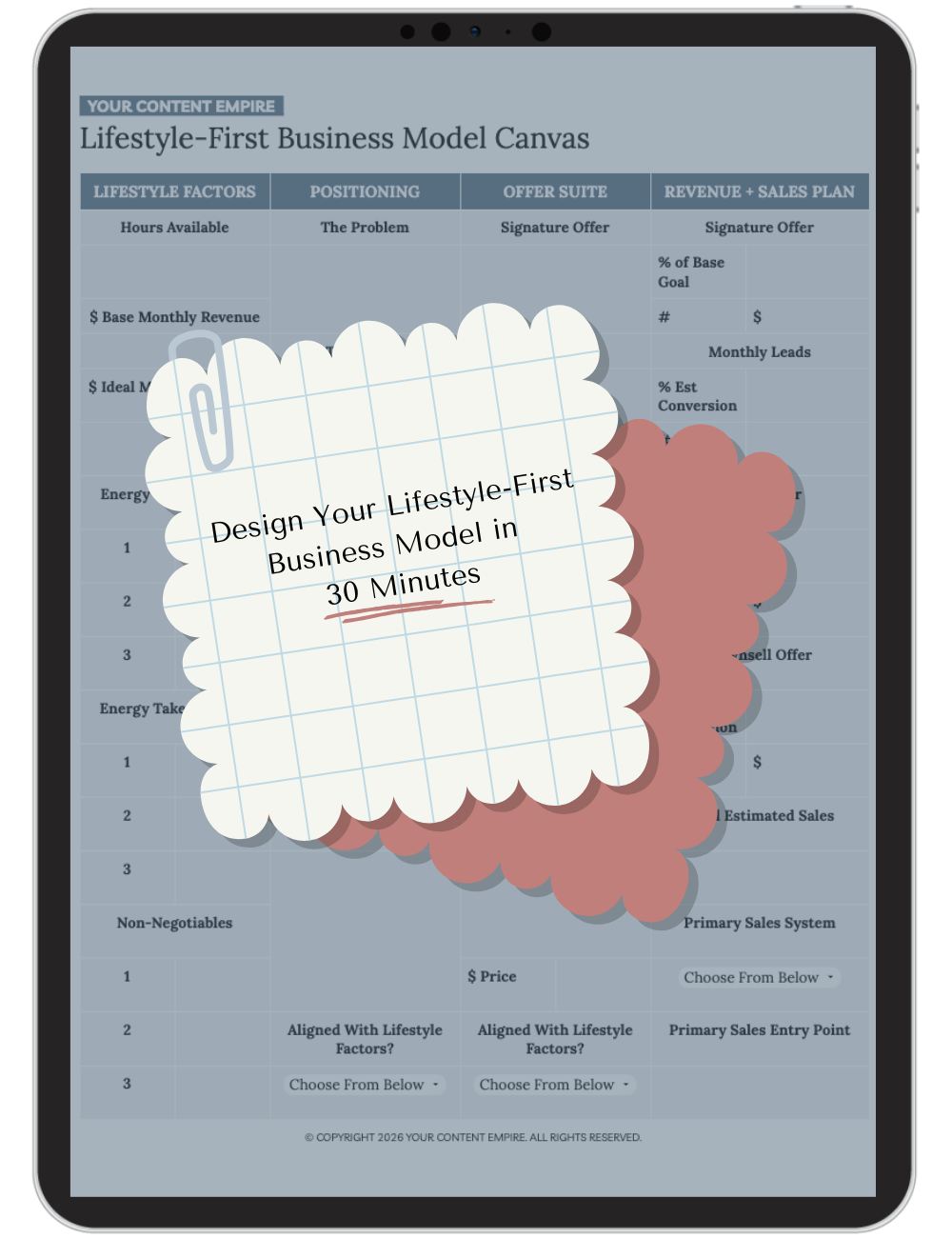
This is why the Lifestyle-First Business Model Canvas matters so much.
Before you can optimize your time, you need to know:
How many hours you ACTUALLY have available each week (not how many you wish you had)
What you're building toward (your positioning)
What you're selling and how you're delivering it (your offer suite)
How many sales you need to hit your revenue goals (your revenue plan)
THEN and only then can you design your ideal weekly calendar around your business model.
So if you haven't done that yet, pause this episode and go download it. Because you need that foundation first.
My Relationship With Time + What My 25 Hours Looks Like
My relationship with time has evolved A LOT over the past 11 years.
I started this business as a side hustle. I had a full-time corporate job and could only dedicate about 15 hours a week to building Your Content Empire.
And honestly? Those were some of my most productive years. Because I couldn't afford to waste a single hour. Constraints forced focus.
Then when I went full-time, suddenly I had 40+ hours a week available. And you know what happened? I filled all of it (and more). Not because I needed to, but because it was there. Was I more productive? Nope. Just busier.
I was working all the time but not necessarily working better. I had so much time available that I didn't have to be strategic about how I used it. I could afford to be scattered. I could afford to be inefficient.
And then a few years ago I had this realization: If I could get the same amount of work or MORE done in 25 hours, wouldn't that be better?
So now I don't just have work goals anymore. I have life goals too. I'm at a point (and it took me awhile) where I want my business to support my life, not consume it.
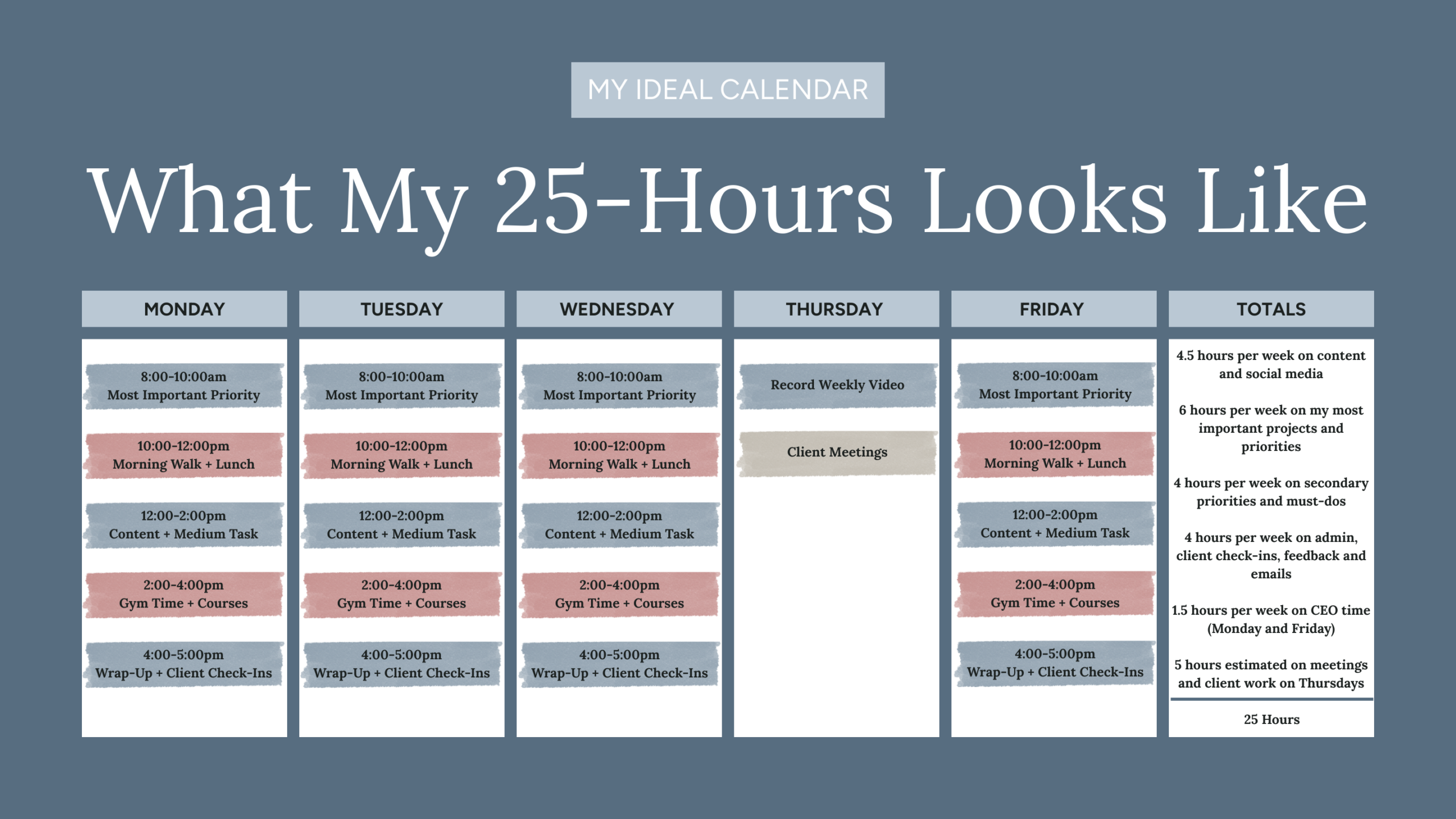
So what does my 25-hour work week actually look like? Let me break it down for you:
8:00-10:00am: I work on my Most Important Priority for the day. This is my Eat the Frog time. The thing that will move my business forward the most. I use my daily content writing, posting and engagement as Pomodoro breaks during this block. So I'm getting focused deep work done, but I'm also staying consistent with my visibility.
10:00am-12:00pm: Morning walk at the ocean and lunch. This is non-negotiable. I have sciatica and cannot sit for long periods without breaks. My body needs this as much as my brain needs this.
12:00-2:00pm: Content-focused Pomodoro session and my Medium Priority for the day. This might be working on a secondary project, handling client feedback or tackling something that's important but not urgent.
2:00-4:00pm: Gym time. I'm also going through courses or listening to podcasts while I'm on the treadmill after my workout. So this time serves double duty. And honestly I SUCKED at going through the courses I purchased until I implemented this.
4:00-5:00pm: Wrap-up time. Client check-ins, feedback, responding to anything that came up during the day. This is also when I do my end-of-day journaling on my active projects, which we'll talk about in a minute.
Thursdays are different because they have no set routine. That's my meeting day, my client work day and the day I record my weekly video in the morning. I only do hair and makeup once a week and I don't look like a total scrub in my client meetings. Everything that requires me to be “on” gets batched into Thursday.
When I add it all up, here's what my 25 hours breaks down to:
4.5 hours per week on content and social media
6 hours per week on my most important projects and priorities
4 hours per week on secondary priorities and must-dos
4 hours per week on admin, client check-ins, feedback and emails
1.5 hours per week on CEO time (Monday and Friday)
5 hours estimated on meetings and client work on Thursdays
That's it. That's the schedule behind my multi-six-figure business.
How I Make This Work: The Strategies
Okay, so you've seen what my week looks like. Now let me show you HOW I make this actually work. Because it's not just about having a pretty, color-coded calendar. It's about having systems and strategies that allow you to get more done in less time:
Strategy #1: The Capacity Paradox
Working less can actually produce MORE results. I know it sounds counterintuitive, but hear me out.
When I was working 40+ hours a week, I had all the time in the world. So I filled it. I took longer on projects than I needed to. I let tasks expand to fill the available time. I didn't have to be ruthlessly focused because I could always just work more hours.
I can honestly say that now with my limited calendar, I get MORE done. Not less.
This is the Capacity Paradox in action. Constraints create focus.
When you have limited time, you can't afford to:
Work on low-priority tasks just because they're easy
Spend hours perfecting something that's already good enough
Say yes to opportunities that don't align with your goals
Do things manually that should be systematized
So if you're feeling guilty about not having 40 hours a week to dedicate to your business, stop. Your constraint might actually be your secret weapon.
Strategy #2: Pre-Work Journaling Protocol
This strategy alone has probably doubled my productivity.
Here's the problem almost every single one of my clients face: You sit down to work on a project and you spend the first 30-45 minutes just trying to figure out what to do. Where to start. What direction to go. What decisions need to be made.
That's not a bad thing. That thinking time is definitely necessary. But when you're doing it during your focused work blocks, you're wasting your most productive hours on executive functioning instead of execution.
So here's what I do instead: I separate the thinking from the doing.
At the end of each workday or when I'm watching TV after dinner, I spend 15-25 minutes journaling on my upcoming projects.
I'm not following a rigid format. I'm just starting to outline the project or brain dump the main messaging points. Each time I do a pass on it, it gets more and more detailed. The process is pretty organic, but it always delivers exactly what I need.
If you want some questions to get started with, try these:
What's the main goal of this project?
What decisions need to be made before I can move forward?
What's the core message or structure?
What are the next specific actions I need to take?
By the time I sit down the next morning to actually WORK on something, I'm not staring at a blank screen wondering where to start. All the executive functioning is already done. I just execute.
If you implement just ONE thing from this episode, make it this. Start doing end-of-day journaling on your projects. It's probably the thing that's made the biggest difference to my productivity.
Strategy #3: The 3-Second System
Here's a principle I live and die by: If you do something more than twice, document it.
And I'm not talking about complicated automations or expensive software. I'm talking about simple systems that eliminate decision fatigue and wasted motion.
Let me give you a practical example.
I spend about 25 minutes per day on my content and social media. Total. That includes writing, posting, engaging, everything.
How is that possible? Because I've turned it into a system.
I have a bookmark folder that opens all my tools instantly. It takes me 3 seconds to have everything I need open and ready to go. I'm not hunting for links or trying to remember where things are.
Then I also have a step-by-step process that I follow every single time. No decision fatigue. No “what should I do next?” I just follow the checklist.
The formula is simple: System + Timer + Repetition = Speed
And this applies to everything in your business.
I also strategically outsource the things I don't want to do. Most of my video editing gets outsourced. Content scheduling gets outsourced. Initial inbox management and customer service gets outsourced. Data entry like adding things to ThriveCart gets outsourced.
But notice I'm selective about what I outsource. I'm not trying to remove myself from my business entirely. I'm removing the tasks that drain my energy so I can spend more time on the things that light me up.
Here are some other ways I systematize:
Time blocking to prevent context switching. I batch similar work together. All my content creation happens in content blocks. All my client work happens on Thursdays. All my CEO time happens on Mondays and Fridays. This prevents the productivity killer that is context switching. So when I get a brilliant idea or remember something I need to do, instead of dropping everything and doing it right then and there, I add it to my list for the next time block where it fits.
Pomodoro sprints and timers to leverage Parkinson's Law. I work in focused 25-50 minute sprints with my favorite app, BeFocusedPro. The timer creates urgency. Work gets done faster because it has to. Parkinson's Law is real: Work expands to fill the time available. When I give myself 25 minutes, I get it done in 25 minutes. When I give myself an hour, it takes an hour. I don’t really know how, it just kind of feels like magic.
Outcomes without time-blocking them. I have weekly outcomes, but I don't assign them to specific time blocks. Instead, I have perpetual to-do lists by category. During my “Client Work” block, I just work on the next thing from my Client Work list. During my “Content” block, I work on the next thing from my Content list.
This means I never feel “behind.” I'm always making progress. As long as I'm working during the designated block, I'm doing the exact right thing.
Small systems compound. And over time, they create massive time savings.
Supporting Strategies
Here are a couple other principles that make all of this work:
Think in weeks and months, not days.
When you're only looking at what you can get done today, it's easy to feel like you don't have enough time. But when you zoom out and look at what you can accomplish in a week or a month, you realize you actually have MORE time than you think.
A “bad” day doesn't derail you when you're thinking in weekly progress. You just make up for it over the rest of the week.
Ruthless prioritization is non-negotiable.
Not everything is urgent. Not everything is important. When you have limited time, you have to get really clear on what actually moves the needle and let go of everything else.
I use the Eat the Frog principle. My most important priority gets the 8-10am slot. If something derails my afternoon, at least I made visible progress on what matters most.
Creating Your Own Ideal Weekly Calendar
So now that you've seen what my week looks like and the strategies I use, let's talk about how you create YOUR ideal weekly calendar.
First a reminder: This is an IDEAL. Not every week will look like this. Life happens. That's okay. The ideal weekly calendar isn't a rigid cage. It's a compass. It shows you what you're aiming for and helps you course-correct when you drift off track.
Here are the things to keep in mind as you design yours:
Start with your Lifestyle-First Business Model Canvas.
You need to come in knowing:
How many hours you actually have available each week
What your energy givers and energy takers are
What your non-negotiables are
What your business model requires (delivery hours, content requirements, client touchpoints)
And all of that is in the template, I’ll put a link down below so you can grab it.
Batch similar work together to prevent context switching.
Context switching is one of the biggest productivity killers. Every time you switch from one type of task to another, your brain needs time to adjust. That's wasted time and wasted energy.
Psychology Today cited research and related summaries estimate multitasking and frequent task switching can drain up to 40% of productivity.
So batch your content creation. Batch your client calls. Batch your admin. Batch your meetings. Keep similar work together as much as possible.
Protect your deep work time.
You need uninterrupted blocks for your most important work. No meetings. No notifications. No distractions.
For me, that's 8-10am. For you, it might be different. But identify when you do your best thinking and protect that time fiercely.
Review and adjust regularly.
Your ideal weekly calendar isn't set in stone. As your business evolves, as your life changes, as you learn what works and what doesn't, you adjust.
I recommend reviewing your calendar every quarter.
And the most important thing is to remember that your calendar should make your life EASIER, not harder.
If your ideal weekly calendar stresses you out just looking at it, it's not ideal. Simplify. Remove things. Give yourself more space.
The goal isn't to cram as much as possible into your available hours. The goal is to create a sustainable structure that allows you to make consistent progress without burning out.
Creating Your Own Ideal Weekly Calendar
Now, if you're listening to this and thinking “Okay, this all makes sense, but I need help actually building this for MY specific situation,” that's exactly what we do inside Your Signature Scaling System.
And one of the first things we do together? We build your ideal weekly calendar based on YOUR lifestyle factors, YOUR business model, YOUR energy and YOUR goals.
Because it's one thing to understand these concepts. It's another thing entirely to apply them to your unique situation and actually make them work.
If you're tired of trying to figure this out alone, let's talk. Book a free strategy call and we'll look at where you are, where you want to go and map out what working together would look like.
Or grab my Lifestyle-First Business Model Template here ↓
HEY THERE!
I’m Hailey and I help business owners who are tired of the hustle-harder advice build content systems that actually sell. No performative posting. No chasing algorithms. Just strategic, sustainable growth. More about me + my approach →
Stop guessing. Start scaling. This one-page template helps you design a business model that supports both your revenue goals and your actual life.
Browse By Topic
Scaling
Sales
Content
All Posts
Search The Blog
FREE TEMPLATE
The Lifestyle-First Business Model
Design a business model that supports both your revenue goals and your real life. This one-page template walks you through your lifestyle factors, positioning, offer map, revenue plan, and sales strategies so you can finally stop guessing and start scaling with clarity.
In This Post: How do you get more sales from your sales funnel? The best way to get more sales from your sales funnel is to follow up with the people who didn't buy the first time, since only about 5% of your audience is ready to buy at any given moment. Set up a...
In This Post: How do you reset your business model? You reset your business model by rebuilding it in the right order: lifestyle first, then positioning, offers, revenue planning and marketing. Follow that sequence and you can reset your business model in about 90...
In This Post: What is a monthly business retreat? A monthly business retreat is a full week you block off each month with no meetings, calls or client work so you can focus entirely on the projects that grow your business. Rotating through a few types of monthly...