“As an entrepreneur, I've learned to surround myself with people who have skills that I lack. FB ads and email funnels were something I knew I wanted to be doing in my business but I had no idea where to start. I put it off for a while because it was outside my comfort zone, and it wasn’t until I found Hailey that I felt confident moving forward with them. Hailey took the reigns and created a system for me that was not only profitable, but really helped me create more space in my day to work on the things that are in my zone of genius!”
Lauren Bongiorno Diabetic Health Coach
Click Here to Design Your Lifestyle-First Business Model with My Free Template
What to Do When Your Business Model No Longer Fits Your Life
As I've been talking about this whole lifestyle-first business model design process, I got a DM and it was a major “duh” moment because of course this is an obstacle.
The message said: “This all sounds great. But I still need to pay my bills, so it feels like I can't afford to make major changes to my business.”
So I knew this was something I had to cover.
Because you don't have to choose between staying miserable in Business A or blowing everything up to get to Business B.
There's a third option. Building a strategic bridge between where you are and where you want to be.
Today I'm walking you through the exact 5 priorities, plus a bonus, for transitioning your business model without your revenue collapsing underneath you. Let's talk about it.
Prefer to watch instead?
Want to listen on the go?
Most business owners hit a point (at some point) when their business model stops fitting their life.
Maybe you started with one-on-one services and now you want to shift to group programs or courses. Maybe you've been serving one audience but you're feeling called to serve a different one. Maybe your delivery model made sense three years ago but now it's taking up too much time.
Whatever the reason, you've realized you're running Business A but what you actually want is Business B.
And the gap between those two things is not dramatic announcements. It's not blowing everything up and starting over. It's strategic decisions made over time that compound into major transformation.
That's what today's episode is all about. How do you make the shift from your current business model to your ideal business model when you still have bills to pay and revenue goals to hit?
Priority 1: Clarify the Ideal Versus Current Business Model – What's the Gap?
The first priority is getting crystal clear on where you are versus where you want to be. Because you can't bridge a gap you haven't identified.
The wild thing is how many people skip this step. They know they're unhappy but they haven't actually mapped out what's misaligned or what would need to change. So they end up feeling stuck without a clear path forward.
This is the Business Model Gap Framework. On the left, your Current Reality. On the right, your Ideal Model. And in the middle, a bridge showing the strategic path between them.
Let's start with your Current Reality.
What are you selling right now? List out all your offers.
Who are you serving? Who's your current audience or client base?
How are you delivering? Is it one-on-one, group programs, courses, done-for-you services?
What's your revenue breakdown? Which offers are bringing in the most money?
How many hours does your current model require?
Write all of that down. That's Business A. That's what exists right now.
Now let's map your Ideal Model.
What do you want to be selling? If you could design your offer suite from scratch, what would it look like?
Who do you want to serve? Is it the same audience or a different one?
How do you want to deliver? What delivery model would actually fit your lifestyle factors and energy?
What revenue do you want to generate? Both your base and your ideal monthly revenue.
How many hours do you want to work? What's your realistic and ideal capacity?
Write that down too. That's Business B. That's where you want to go.
Now here's where it gets useful. Look at both sides and identify the gaps.
Where's the biggest misalignment? Is it your positioning? Your offers? Your delivery model? Your audience? Your capacity?
What would need to change in each category to get from Business A to Business B?
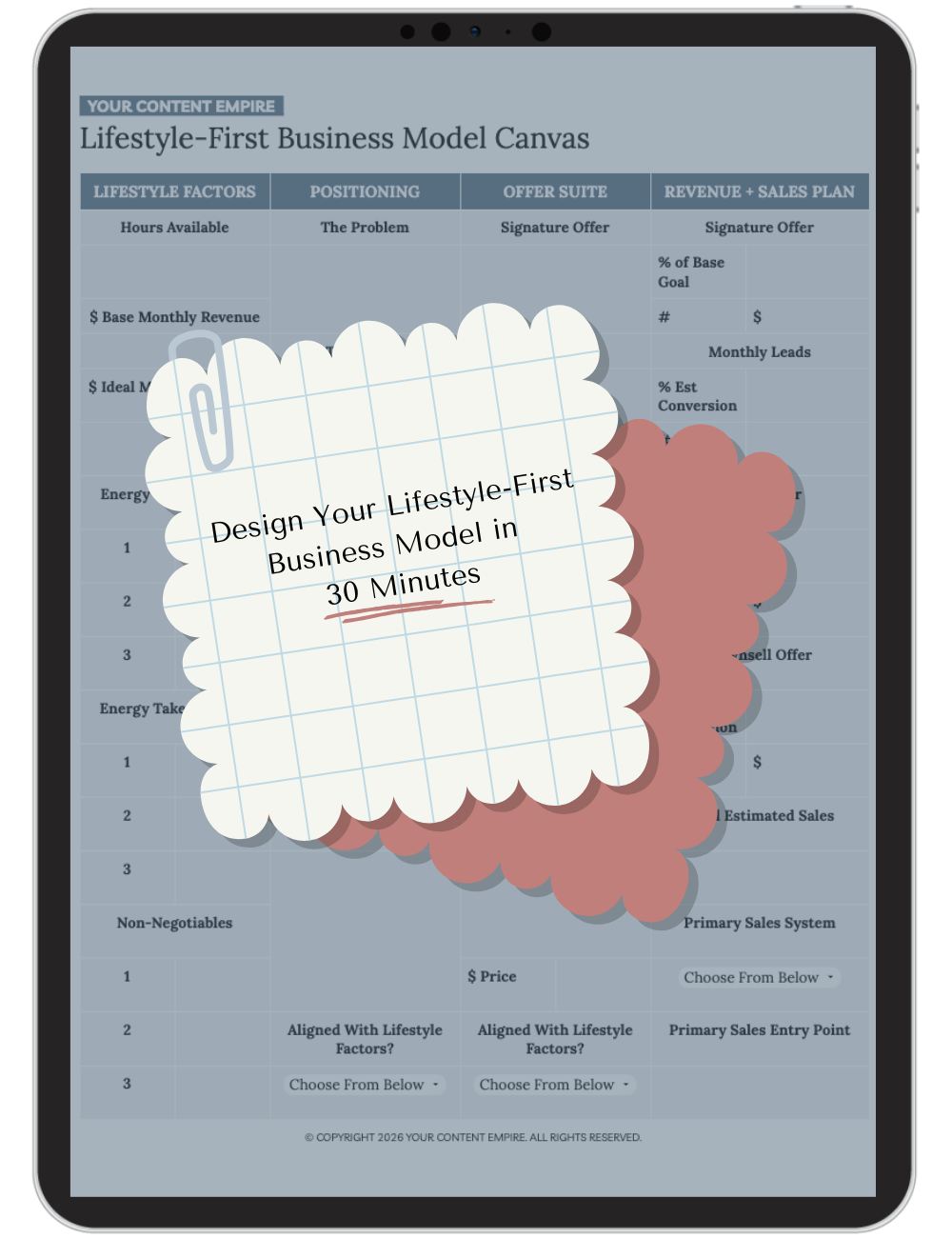
By the way, if you want help with this step, I have a free resource called the Lifestyle-First Business Model Template. It walks you through mapping your current versus ideal business model in detail. I'll put the link in the description.
But before you can start building Business B, you need to create capacity so you actually have space to make these changes. Which brings us to Priority 2.
Priority 2: Capacity Rescue
You can't build a new business model if you don't have time or energy to work on it.
Most people stay stuck in Business A because they're so consumed by keeping it running that they have no space to build Business B.
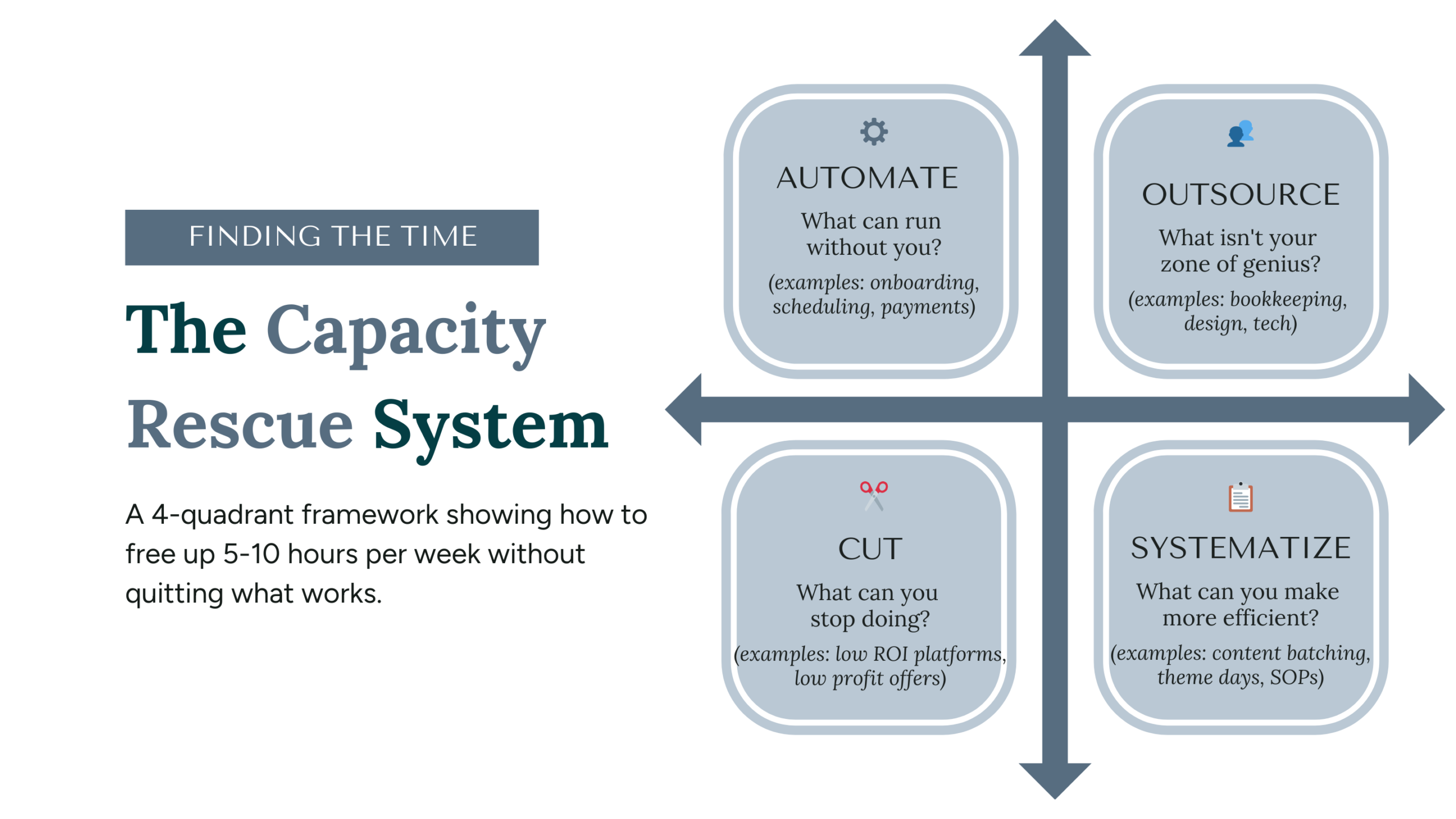
So Priority 2 is what I call Capacity Rescue. You're going to audit your current business and free up 5 to 10 hours per week minimum. That time gets dedicated to your new priorities like testing your new offer, building your new audience or rolling out your rebrand or newly refined positioning.
This is where the Capacity Rescue System comes in. In 4 quadrants we have: Automate, Outsource, Cut and Systematize. Each quadrant represents a different way to free up your time and energy.
First is Quadrant 1: Automate
What tasks are you doing manually that software could handle?
Think about things like email sequences, payment processing, client onboarding, social media scheduling, invoice reminders, all of it.
The question to ask yourself is: what am I doing manually that could run without me?
For example, if you're still manually sending welcome emails to new clients, set up an automated onboarding sequence. If you're manually invoicing people, use a tool that handles recurring payments. If you're manually posting on social media every day, use a scheduler.
Automation doesn't strip the humanity out of your business. It frees you up for the parts that actually require your presence.
Quadrant 2: Outsource
What tasks drain your energy that someone else could do?
What's taking up my time but isn't actually making me money?
And yes, outsourcing costs money. But if you can free up 5 hours per week by hiring a VA for $500 a month, and you use those 5 hours to test a new offer that brings in $3,000, the math works.
Outsource even just one thing that isn't your zone of genius or joy and see how much breathing room it creates.
Quadrant 3: Cut
What can you stop doing entirely?
This is the hardest one for most business owners because we're conditioned to think everything matters. But not everything does.
Are you showing up on a platform that doesn't actually bring in leads? Cut it.
Do you have an offer that takes up a ton of delivery time but doesn't sell well? Sunset it.
Are you doing tasks out of obligation or habit, not strategy? Let them go.
The question to ask yourself is: what am I doing that if I stopped tomorrow, no one would notice and my revenue wouldn't drop?
Permission slip: not everything needs to be replaced. Some things just need to end.
Finally, Quadrant 4: Systematize
What can you make more efficient?
Think about tasks you do repeatedly that could be turned into a system or template.
For example, if you're writing sales emails from scratch every time, create templates. If you're onboarding clients manually, create a checklist and process. If you're batching content once a week, could you batch it once a month instead?
The question to ask yourself is: what do I do over and over that could be streamlined with a system?
Your goal with Capacity Rescue is to carve out either one full day per week or a two-hour block a few times a week dedicated to Business Model B priorities.
Capacity isn't found, it's created. And it starts with getting ruthlessly honest about what's actually necessary versus what's just “the way it’s always been done.”
Priority 3: Start Small With Offers
Alright, so now you've identified the gap and you've created capacity. Priority 3 is about testing your new offer without blowing up your current ones.
Most people think their new offer has to replace their current revenue immediately. So they either don't launch it at all because the pressure feels too high, or they launch it in a panic and it flops because they're desperate for it to work.
There's a better way. You run your old and new offers in parallel. You let the new one prove itself. And then you phase out what's not working once the new revenue is consistent.
This is a transition more than a light switch.
So let's talk about how to test your new offer in a low-risk way. Here are some ways to test your new offer in a low-risk way.
Option 1: Beta Version
Launch a beta program at a discounted price with limited spots. You're selling the transformation, not the polish.
This is perfect for proving your concept and getting testimonials. You tell people upfront: this is a beta, I'm refining the program as we go, and in exchange for a lower price point I'm asking for feedback.
The right people will say yes because they care about the result, not whether your slides are perfect.
Option 2: Workshop First
Run a one-time live workshop. Could be 90 minutes, could be 3 hours, depending on what you're teaching.
Small group, low price point or even pay-what-it's-worth. This lets you test your content and see who's interested without committing to a full program.
And if the workshop goes well? You can turn it into an official offer later.
Option 3: Off-Menu Offer
This is one of my favorite strategies and I use it in my own business.
You keep your new offer available to existing clients only. It's not publicly promoted. It's your secret menu.
For example, my coaching is front-facing. That's how I work with new clients. But for a long time I ran an agency doing sales systems and done-for-you content. That CMO work is still part of my business and represents a lot of my revenue. But it's off-menu. Existing clients stay for years and I bring in maybe one or two new clients throughout the year.
This strategy lets you keep revenue stable while you're testing new positioning. Your current clients don't care if you're pivoting publicly. They just care that you're still serving them well.
So here's the strategy. Pick one of these options and test your new offer. Don't make a big announcement. Don't put all your eggs in one basket. Just quietly test it and see what happens.
If it works? Great. Scale it.
If it doesn't? Tweak it and try again.
Priority 4: Build and Leverage Your Existing Audience
Alright, Priority 4 is about audience. What most people assume when they're shifting their business model is: I need a whole new audience.
Not true.
Unless you're doing a massive pivot like going from B2B to B2C or switching industries entirely, a significant portion of your existing audience will likely still be interested in your new direction.
You don't need to start from zero. You just need to re-engage the audience you already have and attract new aligned people at the same time.
So let's talk about both.
Leveraging Your Existing Audience
Your current audience already knows, likes and trusts you. That's valuable.
So your job is to communicate the shift through your content and market research.
A great example of this is a past client of mine. She initially worked with therapists building their side hustles. Now she's shifted to serving a more general business audience. Did she lose her entire audience? No. A big portion of her old audience was still interested because her frameworks applied to both.
Don't assume you need to abandon your current audience. Just start shifting the conversation and see who comes with you.
Attracting New Audience Using a Hand-Raiser Freebie
Now let's talk about how to attract new people who are aligned with your new positioning.
A hand-raiser freebie is a simple lead magnet designed so that you can say with 90% certainty: because someone downloaded this, they're also very very likely interested in my paid offer. It's not just any freebie. It's strategically designed to attract people who are already primed for what you're selling.
Create a simple lead magnet that attracts your new ideal audience.
The key here is that you want to be able to say with 90% certainty: because someone downloaded this freebie, they're also interested in my new offer.
This validates demand before you build the full thing. And it starts attracting the right people into your ecosystem.
Attracting and Nurturing at the Same Time
The strategy here is what I call a Content Campaign.
Here's what you're looking at. A 4-week structure. Three weeks of priming content, one week of selling.
Week 1 to Week 3 are your Priming Phase. You publish long-form content, whether that's written, video or podcast, and you promote that content to your audience and on social media. You're planting seeds. You're warming people up to your new themes and ideas.
Week 4 is your Sales Phase. You send sales emails and promote your paid offer.
Here's why this works so well for transitions:
You pick one theme related to your new positioning. You run a 4-week campaign focused on that theme. This re-engages your existing list and attracts new people who are interested in that topic.
Then next month? You do it again with a different angle of your new positioning.
This is a free rebrand. You're not making a big announcement. You're just shifting the conversation. Your content is training your audience on what you're about now.
And here's the beauty of it. Content campaigns create momentum. They're focused. They're strategic. And they give you a clear path for re-engaging your list and attracting new aligned people without needing to be everywhere all the time.
So you run one campaign. See what resonates. Refine your messaging. Run another one. Over time, your audience shifts naturally because you're consistently talking about your new themes.
Your content is your rebrand. Every piece you publish is a signal about what you stand for and who you serve.
Priority 5: The Slow Brand Rollout
Priority 5 is the actual rebrand. And you don't have to update everything at once.
Most people think a rebrand means new logo, new website, new everything, all launched on the same day with a big announcement.
That's one way to do it. But it's not the only way. And frankly, it's not the best way if you're trying to transition without losing revenue.
The Slow Brand Rollout is exactly what it sounds like. You update your brand gradually over time, starting with content and layering in visual changes as you go.
Here's how it works.
Phase 1: Content Shift (Month 1-2)
You start publishing content on your new themes. You test new messaging and frameworks. You gather market feedback through engagement.
This is what we talked about in Priority 4 with the Content Campaign. You're shifting the conversation before you change anything visual.
Phase 2: Offer Testing (Month 2-3)
You launch your beta, workshop or off-menu version of your new offer. You validate your positioning with real sales. You refine based on what you learn.
At this point, most of your audience doesn't even realize you're pivoting. They just think you're creating helpful content and launching a new offer. Which you are.
Phase 3: Update Key Touchpoints (Month 3-4)
Now you start updating the visual stuff. Your social bio. Your website homepage and about page. Your email signature and newsletter header. You create a new lead magnet aligned with your new positioning.
These are the high-traffic touchpoints that signal your new direction to anyone discovering you for the first time.
Phase 4: Full Visual Rebrand (Month 4-6, Optional)
If you want to do a full visual rebrand with new colors, fonts, logo, updated sales pages and refreshed templates, this is when you do it.
But you might not even need to. Sometimes just updating your messaging is enough.
The point is this. You don't have to do everything at once. Most of your audience won't even notice the gradual shift. They'll just feel like you're becoming more focused and clear.
A rebrand doesn't require an announcement. It requires consistency in a new direction.
Bonus Priority: Nervous System Safety
I also have a bonus priority for you. And honestly, this one might be the most important.
The biggest obstacle to changing your business model isn't strategy. It's fear.
Fear that your revenue will drop. Fear that you'll lose clients. Fear that you'll make the wrong decision and regret it.
And you know what creates that fear? Lack of financial safety.
When you're essentially living paycheck to paycheck in your business, every decision feels high-stakes. You can't test a new offer authentically because you're desperate for it to work. You can't shift your positioning because you're terrified of losing your current clients.
You're making survival decisions, not strategic decisions.
That's why this bonus priority is about Nervous System Safety.
Here's what that means. Nervous System Safety is having enough money saved in your business to cover your personal paychecks and business expenses for multiple months. This removes the desperation from your decision-making and lets you build strategically instead of reactively.
Let's talk about The Nervous System Safety Net.
You're looking at 4 milestones. One month, three months, six months and twelve months. The goal is to work toward 6 to 12 months saved, but you don't need that all at once.
I have 12 months of paychecks and business expenses saved. That means even if I made no money for an entire year, which would never happen, I'm good.
This allows me to create from a place of safety, not survival. I can test new offers. I can shift my positioning. I can build for the long-term because I'm not desperate for the next sale.
Now here's how you build this. You start with Milestone 1 as your goal. Once you hit one month saved, you aim for three months. Then six months. Then twelve.
And as it builds, your decision-making changes. You stop being reactive and start being strategic.
When you have financial cushion, you make better choices. You're not grabbing at every opportunity out of fear. You're choosing what aligns with where you actually want to go.
What's The Next Step? Start Here ↓
You can do this work on your own. The Lifestyle-First Business Model Template is a free download that walks you through mapping your current versus ideal business model. It helps you identify the gaps and gives you a roadmap for closing them.
It's the exact framework I use with my coaching clients to help them bridge the gap between Business A and Business B. And it's completely free.
Inside you'll get the full Canvas to map out your lifestyle factors, your positioning, your offer suite and your revenue plan. Plus the detailed workbook that walks you through every single question step by step.
This is your starting point. Download it, work through it and get clarity on exactly what needs to shift in your business model. ↓
HEY THERE!
I’m Hailey and I help business owners who are tired of the hustle-harder advice build content systems that actually sell. No performative posting. No chasing algorithms. Just strategic, sustainable growth. More about me + my approach →
Stop guessing. Start scaling. This one-page template helps you design a business model that supports both your revenue goals and your actual life.
Browse By Topic
Scaling
Sales
Content
All Posts
Search The Blog
FREE TEMPLATE
The Lifestyle-First Business Model
Design a business model that supports both your revenue goals and your real life. This one-page template walks you through your lifestyle factors, positioning, offer map, revenue plan, and sales strategies so you can finally stop guessing and start scaling with clarity.
In This Post: How do you get more sales from your sales funnel? The best way to get more sales from your sales funnel is to follow up with the people who didn't buy the first time, since only about 5% of your audience is ready to buy at any given moment. Set up a...
In This Post: How do you reset your business model? You reset your business model by rebuilding it in the right order: lifestyle first, then positioning, offers, revenue planning and marketing. Follow that sequence and you can reset your business model in about 90...
In This Post: What is a monthly business retreat? A monthly business retreat is a full week you block off each month with no meetings, calls or client work so you can focus entirely on the projects that grow your business. Rotating through a few types of monthly...