“As an entrepreneur, I've learned to surround myself with people who have skills that I lack. FB ads and email funnels were something I knew I wanted to be doing in my business but I had no idea where to start. I put it off for a while because it was outside my comfort zone, and it wasn’t until I found Hailey that I felt confident moving forward with them. Hailey took the reigns and created a system for me that was not only profitable, but really helped me create more space in my day to work on the things that are in my zone of genius!”
Lauren Bongiorno Diabetic Health Coach
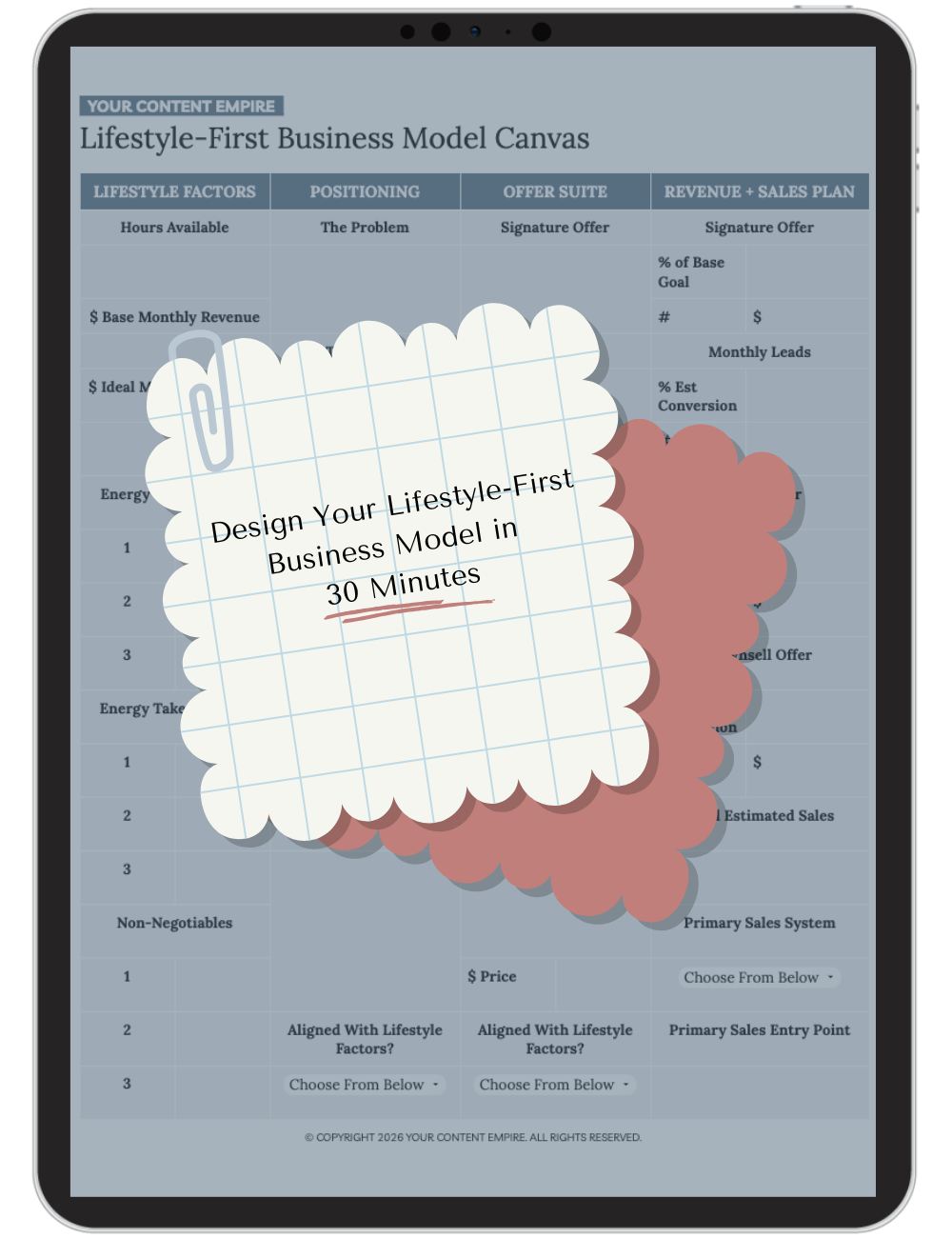
Click Here to Design Your Lifestyle-First Business Model with My Free Template
Great news: You finally hit your revenue goal. The number you've been chasing for months, maybe years. You did it.
But here's what nobody tells you about that moment. You're working 60-hour weeks. And that offer that's selling? Delivering it drains every ounce of energy you have. You're making money, sure, but your business model technically works on paper but completely takes over your life and makes you miserable.
So today we're talking about a completely different approach to business model design. One that starts with your actual life and builds from there. Because ambition doesn't require hustle. It requires intentional design.
Prefer to watch instead?
Want to listen on the go?
Most business model planning starts with questions like: What do you want to sell? How much do you want to make? What's your marketing strategy?
But we're going to start somewhere completely different: What does your actual life require? And what kind of business can exist within that reality?
That's what lifestyle-first business model design is all about.
You can absolutely be ambitious and be in a season where your life needs more of your capacity. Those two things aren't mutually exclusive. But the traditional approach to business planning assumes you're at 100% capacity 100% of the time. It assumes you have unlimited energy, no constraints and a completely flexible schedule.
That's not real life.
Real life has caregiving responsibilities. Chronic illness. Mental health considerations. Jobs you're not ready to leave yet. Kids with special needs. Aging parents. Neurodivergence that affects how you work. Seasonal patterns in your energy or health.
But real life also has personal goals like going to the gym regularly or hobbies like picking up a paintbrush again. Maybe you want dedicated time for rest or creative projects that have nothing to do with your business. Maybe you're working toward something meaningful outside of revenue, like being present for your kids' after-school activities or training for a marathon.
And when you try to force a business model that doesn't account for your real life, something breaks. Usually you.
Lifestyle-first business model design flips the entire approach. Your lifestyle becomes the container. And your business model is what gets built inside that container.
This approach helps you design a business that generates real revenue, creates real impact and actually works for the life you have right now. Not the life you wish you had. Not the life you'll have someday when things calm down. The life you have today.
This isn't about lowering your ambition. It's about designing the smartest, most strategic path to your goals within your actual capacity.
Because the most successful business owners I know aren't the ones working 70-hour weeks. They're the ones who designed business models that generate significant revenue within reasonable working hours, doing what they love, because they were intentional from the beginning.
So let's talk about how to actually do this.
“Ideal” Capacity Vs. Real Capacity
The first thing you need to understand about lifestyle-first business model design is the difference between “in an ideal world” capacity and real capacity.
“In an ideal world” capacity is the version of yourself you're planning for. The one who works 40 hours a week without interruption. The one who has unlimited energy for client calls, content creation and marketing. The one who never gets sick, never burns out, never needs a mental health day.
Real capacity is what you actually have available right now, in this season of your life.
And here's where most business owners go wrong. They look at someone else's business model and think “I want that.” So they reverse-engineer it. They copy the offer suite, the pricing, the marketing strategy, the content calendar. They follow the blueprint step by step.
But they never ask the most important questions:
What was that person's capacity when they built this model?
How many hours were they working per week?
What kind of support system did they have?
What season of life were they in?
Let me give you an example. You see a course creator making $50K months with a specific funnel. Webinar to course to high-ticket offer. You think “Perfect, I'll do that too.”
But what you don't see is that person works 50 hours a week. They have a full-time VA, a marketing team and a partner who handles everything at home. They don't have caregiving responsibilities. They can batch-record 20 videos in a weekend and not need a week to recover.
When you try to implement that same business model, it doesn't work. Not because you're not capable. Not because you're not smart enough or talented enough. But because you're trying to fit a 50-hour-per-week business model into a 25-hour-per-week container.
The math doesn't work.
And this is where “in an ideal world” capacity becomes dangerous. You start thinking “I just need to work harder. I just need to be more disciplined. I just need to push through.”
No. You need a different business model.
One that's designed for your real capacity, not someone else's.
Real capacity accounts for:
The actual hours you have available each week
The energy patterns that affect how you work
The boundaries your life requires you to maintain
The seasons that shift your availability
When you design your business model around real capacity instead of “in an ideal world” capacity, everything changes.
Ambition Through Subtraction, Not Addition
Now here's where things get interesting. Because once you accept that you need to design around real capacity, the immediate fear is: “Does this mean I have to lower my goals?”
No. It means you need to get more strategic about how you reach them.
This is what I call ambition through subtraction, not addition.
Most business owners think scaling means doing more. More offers. More platforms. More content. More launches. More marketing channels. More everything.
They look at their revenue goal and think “If I want to 3x my revenue, I need to 3x my effort.”
But that's the addition model. And the addition model assumes unlimited capacity.
The subtraction model works completely differently. It asks: What's the smallest, simplest, most focused version of this business that can generate the revenue I need?
Let me show you what this looks like in practice.
Addition model thinking:
“I need more offers so people have more ways to work with me”
“I need to be on more platforms so I can reach more people”
“I need to create more content so I stay top of mind”
“I need more marketing funnels running simultaneously”
Subtraction model thinking:
“What's the one signature offer I want to be known for?”
“What's the one platform where my ideal clients actually spend time?”
“What's the simplest content system that consistently brings in leads?”
“What's the one sales system I can optimize until it works really well?”
The addition model scatters your focus, drains your energy and requires massive capacity to maintain.
The subtraction model concentrates your focus, preserves your energy and works within your real capacity.
And here's what's wild: the subtraction model often generates more revenue. Not despite doing less, but because you're doing less.
When you focus on one signature offer, you get really good at selling it and delivering it. Your messaging gets sharper. Your positioning gets clearer. Your conversion rates improve.
When you focus on one platform, you understand that audience deeply. You know what resonates. You know what converts. You're not spreading yourself thin trying to show up everywhere.
When you focus on one content system, it becomes repeatable. Sustainable. Something you can maintain even in low-energy seasons.
When you focus on one sales system, you can optimize every touchpoint. You know exactly where people drop off. You know exactly what to improve.
The most ambitious thing you can do isn't adding more to your business model. It's getting ruthlessly clear on what matters and letting go of everything else.
The 4 Steps To A Lifestyle-First Business Model
So how do you actually design a lifestyle-first business model? There are four steps and they build on each other in a specific order.
Step 1: Lifestyle Factors
This is your foundation. Everything else gets built on top of this.
In this step, you define three critical things:
Your capacity constraints: the real time and energy you have available. Not the hours you wish you had. Not the energy you'll have someday when things calm down. What you actually have right now. This includes identifying what limitations or life circumstances affect your capacity.
Your revenue requirements: both the baseline you need and the goal that would feel expansive. You need two numbers here. Your base monthly revenue, the amount you must generate to keep the lights on. And your ideal monthly revenue, the number that would make your life feel spacious.
Your non-negotiables: the boundaries your business model must honor. Maybe you don't work weekends. Maybe you're not available for calls before 10am. Maybe your business can't require you to be on social media daily. These aren't nice-to-haves. These are the guardrails that keep your business sustainable.
These lifestyle factors become your compass. Your container. The reality that everything else gets designed around.
Step 2: Positioning
Once you know your lifestyle factors, you can make clear positioning decisions.
This is where you define: What problem do you solve? Who do you solve it for? How do you solve it? And what do people get when it's solved?
Your positioning becomes the focus for your business. And it needs to align with your lifestyle factors.
Step 3: Offer Suite
With clear positioning and realistic capacity, you can now build an intentional offer suite.
This is where most people overcomplicate things. They create a buffet of offers trying to appeal to everyone.
But your offer suite should be a clear pathway. Your signature offer that delivers your main transformation. An upsell for people who want to continue working with you. A downsell for people who aren't ready for your signature offer yet. And an entry offer stack that introduces people to your work.
Each offer needs to fit within your capacity constraints and support your revenue requirements.
Step 4: Revenue and Sales Plan
Finally, you design a plan that shows exactly how you'll hit your revenue goals.
This isn't just setting a number and hoping. This is mapping out: How many sales of each offer do you need? What conversion rates are you assuming? How many leads does that require? What's your primary sales system? What's your primary way of generating those leads?
When you have these four pieces mapped out, you have a complete business model. One that starts with your life, focuses through clear positioning, delivers through intentional offers and scales through a strategic revenue plan.
And here's what makes this different from traditional business planning: every single piece is designed to work within your real capacity. Nothing is built on fantasy assumptions. Nothing requires you to be someone you're not or to have resources you don't have.
It's a business model designed for your actual life.
This Does Not Mean You're Settling
Designing a lifestyle-first business model isn't settling. It's not giving up on your ambition. It's not playing small.
It's the smartest, most strategic thing you can do.
Because a business model that doesn't work for your actual life isn't a business model. It's a ticking time bomb.
And the businesses that scale sustainably? They're not built by people hustling harder than everyone else. They're built by people who designed something that fits their life from the very beginning.
So give yourself permission to start with your reality. To build around your capacity. To honor your boundaries. To design for this season.
You can absolutely be ambitious and in a constrained season. You just need a business model that proves it.
Grab the Lifestyle-First Business Model Template at the link in the description and let's build something that actually works!
It walks you through all four steps with prompts, examples and space to map out your own model.
You'll get the one-page Canvas where you can see your entire business model at a glance. Plus a detailed workbook that guides you through each step with specific questions to help you get clear on your capacity, your positioning, your offers and your revenue plan.
This isn't just a template you download and forget. It's the exact framework I use with my private clients when we're designing their scaling strategies. The same process that helps them build businesses generating $10, $25, $50K months or more within 15, 20, 25 hours per week.
Because lifestyle-first doesn't mean low revenue. It means strategic revenue.
If you're tired of trying to force your life into someone else's business model, if you're ready to design something that actually works for you, grab the Lifestyle-First Business Model Template.
HEY THERE!
I’m Hailey and I help business owners who are tired of the hustle-harder advice build content systems that actually sell. No performative posting. No chasing algorithms. Just strategic, sustainable growth. More about me + my approach →
Stop guessing. Start scaling. This one-page template helps you design a business model that supports both your revenue goals and your actual life.
Browse By Topic
Scaling
Sales
Content
All Posts
Search The Blog
FREE TEMPLATE
The Lifestyle-First Business Model
Design a business model that supports both your revenue goals and your real life. This one-page template walks you through your lifestyle factors, positioning, offer map, revenue plan, and sales strategies so you can finally stop guessing and start scaling with clarity.
In This Post: How do you get more sales from your sales funnel? The best way to get more sales from your sales funnel is to follow up with the people who didn't buy the first time, since only about 5% of your audience is ready to buy at any given moment. Set up a...
In This Post: How do you reset your business model? You reset your business model by rebuilding it in the right order: lifestyle first, then positioning, offers, revenue planning and marketing. Follow that sequence and you can reset your business model in about 90...
In This Post: What is a monthly business retreat? A monthly business retreat is a full week you block off each month with no meetings, calls or client work so you can focus entirely on the projects that grow your business. Rotating through a few types of monthly...