“As an entrepreneur, I've learned to surround myself with people who have skills that I lack. FB ads and email funnels were something I knew I wanted to be doing in my business but I had no idea where to start. I put it off for a while because it was outside my comfort zone, and it wasn’t until I found Hailey that I felt confident moving forward with them. Hailey took the reigns and created a system for me that was not only profitable, but really helped me create more space in my day to work on the things that are in my zone of genius!”
Lauren Bongiorno Diabetic Health Coach
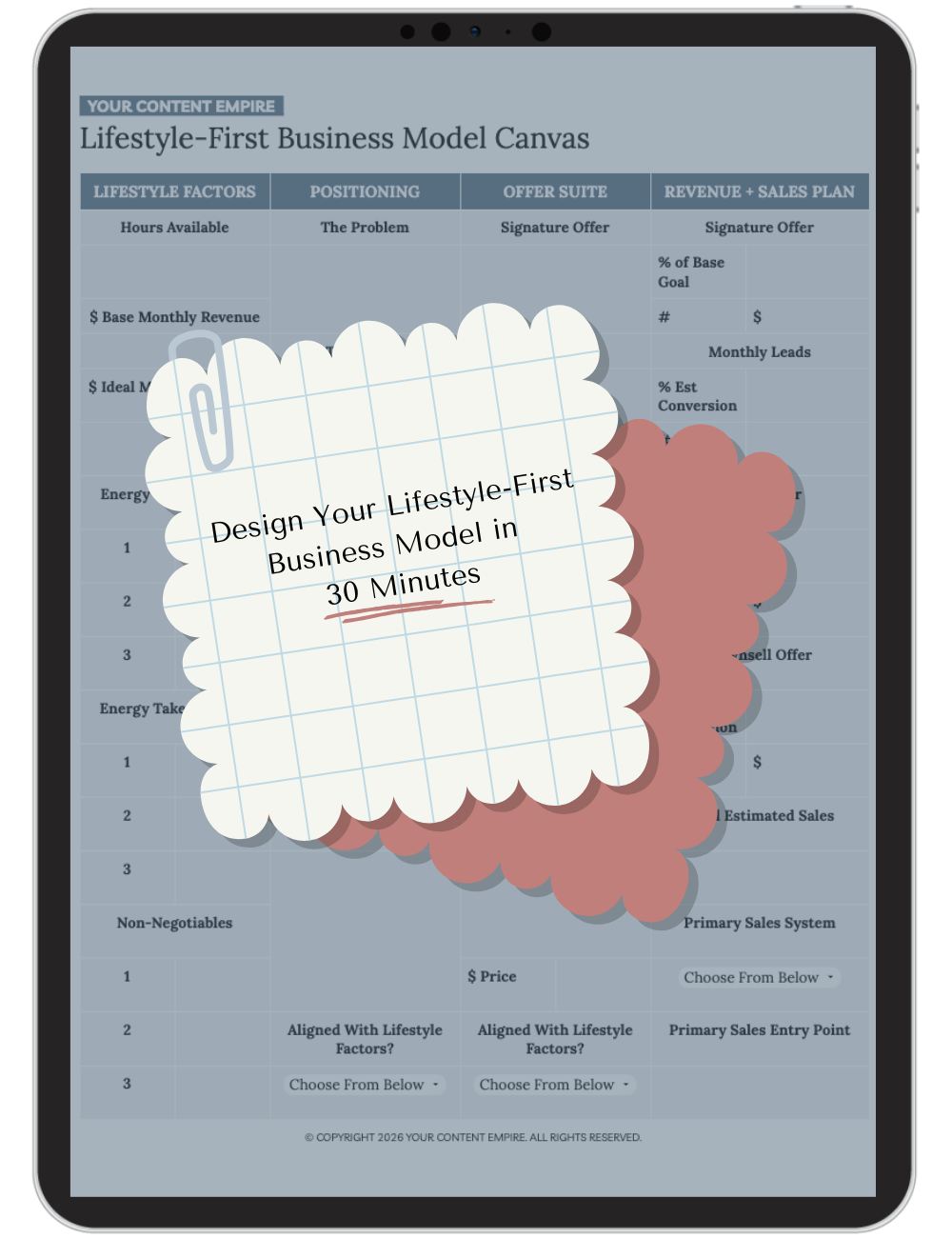
Click Here to Design Your Lifestyle-First Business Model with My Free Template
The fastest way to fill your pipeline and book out your offers has nothing to do with creating more content, building a bigger audience or going viral on social media.
The secret to consistent sales is something you can actually do in 15 to 25 minutes a day and doesn't require you to be on camera, write a single caption or show up on stories.
So many business owners think they need more reach when what they actually need is more genuine connection. They're focused on growing their follower count when they should be focused on growing their conversation count.
In this episode, I'm giving you the exact plug-and-play Daily Conversation System system This will help you turn relationship building into a repeatable 15 to 25 minute daily habit.
This is practical and actionable. And it works even if you hate being salesy or pushy (like everyone) because this isn't actually about selling. It's about having real conversations with real people.
Prefer to watch instead?
Want to listen on the go?
Just this week, I participated in my friend Marissa Lawton's summit called My Favorite Metric. And the whole premise was that every business owner who participated would share their favorite metric to track in their business.
I surprised even myself with what I picked.
Not revenue. Not profit. Not email list growth. Not CPL, LTV or EPLs. Not any of the typical numbers I usually find myself obsessing over.
I picked number of conversations.
And this wasn't a theoretical choice either. This metric, this practice of having and tracking daily conversations, became the strategy that pulled me out of one of the hardest seasons in my business.
In 2024 when I had to pretty much rebuild my business from scratch after hitting my 10 year business anniversary and shutting down my agency, this conversation system took me from practically zero sales to fully booked out again (with an offer I actually love to deliver) within 30 days.
Not a new funnel. Not a launch. Not going viral on social media. Not creating more content.
Daily conversations.
And I love metrics. I love the hard numbers, the data, the analytics. But this was the most influential metric in my business performance last year. And it also made me feel the best about my business, not in a dopamine hit kind of way but in a connected and purpose-filled way too.
Meet The Daily Conversation System
So what exactly is the Daily Conversation System?
It's a simple framework for having intentional conversations with the right people in your audience every single day. It's not random DMing. It's not spam. It's not sliding into people's messages with gross pitches. Instead it’s a strategic approach to relationship building that becomes a 15 to 25 minute daily habit.
Here's the foundation. You've probably heard of the 1000 True Fans by Kevin Kelly concept. You don't need tons and tons of people to have a successful and profitable buiness. You don't need to be an influencer with hundreds of thousands of followers. You need genuine connections with the right people who actually want what you're offering.
But here's where most business owners get stuck. They know they should be “engaging more” or “building relationships” but they don't have a system for it. So it becomes this thing they feel guilty about not doing. Or they do it inconsistently when they actually remember. Or they only do it when they're panicking about sales.
The Daily Conversation System changes that completely. It turns relationship building into a repeatable process that you can do in 15 to 25 minutes a day.
And when you do this consistently, three things happen.
One, your pipeline stays full. You're not scrambling when you need sales because you've been having conversations all along.
Two, you actually enjoy your business more. You feel connected to your people instead of just broadcasting into the void. And they start talking back.
Three, sales become easier and more natural. When you've been in genuine conversation with someone, when they've told you what they're struggling with, when you've offered value without asking for anything in return, the sales conversation isn't awkward or pushy. It's just the natural next step.
And these conversations add up too. If you have 5 daily conversations every week day for a quarter – so 13 weeks. That’s 325 conversations. Small daily actions = Big results – always.
So today we're setting up your Daily Conversation System together. And I'm making this as plug-and-play as possible for you. We're going to walk through exactly how to set up the habit, then how to design your own 30-day conversation challenge and then I'll answer the questions and troubleshooting issues that always come up.
Setting Up The Habit
Alright, let's build your Daily Conversation System. There are three parts to setting up this habit: identifying your segments, creating your tracker and setting up your daily workflow. We're going to walk through each one.
Part 1: Your Conversation Segments
Not all conversations work the same way. Different people in your audience need different approaches. So we're going to start by identifying your conversation segments.
I'm going to cover eight potential segments that you might have in your business. Some may not apply to you. And you might have others that are particular to your business. But here are some of the most common ones I see:
New customers. These are people who just bought from you. This is your immediate thank you and check-in conversation. Your goal here is to make sure they feel supported and get started with what they purchased.
Existing clients. The people currently working with you. You're staying connected, seeing how they're doing, engaging with their content. Your goal is to deepen the relationship and support their success.
Past clients. People who've worked with you before. You're staying top of mind for referrals, repeat purchases or just showing you care even after the paid engagement has ended. Your goal is to stay connected so you're the first person they think of when they or someone they know needs what you offer.
New followers. People who just found you on social media. This is your chance to make a great first impression and understand how they discovered you. Your goal is to start a relationship and gather intel on what marketing is working.
Super engagers. The people who consistently like, comment and share your content. They're already raising their hand. Don't ignore them. Your goal is to acknowledge them and move them deeper into your world.
Hot leads. People who've expressed clear interest. They've filled out a form, asked a question, shown buying signals. These get priority attention. Your goal is to answer their questions and invite them to the next step. And if you want a tutorial on how to set up a hot leads system in MailerLite, I'll link to that down below.
Launch leads. During a launch or promotion, people who signed up for your event or expressed interest in your offer. This is a temporary segment that gets extra focus during active selling periods.
Your Inner Circle. This is your network. And I want to spend a minute here because this segment is really important even though it's not directly sales-focused.
Your Inner Circle is the group of people who do what you do or serve the same audience in a different way. Other coaches, other service providers, other course creators. The people who could refer clients to you or collaborate with you or just understand what you're going through.
This segment isn't the most important for immediate sales. But it makes a huge difference in how you feel about your business. It keeps you from feeling isolated. It opens up collaboration and referral opportunities. It reminds you that you're part of a bigger community.
So how do you define your Inner Circle? Start with people you already know and respect. Add people whose work you admire. Include folks who serve your audience but aren't direct competitors. Think peers in complementary industries.
Okay, so those are your main eight segments. Now for each segment you decide to use, you need two things: a goal for that segment and a base script for reaching out.
For each: What do you want to accomplish with this segment? I’ve already walked you through the goals for each one but adjust these to fit your business.
The base script is your starting template. It's not a rigid script you copy and paste word for word. It's a framework that makes it faster to start conversations without staring at a blank message box every time.
Here's an example of my base script for new followers.
“Hi [NAME]. Thank you for following and I'm happy we're connected. I'd love to know how you found me, it helps me know if my marketing efforts are working.” And then I add a P.S. with a personal observation about something from their profile.
That's it. Personal, genuine, includes a small ask that's easy to answer.
Then here's my script for new customers in the Content Planning Club.
“[NAME]. Thank you so much for signing up for the Content Planning Club. Our quarterly planning retreat is next week. Have you started digging into the planner yet?”
Simple. Warm. Helpful.
So go through your segments and create these base scripts for each one. They don't have to be perfect. They just need to give you a starting point.
Part 2: Create Your Tracker
Next you need a simple system to track your conversations. This doesn't have to be complicated. A spreadsheet works perfectly.
Here are the fields I use in my tracker.
Name
Social URL
Segment – Which category they're in.
Message – What I said to them.
Response – What they said back.
Last Touchpoint – The date of our last conversation.
Next Touchpoint – When I should reach out again. I have this set up to auto-calculate based on my touchpoint frequency for that segment.
Fun Facts – Personal details they've shared. This makes future conversations so much more genuine. Like if they mentioned they just got back from Iceland or their dog's name is Max or they're working on launching a new offer.
Notes – Anything important to remember about the conversation.
You don't have to use all of these fields. But having some kind of tracking system means you're not trying to remember everything in your head. And it gives you the data to see patterns. Who's engaging? Who's gone quiet? Who might be ready for a sales conversation?
Part 3: Set Up Your Daily System
Now we're putting it all together into a system you can actually use every day.
I'm going to share my exact workflow with you. You can adapt this to fit your business but this gives you the framework.
First, I respond to all comments on my posts and all DMs. This is baseline engagement.
Then I open my tracker and work through my segments starting with the highest priority.
New customers. I find any new buyers, send my welcome message and make sure they're getting started with what they purchased.
Launch leads. If I'm in a launch, I go through anyone who signed up for my event or expressed interest and follow up.
Existing clients. I check my client database, pick one or two and either comment on their content, like their posts or send them a message about something they're working on.
New followers. I open my recent followers on Instagram, pick one to follow back and send them my new follower message.
Hot leads. If I have anyone in my hot leads group, they get attention. These are people actively considering working with me.
Past clients. I see what they're up to and send a message. The whole goal is just staying connected.
Super engagers. I check my engagement database, find someone who's been consistently showing up and reach out to thank them or start a conversation.
Your Inner Circle. I pick someone from my list and engage with their content or send them a message.
That's the workflow. And here's the key. I have all of these links saved in a bookmark folder so I can open everything with one click. And I set a timer. Usually 20 minutes. When the timer goes off, I'm done for the day.
That's it. That's the system. Three parts. Segments, tracker, daily workflow.
Designing Your 30-Day Conversation Challenge
Now that you have the system set up, let's talk about how to actually make this a habit that sticks.
This is where most people don't follow through. They set up the system, they're excited about it, they do it for three days and then life happens and they forget about it.
So I want you to design your own 30-day conversation challenge.
Step 1: Set your daily conversation goal
Start smaller than you think you need to.
I recommend three to five conversations a day.
That might sound low if you're thinking you need to talk to everyone all the time. But consistency beats volume every single time. If you set a goal of 20 conversations a day, you'll do it for three days, burn out and quit. If you set a goal of three to five, you can do that every single day for months.
And 3 to 5 quality conversations each work day means roughly 66 to 110 conversations a month.
So decide on your number.
Step 2: Schedule it in your calendar
This is non-negotiable. If it's not in your calendar, it won't happen.
Decide when you're going to do this every day. For me, it's first thing in the morning before I start creating content. For you, it might be during lunch or at the end of your workday. There's no right time. Just your time.
Block 30 minutes in your calendar. Set a recurring event. Treat it like a client call that you cannot miss.
Step 3: Set up your systems to make it easy
Remember that bookmark folder I mentioned? Set that up now. Save every link you need in one folder so you can open everything with one click.
Instagram followers. Client database. Hot leads list. Whatever you need for your workflow.
The easier you make it to start, the more likely you are to actually do it.
Step 4: Track your results
Keep notes on what happens during your 30-day challenge. How many conversations are you having? How many people are responding? What patterns are you noticing? Are sales conversations starting to happen?
This data is gold because it shows you what's working and what needs adjusting (like scripts or segments)
Step 5: Create your “if-then” plan for when you miss a day
Because you will. Life happens. You get sick. You have an emergency. You forget.
This is where premortems come in. Instead of waiting until you’re 5 days behind and then trying to figure out what to do, you're deciding right now what your plan is.
So create your if-then plan. If I miss a day, then I will [blank].
Maybe your rule is: if I miss a day, then I make it up by doing double conversations the next day.
Or maybe: if I miss a day, then I never miss two days in a row.
Or maybe: if I miss a day on a response day, then I do my outreach on days one and two of the week and the rest is for responses.
There's research backing this up. In a meta-analysis of 94 studies with over 8,000 participants, people using if-then plans were about twice as likely to achieve their goals than those who only set goals without specific if-then plans.
So decide your if-then plan right now. This one decision will help you stay consistent even when life gets messy.
Thirty days. That's all I'm asking. Commit to 30 days of daily conversations and see what happens to your business.
FAQs And Troubleshooting
Alright, let's troubleshoot the questions that tend to always come up with this system.
FAQ 1: What if I could do more conversations? Should I?
Have the discipline to pace yourself.
If you're the kind of person who goes all in on new systems, you might be thinking you could do way more than three to five conversations a day. And maybe you could for a few days.
But I want you to resist that urge. This system works because it's sustainable. If you burn yourself out in week one, you won't stick with it. And consistency is what creates results.
So even if you could do more, stick to your goal. Build the habit. Prove to yourself that you can do this every single day for 30 days. Then you can increase if you want to.
FAQ 2: What if it seems like no one is responding?
First, that's normal. Not everyone will respond and that's okay. You're planting seeds. Some will sprout immediately. Some will take months. Some will never grow. That's just how it works.
But if you're consistently getting low response rates, like barely anyone is responding, look at your approach.
Are you leading with a pitch? Are you asking them to do something that takes a lot of effort? Are you making it all about you?
Try a different approach. Include a really small ask. Something they can answer in one sentence. My question about how they found me works so well because it's easy to answer and people like helping.
Or try leading with genuine curiosity about them. Comment on something specific from their content or profile. Make it personal.
FAQ 3: How can I supercharge this system?
If you want to amplify your reach even more, there are two strategies you can add.
First: a $5 a day boosting strategy. Take your best content and put a tiny ad budget behind it to get it in front of more of the right people. Then those people enter your conversation system when they follow you or engage.
Second: ManyChat automations. Set up simple automated messages for people who interact with your content in specific ways. Then those people become another segment you can follow up with personally.
Both of these strategies multiply the number of people entering your conversation system. But start with the basic system first. Get consistent with that. Then layer on amplification if you want to.
FAQ 4: Is this just for Instagram?
No. This system works on any platform where you can have conversations. Instagram, LinkedIn, Facebook, email, even TikTok if that's where your people are.
You could also do this for email if you're not on social media. It might be a little slower but it absolutely works. I had a client who was running workshops and she added a form asking, “What would you like me to cover in the workshop? What questions can I answer for you?” And then she responded back personally to everyone who filled it out. That turned into conversations that turned into sales for her membership – the conversion rate of that launch was nearly double her previous.
The principles are the same. Identify your segments, track your conversations, show up consistently.
Adjust the workflow to fit your platform but the system stays the same.
What's The Next Step? Start Here ↓
You now have the Daily Conversation System. And this alone can transform your business if you use it consistently.
But this conversation system works even better when it's integrated with a complete content strategy.
Because your conversations should be feeding your content ideas. And your content should be bringing people into your conversation system. And all of it should be pointing back to your offers in a way that makes sales natural and consistent.
That's exactly what we do inside the $10K Monthly Content System.
It's my signature program that helps you set up your complete content system in 30 days or less.
Not just conversations. Not just social media. Not just email. All of it working together in a streamlined way that consistently generates leads and sales.
You get all the templates, workflows and step-by-step processes. You get 12 months of group coaching support. And you get lifetime access to everything including all future updates.
This is for service providers, coaches and course creators who are tired of creating content that doesn't generate sales and grow their audiences. Who want a proven system that actually works without burning out.
If you're ready to simplify your content strategy and finally get consistent with content that converts, check out the link in the description.
The Daily Conversation System you learned today? That's one piece of the complete puzzle we build together in the $10K Monthly Content System ↓
HEY THERE!
I’m Hailey and I help business owners who are tired of the hustle-harder advice build content systems that actually sell. No performative posting. No chasing algorithms. Just strategic, sustainable growth. More about me + my approach →
Stop guessing. Start scaling. This one-page template helps you design a business model that supports both your revenue goals and your actual life.
Browse By Topic
Scaling
Sales
Content
All Posts
Search The Blog
FREE TEMPLATE
The Lifestyle-First Business Model
Design a business model that supports both your revenue goals and your real life. This one-page template walks you through your lifestyle factors, positioning, offer map, revenue plan, and sales strategies so you can finally stop guessing and start scaling with clarity.
In This Post: How do you get more sales from your sales funnel? The best way to get more sales from your sales funnel is to follow up with the people who didn't buy the first time, since only about 5% of your audience is ready to buy at any given moment. Set up a...
In This Post: How do you reset your business model? You reset your business model by rebuilding it in the right order: lifestyle first, then positioning, offers, revenue planning and marketing. Follow that sequence and you can reset your business model in about 90...
In This Post: What is a monthly business retreat? A monthly business retreat is a full week you block off each month with no meetings, calls or client work so you can focus entirely on the projects that grow your business. Rotating through a few types of monthly...