“As an entrepreneur, I've learned to surround myself with people who have skills that I lack. FB ads and email funnels were something I knew I wanted to be doing in my business but I had no idea where to start. I put it off for a while because it was outside my comfort zone, and it wasn’t until I found Hailey that I felt confident moving forward with them. Hailey took the reigns and created a system for me that was not only profitable, but really helped me create more space in my day to work on the things that are in my zone of genius!”
Lauren Bongiorno Diabetic Health Coach
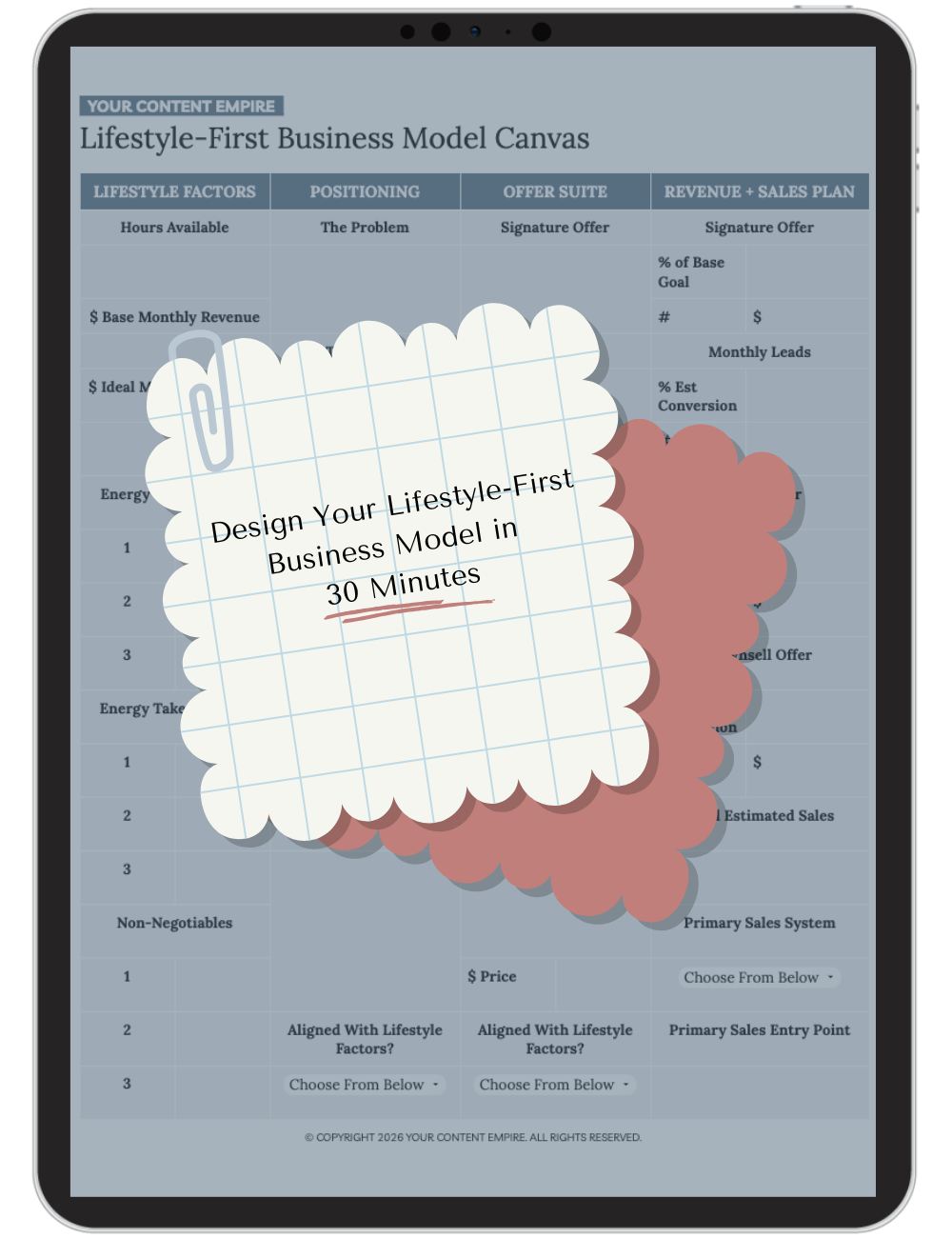
Click Here to Design Your Lifestyle-First Business Model with My Free Template
Case Study: Designing a Coaching Business Model to Scale to $25K
I’m going to say something that might sound a little counterintuitive but hear me out: A complicated business is the fastest path to getting nowhere. And if you’ve been stuck in design-mode or build-mode but not really getting started with putting your content and offers in front of the people you say you want to be helping, your business model is likely the big thing stopping you from taking action.
I put out a call to the members of my program, $10K Monthly Content System, offering an updated business model review that I could use as a video case study and Rachel Bellamy who’s been in the my program for years (this is definitely the kind of program where lifetime access actually means something) and I thought this would be the perfect example of a big mistake I see people starting businesses make when it comes to their business models.
Here’s the thing: Rachel is brilliant. She runs a very successful cybersecurity company and she’s starting a new endeavor with a leadership and legacy coaching company for high-achieving women of faith called REIGN. So we’re not talking about someone who’s new to business or lacking in talent, ideas or drive. She has all of those. In excess actually.
The reason I wanted to share this with you is because it’s a really common trap to fall into when it comes to business models. Starting your second (or even first) business and thinking you have to have every single piece figured out and built out before launching. Putting off getting started until there are all the offers, all the funnels, all the pages, all the systems perfect and in place before getting started. In a lot of ways, it’s like the curse of knowing too much. You’ve seen how other businesses, years into their journeys, operate and think you have to build the same thing.
In almost every case, starting simple. With one signature offer. Is the best and fastest way to build something that actually grows and generates revenue. I’m going to go through the reasons why, show you Rachel’s before and after business models from the review and help you make sure that your business model is set up to reach your revenue goals instead of actively working against you.
So here's some context. Inside my $10K Monthly Content System program, one of the bonuses is having me review your business model to make sure it's actually set up for you to reach consistent $10K months. You'd be surprised how often I find business models that are technically impressive but structurally working against the person behind them.
Rachel had been building REIGN for a long time. She has a lot of proprietary frameworks she’s developed that are really going to help the people she wants to work with. She’s a bit stuck in what I call the Build Trap. She's paused content creation to finalize her funnels. She's delayed launching on LinkedIn because her website wasn't finished. She’s had over 50 people organically complete her quiz without actively promoting it but hasn’t really followed up with them afterwards. There’s a reason why the Build Trap is one of the most dangerous places a smart business owner can be. Because it feels productive. It looks like progress. But it's actually a form of delay disguised as preparation.
So I brought Rachel’s business model through my Lifestyle-First Business Model Design process. And I want to walk you through exactly what I found at each step so you can check your own business model for the same issues.
Step 1: Lifestyle Factors
I always start with lifestyle factors. Always. Before looking at offers, pricing, funnels or content strategy. Because your lifestyle is the container and your business model is what gets built inside that container. If you skip this step, you end up designing a business that looks great on paper but doesn't actually fit within your life. And that's how you end up burned out, resentful or making no progress.
Rachel is currently working over 40 hours per week on REIGN alone. And that's just REIGN. She also has her successful cybersecurity company too. Her focused work window is 9am to 4pm which gives her about 35 hours per week during business hours. So if she's putting in 40+ hours on REIGN, she's almost certainly working evenings and weekends too. She has two middle school kids with hard stops for family time. Her goal for REIGN is $25K per month consistently.
Her energy givers? Strategic and spiritual coaching and teaching and developing frameworks. Her energy takers? Solo execution burden, especially tech, and messaging. And that tracks because right now Rachel is doing everything herself. Strategy, tech, copy, design. All of it.
But Rachel does have some real strengths. She has clear family boundaries. She now has funding secured to invest in support. And her cyber company income means she's not building REIGN from a place of financial desperation. That's a luxury most business owners don't have and it gives her room to build thoughtfully.
My recommendation was to design an ideal weekly calendar that maps out her time across both businesses and gives a theme or purpose to every time block. What does coaching and teaching time look like? When does content creation happen? Where does strategy fit? What about admin and the cyber security company? When you can see it all laid out, you can spot the misalignment immediately. You can see where build-mode tasks are eating into your genius zone hours. You can see where you're spending time on things that could be delegated. And you can protect the non-negotiables, like those hard stops for her kids, by building around them intentionally instead of hoping they don't get squeezed out. And most importantly, hire implementation support as soon as possible, even if it's just 10-15 hours per month of VA support right now for content organization, system maintenance and tech tasks. Because every hour Rachel spends fighting with tech is an hour she's not spending coaching, creating content or having sales conversations. Which are the only activities that actually generate revenue.
So here’s what I want you to ask yourself if the number of hours you're putting in doesn't match the revenue you're getting out of your business: How much of your week is actually spent on the activities that generate revenue versus everything else?
Step 2: Positioning
Once we have lifestyle factors mapped, positioning is the next place I look. Because your positioning is the lens that everything else gets filtered through. Your offers, your content, your sales conversations. When your positioning is clear and focused, every decision in your business gets simpler. When it's fuzzy, everything feels harder than it needs to be.
Rachel actually named this challenge herself. She told me she was unclear on the right messaging balance between her two entry paths. Her problem-aware path focused on Counterfeit Queen patterns, the things that are limiting your leadership. And her strength-aware path focused on Sacred Leadership, discovering your dominant royal identity roles and what's possible. One path leads with what's wrong. The other leads with what's strong. They use different language, different emotional hooks and different products. And Rachel couldn't figure out how to make them feel like one cohesive brand experience.
That's because they weren't one cohesive brand experience. And when you're trying to market two different messages to two different emotional states using two different products? You've just doubled your workload before you've even made a sale.
Then there's Rachel's process. She has the Diamond of Change framework which has 9 phases. She's identified 8 Royal Identity Roles. And she's developed 4 Counterfeit Queen archetypes. That is an incredible depth of intellectual property and it shows how much expertise Rachel brings to her clients. But when someone asks “so how do you help people?” you need to be able to answer that simply and clearly. All of that depth is amazing behind the scenes and inside the client experience. But your positioning needs to communicate your process in a way that someone hearing it for the first time can immediately understand and remember.
My recommendation? First, complete her positioning one-liner. Fill in: “I help [PERSON] with [PROBLEM] by [PROCESS] so they can [PAYOFFS].” Test it with past quiz takers to see if it resonates. Second, simplify and name the signature method. She has the Diamond of Change, the Royal Identity Roles and the Counterfeit Queen archetypes but she needs to package them as ONE framework. Something like “The Diamond of Change: From Counterfeit to Coronation.” That becomes the thing that differentiates her from every other faith-based coach in the space.
So if you find yourself constantly tweaking your messaging or struggling to explain what you do in a way that feels clear and simple, ask yourself: If someone asked you right now what you do and who you help, could you answer in one clear sentence? And would the right person immediately recognize themselves in it?
Step 3: The Offer Suite
With lifestyle factors and positioning in place, the next step is looking at your offer suite. Because your offers are where your positioning meets your revenue goals. They're the actual vehicles that generate income. And if your offer architecture doesn't match your capacity and your revenue targets, it doesn't matter how good your marketing is. The math just won't work.
This is where I saw the biggest opportunities for shifting Rachel’s business model.
Rachel's current offer suite looked like this. Her signature offer was the Royal Identity Assessment at $197. Her signature offer was the Coronation Intensive at $2,497 for 12 weeks. Her upsell offer was the Crown Thyself Journey at $9,997 for 12 months. Her entry offers were the Liberation Journey at $97 and the other quizzes which are free.
Now let's do the math. If Rachel's goal is $25K per month and the Coronation Intensive at $2,497 is her main offer, she needs 10 sales per month. Ten. Every single month. For a 12-week group program that requires building an audience first. That's a really hard number to hit especially when you're just launching.
But if Crown Thyself at $9,997 becomes the signature offer? She needs 2-3 sales per month. That's a completely different business. That's a completely different energy. That's a completely different number of conversations she needs to be having.
So my recommendation was to flip the offer suite. Make Crown Thyself the signature offer. Reposition the Coronation Intensive as the downsell or group alternative. And create a paid assessment call as the bridge to high-ticket enrollment.
Here's what that looks like:
The Royal Identity Assessment stays at $197 but now includes a short one-on-one strategy call where Rachel reviews your results and identifies gaps. And that call IS the sales conversation for Crown Thyself. The Liberation Journey stays at $97 as an order bump or standalone entry. The downsell becomes the Coronation Intensive or a membership at $2,497 for people who aren't ready for the full journey. And Crown Thyself sits at the top at $9,997 per year or $997 per month.
And here's the part I really want you to hear: she can start selling Crown Thyself right now with a cohort of one. She doesn't need a group to form. She doesn't need to wait for 12 people to enroll. She can deliver it one-on-one while she builds her audience and then transition to the group model once demand supports.
This is exactly why I recommend starting with one-on-one delivery first and scaling to a group later. You refine your methodology with real clients. You collect powerful testimonials. You understand what your clients actually need versus what you think they need. And you generate revenue while you're doing it instead of building in silence hoping it all works when you finally launch.
So if you've been holding off on selling because you have your heart set on a group program that isn't fully built or you don't have enough people to fill a cohort yet, ask yourself: Could you deliver your signature transformation to one person right now and charge what it's actually worth?
Step 4: Revenue Planning
With the flipped offer suite, Rachel's revenue plan became much simpler. Phase 1 target was about $13K per month: 1 Crown Thyself sale at $9,997 plus 1 downsell at $2,497 plus 3 entry offer sales at roughly $200 each. Phase 2 was doubling that to hit $25K.
The key numbers? She needs about 300 leads per month flowing to her entry offers (at a 1% conversion rate) and 2-4 assessment calls per month converting at 30-50% to Crown Thyself.
That's manageable. That's clear. That's something she can actually work toward instead of trying to fill a group program with 10 people every single month.
So if your revenue goal feels overwhelming or out of reach, ask yourself: Have you actually done the math on how many sales you need per month at your current pricing? And does that number feel realistic within your capacity?
Step 5: Content and Marketing Plan
Once your offers and revenue plan are clear, the next question is: How are people actually going to find you and move through your offer suite? Your marketing and sales plan is the engine that drives everything. Without it, even the best-designed business model just sits there.
Here's where the “stop building, start selling” recommendation really hit home for Rachel’s business model review.
Rachel had paused all content posting to finalize her funnel. She had zero active visibility. But 50+ people had organically found and completed her quiz already. That's proof of demand. That's proof her frameworks resonate. She just wasn't leveraging it.
My recommendations were to launch LinkedIn content immediately. Don't wait for the perfect website. Ship a “good enough” site with 4 core pages: Home, About, the Assessment and Crown Thyself. Start posting 3-5 times per week. Every post drives to the free quiz or the paid assessment (which now included the 1-1 call).
Reactivate those 50+ quiz completers with a simple email sequence inviting them to the Royal Assessment with the strategy call. Those are warm leads just sitting there waiting for a next step.
And create an assessment call enrollment script. A clear repeatable process: review results, identify gaps, present Crown Thyself, enroll or offer the downsell. That call IS the sales system.
Rachel doesn't need five different funnels running. She needs one clear path working. Either content drives people to the paid assessment which includes the strategy call and then into Crown Thyself. Or content drives people to the free quiz first which nurtures them into the paid deeper assessment with the call and then into Crown Thyself. One path. Not five. Everything else can come later.
So if you've been delaying your marketing because some piece of your funnel isn't finished yet, ask yourself: What's the simplest version of this that I could start with today using what I already have? And a bonus: How can you start using your content and marketing to generate more opportunities for sales conversations?
Final Tips and Things to Keep in Mind
There are a few things I want you to take away from Rachel's case study that apply to almost every coaching or service-based business I review.
Tip #1: Complexity is not the same as sophistication.
Rachel's business model was genuinely impressive. 17 products. Dual paths. Multiple tiers. Detailed sequences. But complexity was actually her biggest obstacle. Every additional product, path and tier is another thing to build, maintain, market and optimize. The most profitable business models I see are almost always simpler than you'd expect.
Tip #2: Your revenue math has to work within your capacity.
This is the step most people skip. They set a revenue goal and build offers without checking whether the math actually works. If your offer is $2,500 and your goal is $25K, you need 10 sales per month. Can you realistically generate that many leads, have that many conversations and close that many sales within your available hours? If not, it's not a marketing problem. It's a business model design problem.
Tip #3: Start with one-on-one and scale to group.
I know this might feel counterintuitive. Group programs are more scalable, right? Yes, eventually. But you need proven methodology, strong testimonials and enough demand to fill a group before scaling makes sense. Starting one-on-one lets you charge premium prices, deliver incredible results, refine your process and generate revenue from day one. Scale when the demand tells you to, not when your business plan says you should.
Tip #4: Building is not the same as selling.
If you've been “building” for months without actively selling, ask yourself what would happen if you started having conversations today with what you have right now. Not your perfect funnel. Not your finished website. Just you, your expertise and a conversation. If the answer is “I could probably help someone,” then you're ready to sell. Stop building. Start selling. You can build while you sell.
What's The Next Step? Start Here ↓
If you're watching this and thinking “I need to take a closer look at my own business model,” I have two ways to help you get started.
First, you can grab my free Lifestyle-First Business Model template. It's the same framework I used with Rachel and it walks you through every step we covered today: your lifestyle factors, your positioning, your offer suite, your revenue plan and your marketing and sales strategy. It's the best place to start if you want to map out your business model on your own and see where the gaps are. You can grab it at the link in the description.
But if you're like Rachel and you want someone to do this with you, to look at your business model with strategic eyes and help you design something that actually fits your life and hits your revenue goals, that's exactly what I do inside my coach-sulting partnership. We sit down together, go through your entire business model and build a custom scaling strategy around your capacity, your positioning and your goals. No generic advice. No cookie-cutter frameworks. Just a clear plan designed for you.
I’m Hailey and I help business owners who are tired of the hustle-harder advice build content systems that actually sell. No performative posting. No chasing algorithms. Just strategic, sustainable growth. More about me + my approach →
Stop guessing. Start scaling. This one-page template helps you design a business model that supports both your revenue goals and your actual life.
Browse By Topic
Scaling
Sales
Content
All Posts
Search The Blog
FREE TEMPLATE
The Lifestyle-First Business Model
Design a business model that supports both your revenue goals and your real life. This one-page template walks you through your lifestyle factors, positioning, offer map, revenue plan, and sales strategies so you can finally stop guessing and start scaling with clarity.
In This Post: How do you get more sales from your sales funnel? The best way to get more sales from your sales funnel is to follow up with the people who didn't buy the first time, since only about 5% of your audience is ready to buy at any given moment. Set up a...
In This Post: How do you reset your business model? You reset your business model by rebuilding it in the right order: lifestyle first, then positioning, offers, revenue planning and marketing. Follow that sequence and you can reset your business model in about 90...
In This Post: What is a monthly business retreat? A monthly business retreat is a full week you block off each month with no meetings, calls or client work so you can focus entirely on the projects that grow your business. Rotating through a few types of monthly...