
Sign up to get instant access to the Monthly Content Planning Kit!
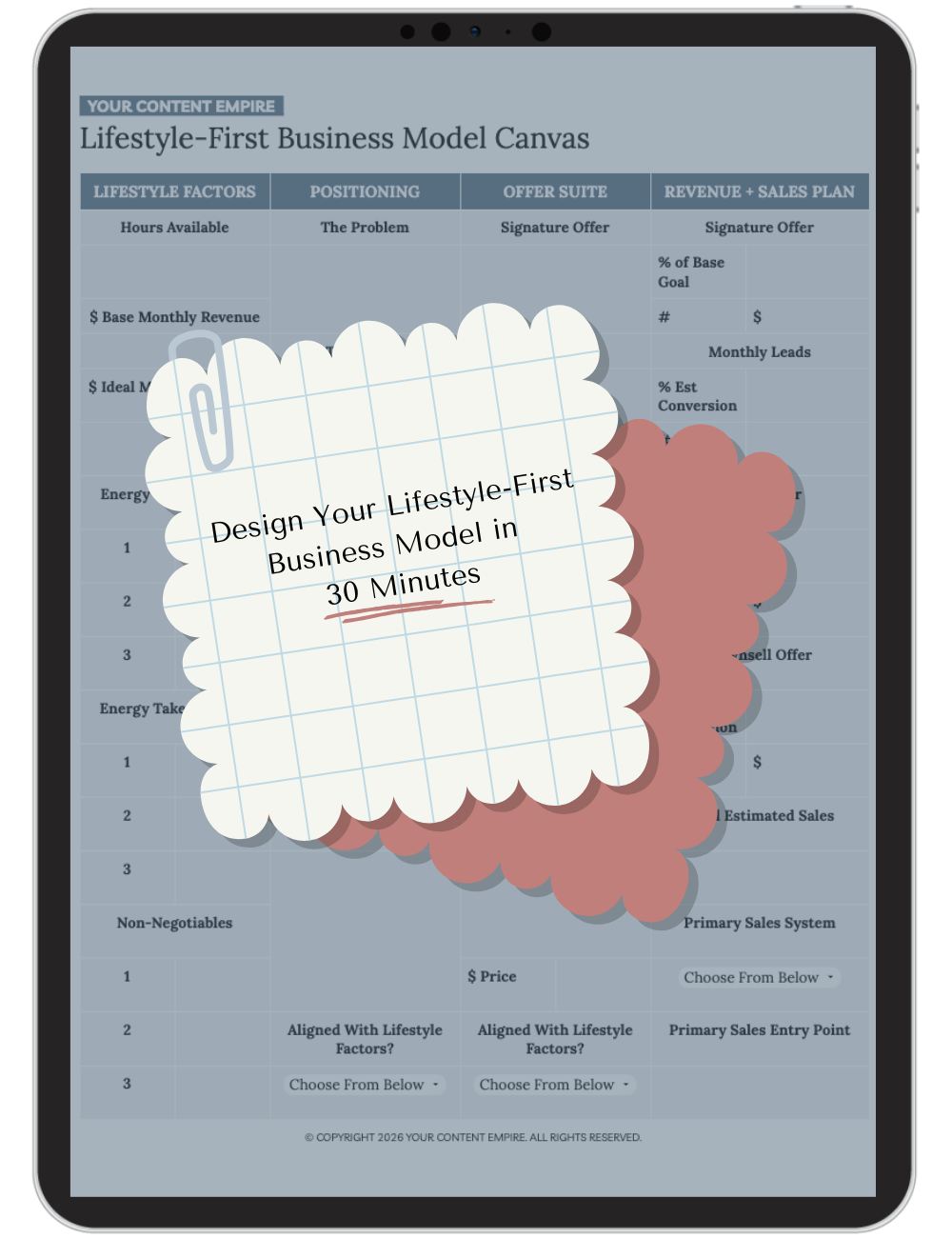
Click Here to Design Your Lifestyle-First Business Model with My Free Template


A monthly business retreat is a full week you block off each month with no meetings, calls or client work so you can focus entirely on the projects that grow your business. Rotating through a few types of monthly business retreat across the quarter, like planning, project sprints and peer masterminds, helps you finish big work and stay out of the day-to-day scramble.
Once a month, every month, I block out an entire week. No meetings, no calls, no external commitments. Just protected time to work on the things that matter most to me and my business.
I started doing this several years ago and I didn’t expect it to have the impact that it has. I wrote my upcoming book this way. I've built entire funnels, launched new programs, prepped entire launches and planned full quarters in these weeks.
And now it's one of the most sacred things in my calendar.
In this episode, I'm walking you through exactly what these weeks look like, why I do it and the 3 different types I rotate through each quarter.
If you’re a business owner, in pretty much any niche, I’d bet you know exactly what all of us struggle with.
It usually starts with a list somewhere. Maybe it's in a doc, maybe it's in your project management tool, maybe it's just living in your head rent-free. But it’s full of the things you really want to work on. The funnel you want to build. The program you want to create. The systems you keep meaning to document. The big project that you know would change EVERYTHING for your business.
And that list just sits there.
Because every week you're in delivery mode. You're on calls. You're managing client work. You've got kids to pick up, appointments to get to, a life that doesn't pause because you have a big project you want to work on. And by the time Friday rolls around, you've been incredibly busy but you haven't touched a single thing on that list.
This was my status quo for way too long. I had big projects I wanted to work on and I couldn't find the time to make real progress because I was always working IN my business instead of ON it.
Pretty much the best thing that has ever happened for my business is me realizing that one big thing needed to change. Which is, I started blocking out one full week for a “retreat” every month.
And I now rotate through 3 different types of retreats depending on what that quarter needs: my quarterly planning retreat, my quarterly project sprint and my quarterly peer mastermind retreat ↓
Context-switching is expensive. Every time you stop delivering client work and try to switch into strategic or creative mode, there's a ramp-up cost. You have to get back into the project, remember where you left off, get into the right headspace. And then just as you hit your stride, it's time to go back to the other thing. You never actually make any meaningful progress, and you certainly don't finish the thing the way you want to.
My monthly retreat strategy eliminates that. You get to go deep. You stay in one mode for days at a stretch and the momentum you build is completely different from what you can create in scattered pockets of time.
One of my favorite books that underpins this entire strategy is the 12 Week Year by Brian Moran and Michael Lennington. The basic premise is that you treat each quarter like its own year. And built into that system is a concept I love called Week 13. In a 12-week cycle, Week 13 is yours. You can use it to catch up, get ahead on the next quarter or, like I do, take it completely off. I'll go deeper on how this connects to my quarterly planning retreat in a minute but I wanted to plant that seed now because it completely changes how you think about your calendar.
Some of you are already thinking: I can't just block out a whole week. I have clients. I have obligations. Things will fall apart.
I thought the same thing. But when I intentionally prepped for them, almost nothing fell apart. What I found is that most things that feel urgent are actually just things that have been trained to feel urgent because you've always been available. When you give people advance notice and set clear boundaries, they adjust. Your business isn't going to collapse because you took a week off from meetings.
A few things that make this work in practice. Tell clients at least 2 weeks in advance. Set an out-of-office so expectations are managed automatically. Block the calendar and actually hold it. And give yourself permission for the week to be imperfect sometimes. Life will interrupt occasionally and that's okay. A partially protected week is still infinitely more valuable than no protected week at all.
Here’s something that I do: When I’m planning my year, I block off ALL of these weeks. They might move but they're blocked off. And I find that having something to look forward to every single month really does something for my motivation.
Like I mentioned, I have 3 types of retreats that I rotate through throughout the quarter. But you don’t necessarily need to do all 3. You might just pick one and run with it for a full quarter. If you've got a backlog of projects you need to ship, maybe you start with all project sprints. If your business feels disorganized and you're flying blind every quarter, the quarterly planning retreat could be your starting point. Or if you’re needing some connection and peer support, the peer mastermind retreat is where it’s at. Pick what's most needed for where you are right now and begin there.
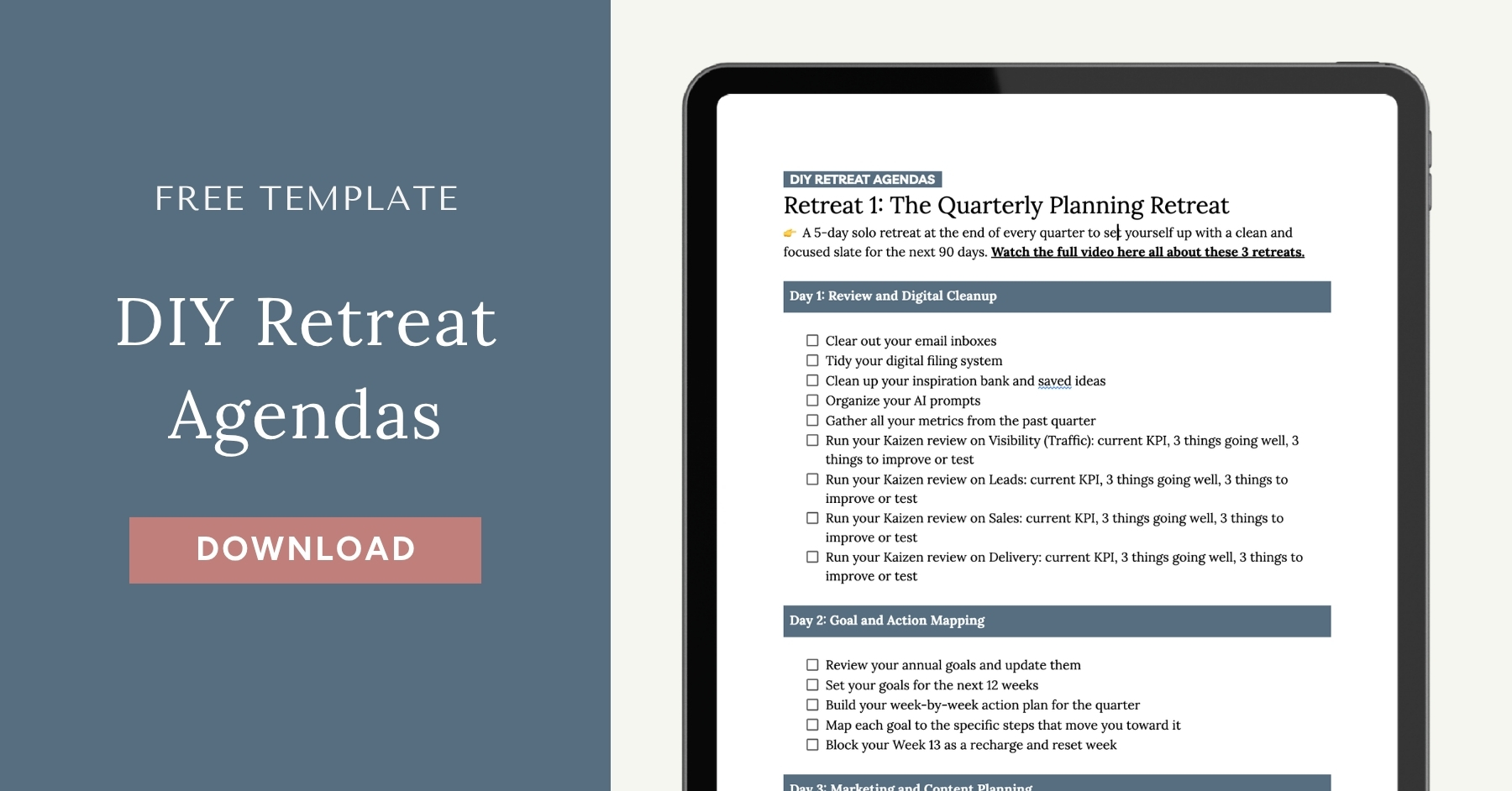
The first type of retreat I run is the quarterly planning retreat. I do this one at the end of every quarter. It's 5 days and it's entirely focused on setting myself up with a clean and focused slate for the next 90 days.
Here’s the agenda that I typically follow:
Day 1 is review and digital cleanup.
Day 2 is goal and action mapping.
Day 3 is the marketing and content planning day
Day 4 is implementation day.
Day 5 is personal planning.
So that’s my 5-day quarterly planning retreat agenda in a nutshell.
Next up is my project sprint retreat.
This one I do in month 1 or month 2 of the quarter and it's the most focused week I have. It's also how I've made more progress on big projects than I ever thought humanly possible.
The concept is pretty simple. You have one big project. You give it a full week of protected time.
Before the retreat starts I break down a detailed action plan for the project. I don't go into the week winging it. I know exactly what needs to get done and in what order before I sit down on Day 1. I don't assign each action item to a day because things often take me longer than I think they're going to take me. Nothing kills my momentum faster than feeling like I'm behind. For me, just having that list of the things that have to get done and in the order they have to get done is perfect preparation.
Then during the week I work in 90-minute sprints with 30 to 60 minute breaks between them. That rhythm is important. It keeps me focused during the sprints and it keeps me from burning out by Wednesday. During my breaks, I'll read a book, go for a walk, go for a workout, sit down and eat without distractions, or do something creative like painting or weaving for me.
I've used these weeks to complete entire funnels, prep new programs, get full launches ready and most recently write my upcoming book. I genuinely didn't think I could write a book while running a business – especially in just a week. These weeks proved me wrong.
The reason this works is pretty simple. When you're also in delivery mode, big creative or strategic projects get constantly deprioritized. There's always something that feels more urgent. A sprint week removes that competition . The project gets your full attention for 5 days. You'll finish the week wondering why you didn't start doing this sooner. I know for myself, whenever I've wrapped up this week, I always have the thought that I wish I could just work like this all the time. That's not entirely practical, which makes these weeks feel really special.
Finally I have the retreat that refills my cup more than anything else.
My other 2 retreat weeks are solo, heads-down and very internal. This one is the complete opposite. A few times a year I get together with my biz besties for a multi-day retreat. We find an Airbnb somewhere, usually 3 to 4 days plus travel on either end, and we just go deep together.
The structure is looser but there are some essentials. For one, each of us prepares a little mini masterclass. A private presentation about a strategy or approach that's working in our business or with our clients right now. We share those, we brainstorm, we mastermind. It's like having a private members-only event with people you actually trust, who are in the trenches with you, and who get it in a way that most people in your life just can’t.
But it's not all business. We hire a photographer for updated head shots and lifestyle photos. We film content together. We go out for really great dinners. We go grocery shopping in new places, which for me, as a Canadian who gets very excited about US grocery stores, means a Trader Joe's run every time.
I've found that this type of retreat does something the solo weeks can't. The energy you get from being around other ambitious, intentional people who are building something real is hard to replicate. You go home with new ideas, renewed motivation and usually a few strategies you can't wait to test.
This one is coming full circle for me this year. I've spent years flying somewhere else to do this. But this October I'm hosting one myself in Canada, on Vancouver Island where I live. I'll link the details below. If it's still available when you're watching this, come and experience this with us. And if the timing has passed, keep an eye out because this is something I plan to keep doing at least every few years.
So those are my 3 types of retreat weeks. The quarterly planning retreat, the project sprint week and the peer mastermind retreat. One per month, rotating through the quarter, each one serving a completely different purpose.
If you want to build your own version of this, I put together 3 retreat agendas, one for each type, that you can use as your own starting point. They've got the full structure mapped out so you're not starting from scratch figuring out what to do with the week.
And if you want to experience a version of this in person, I’m hosting a peer mastermind retreat on Vancouver Island. The details are linked below too. I'd love to have you there.
If this episode was useful, subscribe so you don't miss what's coming next. I'll see you in the next one.
Structure each monthly business retreat around a single purpose so the week stays focused. The quarterly planning retreat runs 5 days at the end of the quarter and moves through review and digital cleanup, goal and action mapping, marketing and content planning, an implementation day and personal planning, which sets you up with a clean and focused slate for the next 90 days.
A monthly business retreat removes the cost of context-switching, which is the ramp-up time you lose every time you stop client work to pick up a big project and have to remember where you left off. A full blocked week lets you stay in one mode for days at a stretch, and that momentum is completely different from what you can build in scattered pockets of time.
Use a project sprint style of monthly business retreat, where one big project gets your full attention for 5 days. Break the project into a clear action plan ahead of time, then work in 3 to 4 ninety-minute sprints a day with real breaks in between, which is how entire funnels, launches and even a book have gotten finished in a single week.

I’m Hailey and I help business owners who are tired of the hustle-harder advice build content systems that actually sell. No performative posting. No chasing algorithms. Just strategic, sustainable growth. More about me + my approach →
You’ve got two options: start small with a one-time strategy session, or go all in with done-with-you scaling support.
Scaling
Sales
Content
All Posts

In This Post: How do you create a business vision? To create a business vision, start with your ideal life, design the business that supports it, then combine the two into one cohesive plan. The most reliable way to create a business vision you'll actually use is to...

In This Post: How do you sell after a workshop? The secret to how to sell after a workshop is the 5 to 7 days right after it ends, where most of your sales actually get made. Run a daily follow-up plan of emails, posts and real conversations, sell to your warmest...

In This Post: What is the best workshop promotion plan for coaches and course creators? The most effective workshop promotion plan for coaches and course creators is a 3 to 4 week promo ramp that builds momentum gradually, paired with the 1 Message 4 Ways system that...
