“As an entrepreneur, I've learned to surround myself with people who have skills that I lack. FB ads and email funnels were something I knew I wanted to be doing in my business but I had no idea where to start. I put it off for a while because it was outside my comfort zone, and it wasn’t until I found Hailey that I felt confident moving forward with them. Hailey took the reigns and created a system for me that was not only profitable, but really helped me create more space in my day to work on the things that are in my zone of genius!”
Lauren Bongiorno Diabetic Health Coach
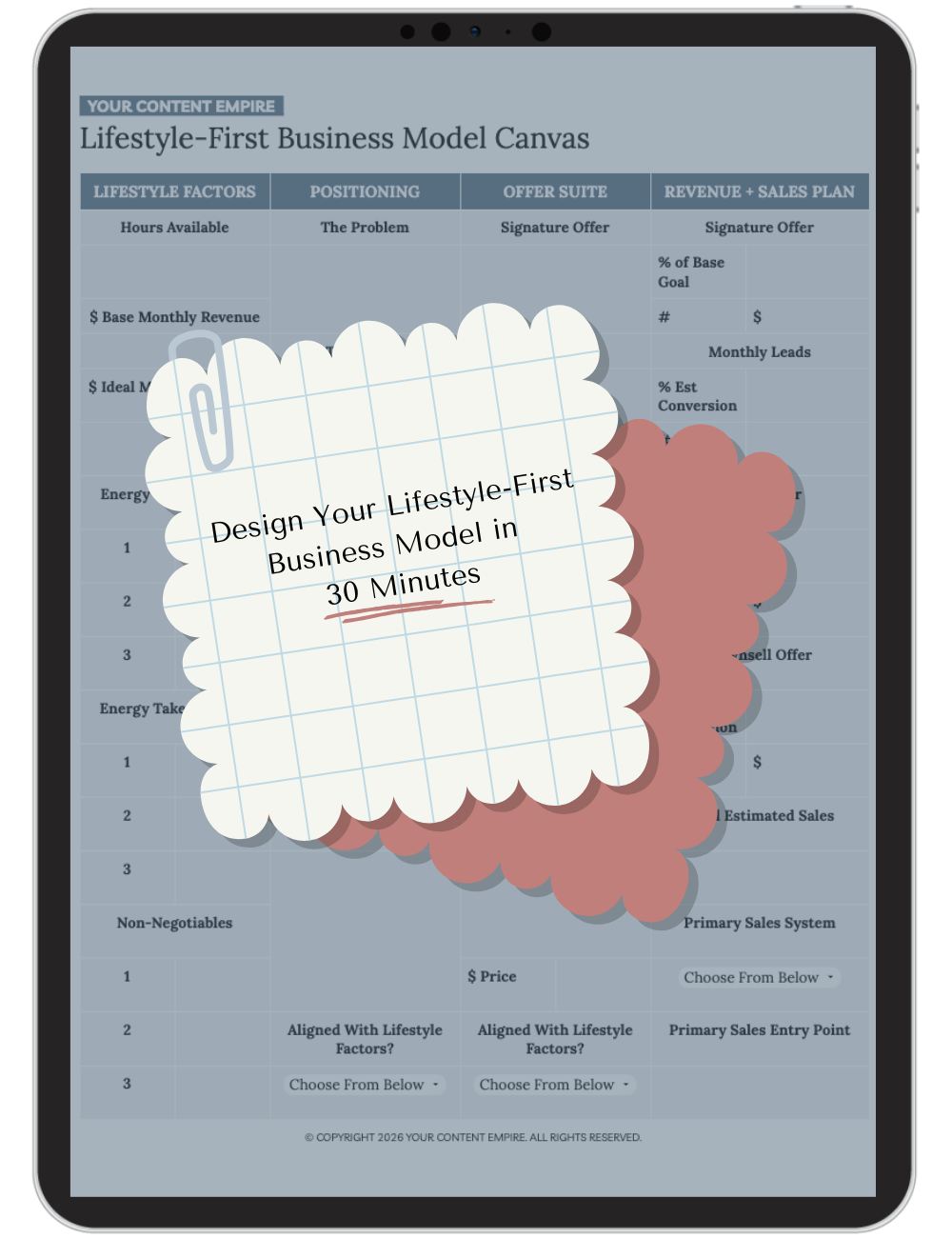
Click Here to Design Your Lifestyle-First Business Model with My Free Template
Case Study: Redesigning a Legacy Blogger’s Business Model
What would you do if two of your main income streams started declining at the same time? That's the situation one of my long-time customers (a legacy blogger) found herself in and when I looked at her business model I found something a lot of people in her situation miss entirely.
I recently put out a call to the members of my program, the $10K Monthly Content System, offering a business model review that I could use as a video case study. One of my members volunteered right away and honestly her situation was so relatable that I knew I had to share it with you. She's been in the online space for over 16 years. She's built a lot of really great content and has genuinely helped a lot of people.
But she's dealing with a two-front revenue squeeze. Her blog ad revenue has been declining for a couple of years now, which is something a lot of legacy bloggers are experiencing right now. And her digital product sales have dropped at the same time. It's two things hitting simultaneously. And when that happens the instinct is to create more. More content. More products. More effort. But in a lot of cases I see (including hers) the answer isn't more. It's different. Specifically, a different business model.
I'm going to walk you through exactly what I found when I brought her through my Lifestyle-First Business Model Design process so that if you find yourself in a similar situation, you can follow along.
Prefer to watch instead?
Want to listen on the go?
Just a note: This volunteer asked to remain anonymous and I completely respect that. So I've redacted her name, her business name and the specific names of her offers and methods throughout this episode. But the strategy is real, the numbers are real and I promise the lessons apply directly to your business regardless.
Like I mentioned, our case study subject has been in her niche for over 16 years. She has a real body of work, established methods and a genuine community. She's not someone who's new to this. But right now she's at a crossroads. Her blog ad revenue, which used to be a reliable income stream, has been declining. And her digital product sales have followed. She used to be at $6000 a month consistently but that’s dropped to just $1000 a month. So her first revenue goal milestone that she’s working towards is stabilizing at $3000 per month.
What I found when I looked at her business model wasn't a content problem or a traffic problem. It was a structure problem. Her current setup requires too many individual sales every single month with no compounding mechanism to make hitting her goal easier over time. That’s especially common when we’re looking at lower price point products.
So let me walk you through each step of the business model redesign process:
Step 1: Lifestyle Factors
Step 1 was to get clear on her lifestyle factors and non-negotiables. I always start here. Because your business has to work with your life otherwise you’re never going to stick with it long enough to ever see results.
This case study subject has about 20 to 25 hours available per week to work on her business. She has caregiving responsibilities that require a flexible schedule. And she deals with unpredictable energy due to perimenopause.
Her energy givers? Teaching, creating content when it feels connected to her mission and selling that's rooted in service rather than pressure.
Her energy takers? The unpredictable energy cycles, the emotional crash after launches and client-facing conversations that drain rather than fill her up.
Her non-negotiables were a flexible schedule to accommodate her caregiving responsibilities, a workload that doesn't follow a boom and bust pattern of one-off launches and selling that feels genuinely aligned with who she is.
My recommendation was to design a flexible ideal work calendar with time blocks for each task type: content creation, marketing, delivery and admin. Not hard deadlines. A perpetual to-do list she can work through at whatever pace her energy allows that day. On high-energy days she moves faster. On low-energy days she pulls from the same list at a gentler pace. This helps remove guilt. The “falling behind” trap. And avoids the all-or-nothing launch cycles that lead to weeks of recovery afterward.
So here's what I want you to ask yourself if you find yourself in a similar boat: Is your current business model designed for your real capacity or the capacity you have on your best days? Because those two things are often very different and your business model should always be built around the first one.
Step 2: Positioning
Once lifestyle factors are mapped, positioning is the next place I look. Because your positioning is the lens that everything else gets filtered through: your offers, your content, your sales conversations. Clear positioning makes every decision easier. Alternatively, fuzzy positioning makes everything harder.
Our case study subject has been in her niche long enough to have developed real depth. She teaches home organization, decluttering and decorating. Three distinct things she knows inside out. And that's actually where the positioning challenge comes from. Because when you're selling to people, they don't necessarily see those three things as one cohesive solution. They tend to see them as separate needs. Some people want to tackle the clutter. Some people want to redecorate. And some people can't even think about decorating until the clutter is gone.
She told me she's questioned her own decision to bundle all three together because people see these as separate things. And she's right. They do. But the problem isn't that she teaches all three. The problem is that she's been selling them all at once rather than sequencing them strategically.
My recommendation was to restructure her signature framework into three clear phases. Phase one tackles decluttering. Phase two tackles organization. Phase three is design and decorating once the foundation is in place. Her core offer delivers phases one and two. Design becomes the natural exciting next step. The upsell. The thing people are ready for once their home finally feels functional and calm.
This isn't about shrinking her expertise. All of her knowledge is still in the business and in her offers. It's just sequenced in a way that makes sense to buyers and creates a natural progression instead of one overwhelming bundle. And it also gives her a much cleaner content strategy. Every piece of content maps to one of the three phases and speaks to someone at a specific point in their journey.
So here's the question to ask yourself: If someone landed on your content or your website today would they immediately understand what stage of their journey you help with and what the logical next step is for them? If the answer is no that's probably worth sitting with.
Step 3: The Offer Suite
With lifestyle factors and positioning mapped, the next step is looking at the offer suite. Because your offers are where your positioning meets your revenue goals. And if your offer architecture doesn't fit your capacity or create a clear pathway to your targets, it doesn't matter how good your content is. The math just won't work.
This is where the biggest structural issue in her business showed up.
Her current signature offer is a self-paced course at $197 one-time. No recurring revenue. No structural reason for buyers to stay engaged after purchase. And here's where the math becomes really important.
If her goal is $3000 a month she needs 15 sales of that $197 course every single month. Starting from zero each month. And to do that consistently without a launch or a big ad spend is gonna be tough. That's the model that's been burning her out. And that's also the model that makes her revenue feel so feast and famine. She launches, she gets a burst of sales, the promotion stops because she’s burnt out and the revenue dries up.
Here's the big shift: What if instead of a $197 one-time course her signature offer was a $27 per month membership? To hit $3,000 per month she needs 111 active members. Those members stack each month. Month one she gets 10 members. She carries those 10 into month two. She adds 10 more. Now she's carrying 20 into month three. She's not starting from zero. She's building on what already exists. That compounding effect is what changes everything.
And she already has the content to fuel it. Sixteen years of teaching in her niche means she's not starting from scratch. She can systematize what already exists and deliver it as a recurring monthly experience rather than a static one-time course that buyers complete and leave.
The redesigned offer suite looks like this. A monthly membership as the signature offer. A design and decorating course as the natural upsell for members who are ready for phase three. A standalone Home Habits course as the downsell for people who aren't ready to commit to a membership yet. And a monthly paid challenge or workshop as the primary entry offer at around $15 early bird and $27 regularly with an order bump for a VIP experience at an additional price.
She doesn't need to start with 111 members. She needs to start with one. And then two. And focus on designing an experience so good, they stay (which for her with her natural skillset and how she makes her audience feel is going to be much easier and aligned).
So here's the question for you: If you're selling one-time products or courses have you done the math on how many new sales you need every single month to hit your revenue goal? And is that number something you can realistically hit without burning out?
Step 4: Revenue Planning
With the redesigned offer suite in place, the next step is reverse engineering the revenue plan. Because it's one thing to have the right offers. It's another to know exactly how many sales of each one you need to actually hit your goal. This is the step most people skip and it's also the step that makes everything feel so much more achievable once you do it.
But first I want to address why I'm recommending a membership model here because memberships are not the right fit for every business or every business owner. What makes them worth considering for our case study subject specifically are her product price points. When your products are priced at $27 or $197 you need a lot of individual sales to move the needle every month. MRR or monthly recurring revenue becomes a really powerful lever for simplifying your path to your monthly goal because instead of chasing 15 new sales every month you're building a base that carries forward and compounds. The lower your price point the more that compounding effect matters.
So let's look at what $3,000 a month actually looks like with the new model.
The monthly challenge or workshop becomes the primary entry point and sales engine. And here's something I love about the way this is structured: the challenge is priced at $15 early bird and $27 regularly which is the same price as the monthly membership. That's intentional for two reasons. First because members get access to the monthly challenge as part of their membership experience so we’re not creating additional work. So the challenge is both a standalone paid event for new people and a retention and value driver for existing members. Second because it price anchors the membership perfectly. Someone pays $27 for a single challenge and then discovers they can get that every single month plus everything else in the membership for the same price. That's an easy yes.
At a 5% conversion rate she needs around 2,000 page visitors or about 100 engaged leads per month to generate 100 challenge sign-ups. Of those 100 sign-ups around 25 add the VIP order bump at around $47 generating roughly $1,175 in additional revenue right there. The challenge then becomes the conversion event for the membership. At a 10% conversion rate from challenge attendees she's adding around 10 new members per month at $27 each. Those members carry into the next month and the month after that. Layer in one or two upsell sales of the design course and a downsell here and there and by month three or four she's hitting $3,000 from a combination of challenge revenue and compounding membership revenue. Without a single big launch, putting tons of pressure on any one product to pull all the weight or relying on dwindling ad revenue.
Now just to be transparent about where these conversion estimates come from. They're based on patterns I see across clients running similar models and they reflect what's realistic when your leads are already warm and bought into what you do. They're a starting point not a guarantee. She'll dial these numbers in based on her own experience running the paid challenge or workshop system each month and adjust from there as she sees her actual numbers come in.
That's the difference between revenue that resets and revenue that stacks. Every month with a one-time product she starts at zero. Every month with a membership she starts at whatever her current member count generates and adds to it. Same marketing effort. Completely different result.
So here's the question for you: Have you actually mapped out what your revenue plan looks like broken down by offer? Not a general goal but the specific number of sales at each price point that adds up to your monthly target? Because until you can see it clearly it's really hard to know whether the path you're on is actually going to get you there.
Step 5: Content and Marketing Plan
Once your offer suite and revenue plan are clear the next question is: how are people actually going to find you and move through your offer ecosystem? Your marketing and sales plan is the engine that drives everything. Without it even the best-designed offer suite just sits there.
I use a framework called the TLC Method to plan this. Traffic, Leads and Conversions. Three things that every business needs working together to generate consistent revenue. Most business owners have at least one of these running but rarely all three connected in a way that flows smoothly from one to the next.
For our case study subject all three existed but they were disconnected. She has real traffic infrastructure from 16 years of content creation across multiple platforms. She has proven lead magnets that have shown they can convert. But there was no consistent pathway taking someone from traffic to lead to paying customer. Every sale required a manual push.
So here's how the redesigned TLC plan comes together.
For traffic the focus for the first 90 days is SEO-driven content. She's already working on it and it builds compounding long-term traffic without requiring her to show up and perform every single day. Every piece of content ties back to the monthly challenge or workshop theme giving each post a clear job to do rather than just existing for the sake of consistency.
For leads the monthly challenge or workshop becomes the primary opt-in and relationship builder. A freebie specifically connected to phases one and two of her framework feeds cold traffic into the membership pathway. And every new subscriber enters a welcome sequence that leads naturally toward the next challenge registration.
Then circling back quickly to traffic: once that SEO foundation is in place the next layer is paid ads pointing directly to her freebie. The goal is to fund those ads with revenue from her standalone digital products so the growth engine is essentially self-financing rather than coming out of pocket or the revenue plan.
For conversions the paid challenge or workshop system does the heavy lifting. It's the event that warms people up, delivers real value and then makes the membership invitation feel like the most obvious next step in the world. Post-purchase email sequences on every entry offer automatically walk buyers toward the membership so that no sale is ever a dead end again.
One engine. Traffic flows to the challenge. The challenge converts to the membership. The membership leads to the upsell. Everything else can be layered in later once this core system is running consistently.
So here's the question for you: Is there one clear pathway in your business right now that takes someone from first contact to your best offer? Or are you spreading your energy across multiple systems and not getting enough traction on any of them?
What's The Next Step? Start Here ↓
If you're watching or reading this and thinking “I need to take a closer look at my own business model” I have two ways to help.
First you can grab my free Lifestyle-First Business Model template. It's the same framework I used in this case study and it walks you through every step we covered today: your lifestyle factors, your positioning, your offer suite, your revenue plan and your marketing and sales strategy. It's the best place to start if you want to map your own business model and see where the gaps are. The link is in the description.
But if you want someone to do this with you, to look at your business model with fresh strategic eyes and help you design something that actually fits your life and hits your revenue goals, that's exactly what I do inside my coach-sulting partnership. We sit down together, go through your entire model and build a custom scaling strategy around your capacity, your positioning and your goals. No generic advice. No cookie-cutter frameworks. Just a clear plan designed specifically for you.
What I found with our case study subject is what I find with almost every business owner I work with. The problems aren't unique. The structure is almost always the thing that needs shifting. And once you can see it clearly everything else gets so much simpler.
I’m Hailey and I help business owners who are tired of the hustle-harder advice build content systems that actually sell. No performative posting. No chasing algorithms. Just strategic, sustainable growth. More about me + my approach →
Stop guessing. Start scaling. This one-page template helps you design a business model that supports both your revenue goals and your actual life.
Browse By Topic
Scaling
Sales
Content
All Posts
Search The Blog
FREE TEMPLATE
The Lifestyle-First Business Model
Design a business model that supports both your revenue goals and your real life. This one-page template walks you through your lifestyle factors, positioning, offer map, revenue plan, and sales strategies so you can finally stop guessing and start scaling with clarity.
In This Post: How do you get more sales from your sales funnel? The best way to get more sales from your sales funnel is to follow up with the people who didn't buy the first time, since only about 5% of your audience is ready to buy at any given moment. Set up a...
In This Post: How do you reset your business model? You reset your business model by rebuilding it in the right order: lifestyle first, then positioning, offers, revenue planning and marketing. Follow that sequence and you can reset your business model in about 90...
In This Post: What is a monthly business retreat? A monthly business retreat is a full week you block off each month with no meetings, calls or client work so you can focus entirely on the projects that grow your business. Rotating through a few types of monthly...