“As an entrepreneur, I've learned to surround myself with people who have skills that I lack. FB ads and email funnels were something I knew I wanted to be doing in my business but I had no idea where to start. I put it off for a while because it was outside my comfort zone, and it wasn’t until I found Hailey that I felt confident moving forward with them. Hailey took the reigns and created a system for me that was not only profitable, but really helped me create more space in my day to work on the things that are in my zone of genius!”
Lauren Bongiorno Diabetic Health Coach
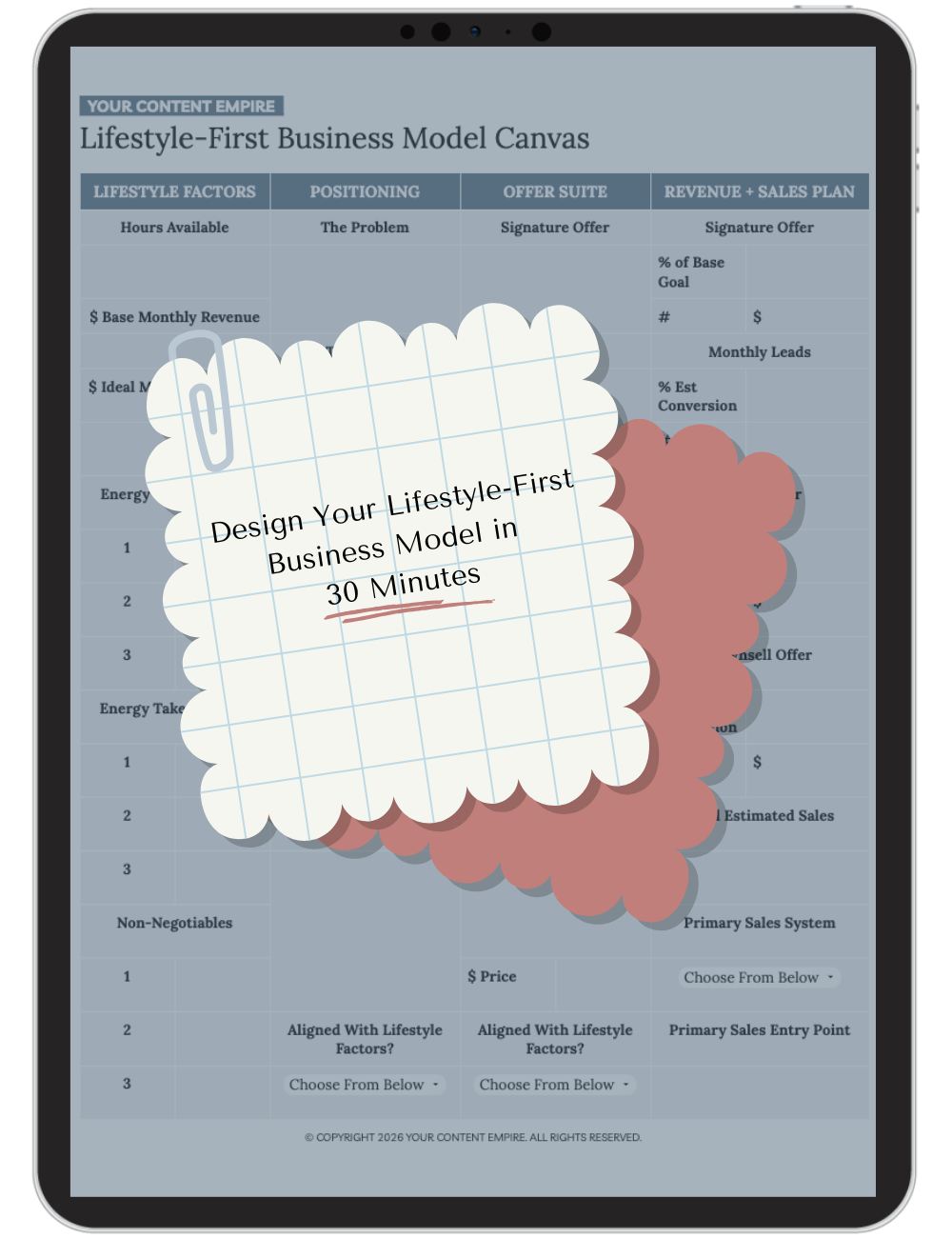
Click Here to Design Your Lifestyle-First Business Model with My Free Template
How to Delegate Your Content Without Making It Suck
You've built a successful business on the strength of your voice, your stories, your unique perspective. But now you're at that stage where content creation is becoming the bottleneck in your growth. You know you need some help, but every time you think about how to delegate your content, a little voice in your head says “But what if it doesn't sound like me anymore?”
But guess what? You don't have to choose between scaling your content and maintaining your authentic voice. Today I'm breaking down exactly how to delegate your content creation without losing what makes you… you. And if you're thinking “easier said than done,” stick around because I'm sharing the exact framework I use with my content management clients who are getting some major help with their content so they can scale to bigger audiences and reclaim more time for the work that only they can do.
Prefer to watch instead?
Want to listen on the go?
Let me ask you a question – are you spending more time managing your content than creating it? Because if you've been in business for at least a few years, chances are you've hit that point where your content workflow has become this behemoth that's eating up all your time. Or, alternatively, more than a few deadlines are falling between the cracks.
Here's what I'm seeing happen with influencers and business owners at that awkward stage where they’re ready to go bigger but haven’t found a way to clone themselves yet so they can physically do more in the time they have. They already know that their content is working. They've got the audience, the engagement, the sales, the brand deals. But they’re often drowning in the operational side of getting that content out into the world consistently.
The problem is, when most people think about delegating content, they think about handing over the whole thing. And that's exactly where the risk is, that you’ll lose their voice and with it the momentum you’ve worked so hard to build.
In this video, I’m going to cover the 5 layers of content delegation – what to keep, what to give away and how to do it to maintain the integrity of your brand.
Ideation (The Foundation Layer)
Let's start with the foundational layer – ideation. This is where most people get it wrong right out of the gate.
Here's what you should NOT being doing: Opening ChatGPT and saying “write me 10 blog post ideas about BLANK – marketing, parenting, painting, bread making.” I don't care how good your prompts are – that's not going to connect with your audience because it's not coming from your experience.
What's working in 2025 is content that removes the distance between you and your audience. We're seeing a major shift away from generic educational content toward story-driven, experience-based content. People can get a how-to anywhere but they can only get your experience with that how-to from you.
So ideation needs to stay with you, but here's the strategic way to approach it:
Your best content ideas come from three places: your signature frameworks, your client conversations, and your personal experiences. The key is having systems to capture these ideas when they hit.
I work with a handful of business owners really closely through the year in my Type-A Creative content and business management package. And one of the things that we all love is the ideas that come from between call conversations where we’re bouncing ideas back and forth. Just last month, with one client, our ongoing conversations filled an entire Asana board with over 100 content ideas. Her problem wasn't finding ideas – it was having too many great ones to choose from. There wasn’t a single one of there that she wasn’t excited about and was willing to let go.
But here's where delegation (through collaboration and conversation) becomes powerful: Having someone who understands your frameworks enough to help you identify which stories and examples will best illustrate your points. Often that outside perspective is exactly what unlocks a steady stream of content ideas you can’t wait to create.
Creation (The Voice Layer)
Now let's talk about the actual creation phase – the writing, the speaking, the core content development. This is what I refer to as the voice layer. And it’s also where I see the biggest mistakes happening when it comes to delegating.
The tempting thing is to hand this off completely. “Here's my outline, can you write the blog post?” But if you do that, you're going to lose what makes your content magnetic – your personality, your specific way of explaining things, your unique analogies and examples.
Whether you’re outsourcing to a person or a robot (hey, ChatGPT or Claude), they’re likely not going to be able to capture the essence of your voice or create something to the standards of what you were yourself putting together. Yes, they can likely do a great first draft. But you’re going to have to put in some work to make it yours again.
Seriously though, if using ChatGPT to write all your copy or create all your content was “good enough,” why is there so much time being spent on disguising AI content to appear completely human written? Like removing all my beloved em-dashes which I no longer let myself use. The answer tells you everything you need to know about the value of authentic voice in your content and the importance of protecting it – even at the cost of your time.
It’s really interesting to see the slight downfall of written content we’re seeing happening because with the proliferation of AI-generated content, people are craving REAL. That’s one of the reasons that some of the most popular videos on YouTube right now are those long-form, two-hour podcast conversations. Why? Because they're authentic. They're real. And they're impossible to replicate with AI.
Side note: Could you imagine how quiet the internet would be if ChatGPT went down for a day?
This is such a tangent, but there’s also some fascinating research coming out of MIT about how using AI specifically for writing can actually weaken your own neural pathways for critical thought and may lead to cognitive decline.
So – back on track – what should you do instead? How can you, as a successful business owner or influencer, prioritize content creation when your schedule is overfilled or you want to get some help with it?
These are 2 approaches I’ve seen work wonders with clients and friends in similar predicaments:
First, develop a journaling and free-writing practice. Get your raw thoughts onto the page in your voice, and then have someone help refine and structure them.
Second – and this is what we do with some of my Type-A Creative content management clients are content interviews. Think of it like a mock podcast interview where someone asks you strategic questions that draw out your best thinking on a topic. You get to speak in your natural voice, share your stories, and express your ideas the way you naturally would. Then that becomes the foundation for a long-form piece of content and the repurposed snippets for social media and email.
This approach removes the distance between you and your content while giving you the support you need to actually get it created consistently.
Publishing (The Efficiency Layer)
Here's the part of your content strategy that you absolutely should delegate without hesitation.
Most visionaries and creatives I know, this is where they either become the bottleneck or completely stifle their content creation. They create amazing content and then it sits on their computer for weeks because getting it formatted, scheduled and distributed feels overwhelming. Because of who you are – an entrepreneur, an influencer, a creative business owner, the monotonous scheduling and publishing side of things is very very likely NOT your zone of genius or where you like to spend your time. Frankly, it’s a big waste of your time.
Even I drag my feet on the publishing side of things. It's not the strategic work or the creation part that really lights me up.
So delegate this part to your heart’s content – with one big caveat. Make sure that when you’re outsourcing your scheduling, you’re doing it with solid systems in place and quality control guardrails established.
The publishing phase includes everything from formatting and graphics to scheduling, cross-platform distribution, email integration – all the operational pieces that need to happen but don't require your creative brain.
The big thing here is that you want systems designed from your strategy, not just any old generic systems. Don't just ask someone “What's the system for posting on social media?” Instead, have them create workflows that align with your specific goals, your launch calendar, your audience behavior.
This is that crucial junction where strategy meets systems and having someone design these systems for you is a super smart investment.
This is one of the first things that we tackle with any new clients who become a Type-A Creative content management client – we get your content documentation and strategy figured out so they work together.
Strategy (The Management Layer)
This brings us to one of the most overlooked aspects of content delegation – the strategy or the management layer.
Having someone else hold the editorial calendar, deadlines and content strategy in their head for you is game-changing. This frees up your mental bandwidth for the creative and thought leadership work that only you can do.
While someone else worries about the details like tracking what content ties to which launch, what deadlines are coming up, how your content calendar aligns with your business goals, all the pieces that need to happen to get that next post out.
This is especially crucial for 6- and 7-figure business owners and influencers because your content isn't just content anymore – it's a strategic business asset that needs to coordinate with launches, campaigns and revenue goals.
With my Type-A Creative clients, I'm the one holding that bigger picture. They know I'm tracking how their content supports their business objectives, so they can dive deep into creating without worrying that something’s going to get missed.
Optimization (The Data Layer)
Finally, that brings us to optimization (the data layer) which is the analyzing and improving phase that most creatives either skip entirely or get overwhelmed by
If you're not someone who loves looking at the numbers (and most of my creative clients aren't or they just don’t have the bandwidth for it), this is another perfect area for delegation. But it's not just about collecting the data – it's about analyzing what it means and turning insights into actionable improvements.
The right person on your team can track your content performance, identify patterns in what is resonating with your audience, and give you strategic recommendations for improving your content and marketing without you having to dive into analytics dashboards.
This is where having someone who understands both your creative process AND your business goals becomes invaluable.
So many of my clients waste so much time working in circles, trying to fix the wrong problems or things that just don’t matter. If there’s one thing that’s going to help you bring your business or brand to the next level, it’s focusing on the right things – and your numbers hold the keys to those right things.
A Strategic Business Partner Who Doesn't Need Equity…
At the end of the day, there isn't a one-size-fits-all prescription pill for content delegation. The strategies and systems that actually stick and work long-term are going to be the ones designed specifically for you, your goals, your constraints and your natural creative process.
My clients are evidence of this. One client’s a journalist with 15 years of experience; and she needs a completely different content system and set up than another client who’s an influencer with a passion for creating the funny, viral tiktoks but has admittedly a complete distaste for everything else content and copy related. The key is finding someone who can create custom systems that amplify your strengths rather than trying to force you into some generic process that they claim is proven to work for everyone.
The goal isn't to remove you from your content – it's to remove you from everything that isn't your genius zone so you can create more, with less stress, and reach those bigger audiences you're dreaming of.
If you're ready to scale your content without losing your voice, I'd love to chat about how this might look for your specific business. I work with a select number of creative entrepreneurs and influencers through my Type-A Creative partnership, where we handle everything from strategic planning to execution so you can focus on what you do best.
HEY THERE!
I’m Hailey and I help business owners who are tired of the hustle-harder advice build content systems that actually sell. No performative posting. No chasing algorithms. Just strategic, sustainable growth. More about me + my approach →
Stop guessing. Start scaling. This one-page template helps you design a business model that supports both your revenue goals and your actual life.
Browse By Topic
Scaling
Sales
Content
All Posts
Search The Blog
FREE TEMPLATE
The Lifestyle-First Business Model
Design a business model that supports both your revenue goals and your real life. This one-page template walks you through your lifestyle factors, positioning, offer map, revenue plan, and sales strategies so you can finally stop guessing and start scaling with clarity.
In This Post: How do you get more sales from your sales funnel? The best way to get more sales from your sales funnel is to follow up with the people who didn't buy the first time, since only about 5% of your audience is ready to buy at any given moment. Set up a...
In This Post: How do you reset your business model? You reset your business model by rebuilding it in the right order: lifestyle first, then positioning, offers, revenue planning and marketing. Follow that sequence and you can reset your business model in about 90...
In This Post: What is a monthly business retreat? A monthly business retreat is a full week you block off each month with no meetings, calls or client work so you can focus entirely on the projects that grow your business. Rotating through a few types of monthly...