“As an entrepreneur, I've learned to surround myself with people who have skills that I lack. FB ads and email funnels were something I knew I wanted to be doing in my business but I had no idea where to start. I put it off for a while because it was outside my comfort zone, and it wasn’t until I found Hailey that I felt confident moving forward with them. Hailey took the reigns and created a system for me that was not only profitable, but really helped me create more space in my day to work on the things that are in my zone of genius!”
Lauren Bongiorno Diabetic Health Coach
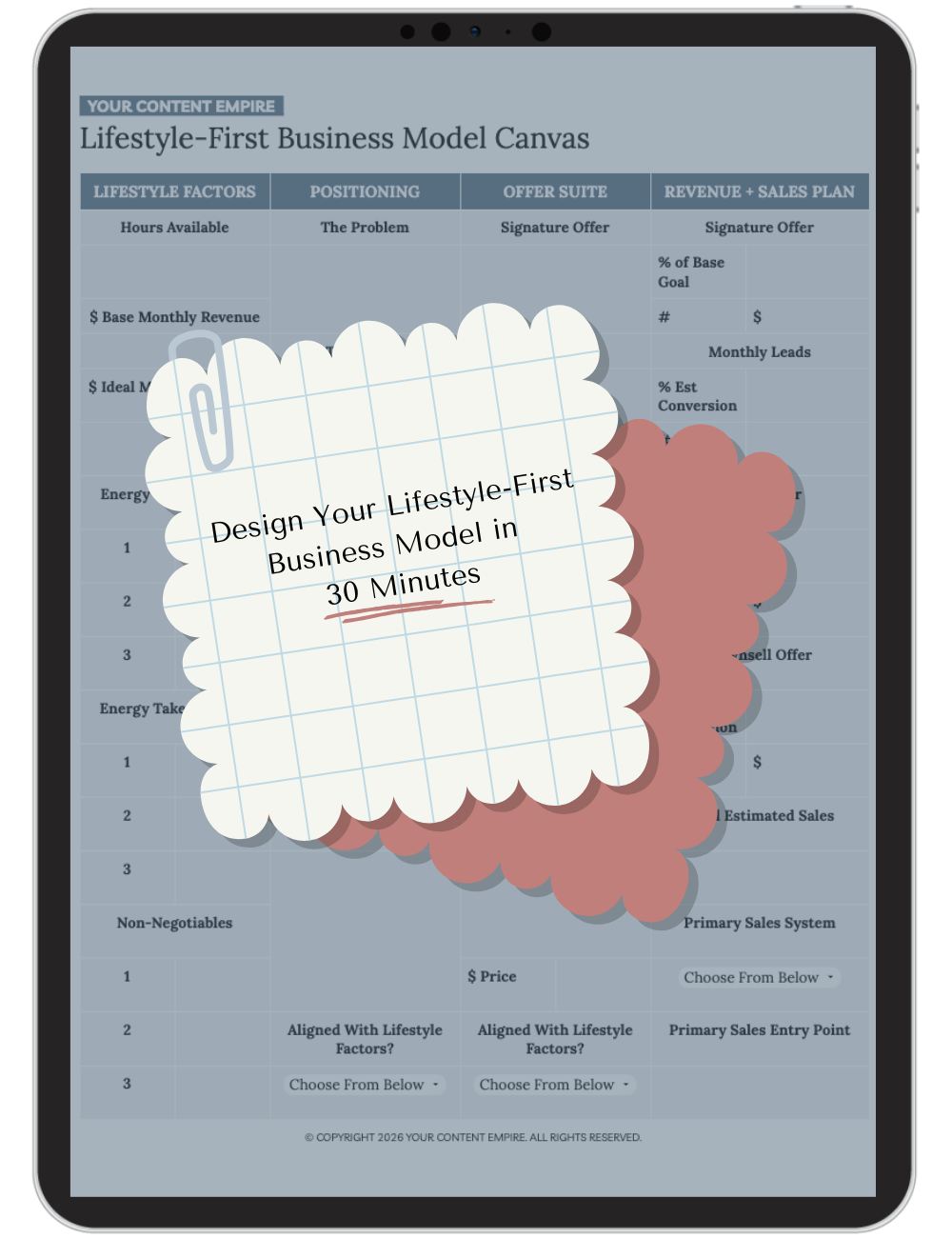
Click Here to Design Your Lifestyle-First Business Model with My Free Template
Why Scaling Requires a Personality Shift (In the Best Way)
What if the thing standing between you and scaling your business isn't finding the perfect strategy?
What if it's actually your personality?
Okay, I'm being a little dramatic. It’s not like you need a personality transplant.
But something I see a lot when working with business owners who are trying to scale: the strategies are usually fine. The offers are generally solid. But what’s getting in the way of them executing those strategies (assuming they have a sound business model, of course) is the way that they’re relating to their business.
What this shows up as is you chasing every new idea that crosses your feed. Deriving your mood from your metrics. Waiting for proof before you commit to the process.
And I get it because I was doing all of those things too.
What actually changed for me that let me start scaling without a ton of drama or hustle, happened internally. In fact, I didn’t even realize I’d made these 3 internal personality shifts until I looked back in hindsight and connected the dots.
And so if you want to scale in a way that actually protects your life instead of consuming it, this episode will show you the 3 biggest personality shifts you need to embrace.
Prefer to watch instead?
Want to listen on the go?
I want to be really clear about something. When I say scaling requires a personality shift, I'm not talking about the Alex Hormozi school of thought that says work every hour you have, never take a day off and sacrifice everything now for results later. That approach works for some people. But is it sustainable for the person with caregiving responsibilities, a health condition, a life they actually want to live right now? For most of the people I work with, the answer is no.
And before we go any further, it's worth asking yourself: why are you actually running a business? Is it for the life it's going to let you live? Or is it to build a giant empire no matter what the cost? Because those are two very different goals and they require two very different approaches.
The kind of scaling I'm talking about here is lifestyle-first scaling. Building a business that grows within the container of your real life, not at the expense of it.
And what I've found, both in my own business and working with clients, is that this kind of scaling requires you to become a specific type of person. Not a harder-working person or a more-motivated person. But a more discerning, more grounded and more devoted person.
Those are the three shifts we're talking about today.
Shift #1 is Discernment: learning to choose one thing and actually stick with it long enough for it to work.
Shift #2 is Boring: breaking up with the idea that your business should be a constant source of excitement and emotional highs.
Shift #3 is Devoted: replacing the need for results as proof with a deep commitment to the process itself.
Shift #1: Becoming More Discerning
For a long time I was a total strategy chaser. And honestly it wasn't even always about the results. I'd let my curiosity get the better of me. I was more interested in seeing what would happen with a new idea than I was in choosing the best strategy for my actual goals. Every time something new would cross my Instagram feed, a new funnel hack, a new content format, a new launch strategy, I'd think “I should drop everything and do this instead.” And so I'd drop whatever I was doing and start building something new.
It wasn’t just exhausting, as you can expect, my results also took a big hit, not because the strategies were bad but because I wasn't sticking with anything long enough for it to actually work. The results you're seeing in your business right now are largely a reflection of the work you were doing 90 days ago. So when you're constantly switching strategies every few weeks, you're never actually seeing what any of them are capable of.
Discernment is the antidote to that.
Discernment isn't about being closed-minded or resistant to new ideas. It's about having a clear filter so that when a potentially promising new strategy crosses your path, you can evaluate it quickly and objectively instead of just reacting to it.
And if you recognize yourself in what I just described, if you're someone who also struggles with chasing the next shiny strategy before the last one has had a chance to work, here's a little mental model tool I use called the Strategy Decision Matrix that’ll help.
When you're sitting on a list of strategy ideas and trying to figure out which one to actually move forward with, you score each one across four qualifications from 1 to 10:
ROI Potential. Realistically, what kind of return could this generate for the time and energy it requires?
Ease of Implementation. How complex is this to actually build and run given your current capacity and team?
Complements Existing Strategy. Does this fit naturally into what you're already doing or does it require you to rebuild everything around it?
Personal Buy-In. Do you actually want to do this? Not is it exciting. Not is it trending. Do you genuinely want to implement this in your business right now?
You tally the scores, rank your ideas and then the rule is simple: you choose your top scoring idea and you focus there first.
But here's the rule that matters even more than the matrix itself, and this is something I set for myself a few years ago and it genuinely changed how I operate:
You are only ever implementing one new strategy at a time.
You can be maintaining multiple things. Running your content, serving your clients, nurturing your list. That's maintaining. But introducing something new? One at a time. Everything else goes into a parking lot. A running list of ideas you're not ready to act on yet but you're not willing to lose either. Your brain gets to relax because the idea is safe. It's not gone. It's just waiting for the right time. And when you finish what you're currently implementing, that's when you go back to the parking lot and run the matrix again.
The businesses that scale aren't the ones with the most ideas. They're the ones that chose the right idea and stayed with it long enough to see what it could actually do. Discernment is what separates the business owners who are always busy from the ones who are actually building something. When you stop spreading your energy across ten half-implemented strategies and start directing it toward one thing at a time, the compound effect is a big deal.
Shift #2: Embrace Boring
For a really long time (way too long) I defined a lot of my life and my worth through my business. I put off real life things, investing in friendships, exploring hobbies, just being a person, I even postponed my wedding 3 times because I was too busy with business stuff. There was always something in the business that felt more pressing or more important.
I really relied on my business to be a constant source of excitement, diversion and fun. That the buzz I got from a good launch or a post that took off or a new idea was part of the deal.
Here's what I know now: even though being obsessed with my business was something I thought was necessary to grow a business as big as possible, that belief was quietly sabotaging my ability to scale.
Because when your business is your sole source of excitement, every strategic decision becomes personal. A slow month feels like a personal failure. A post that doesn't land feels like a referendum on your worth. You end up needing the business to perform in order to feel good. It’s definitely a form of emotional dependency – a very unhealthy one.
The shift for me was to embrace boring.
Boring business means your business gets to be exactly what it is, a vehicle for your work and your income, without it having any say in how you feel about your life.
And since I made this shift, everything related to business has honestly gotten a lot easier, like: making strategy decisions without it feeling personal, looking at my numbers without feeling attacked by them, sticking with strategies even when they're not producing visible results yet because I'm not chasing some dopamine hit, having better boundaries with my email and social media because I don't need the feedback loop anymore and separating my self-worth from my metrics.
I have such a rich life now outside of work. My family, my hobbies, my friends, being a participating member of my local community. My whole identity isn’t wrapped up anymore by being a “business owner,” that’s one small part. And my business, as a result, allows me to have the lifestyle I really want.
That's not to say your business can't be a source of joy or purpose or pride. It absolutely can be (and still is for me). But it shouldn't be the sole source of those things. When it is, the stakes are too high and every decision gets distorted.
Save the excitement for your life. Let your business be steady, consistent and yes, a little boring. That's actually a really good sign.
This personality shift will help you scale because scaling requires you to keep going when it's not exciting. And if you've been relying on excitement as your fuel, you're going to run out of it. Boring business also removes much of the emotional noise. And without the noise, you can finally hear what your business actually needs.
Shift #3: Shifting Into Devotion
If discernment is about choosing the right strategies and boring is about detaching from the emotional noise, then devotion is what keeps you going when neither of those is easy.
Devotion is commitment to the vision even when you have no evidence yet that it's coming true.
The truth is that when you're scaling, there's going to be stretches of time where you're doing everything right and nothing looks like it's working yet. The leads haven't spiked. The launch numbers aren't there. The content feels like it's going into a void. I call this the “nothing's happening” middle. And it's not a sign that something is wrong. It's actually a completely normal part of the process. But it's also exactly where most people quit or pivot. And that's the problem.
The easiest path I've found into devotion is this: learn to celebrate more things.
Most business owners are only tracking one thing, the outcome. The revenue goal. The launch number. The follower count. And when that number isn't moving, it feels like nothing is working. But that's not actually true. There's so much more happening beneath the surface that never gets acknowledged.
Here's the practice I want to introduce. For any strategy you're implementing, I want you to identify three layers of metrics to track and celebrate.
The first layer is your outcome metric. This is your goal. The launch revenue, the number of clients signed, the course enrollments. You already know this one.
The second layer is your input metrics. These are the daily and weekly actions you're taking in service of that goal. The number of conversations you're having. The touchpoints promoting your launch event. The content pieces published. The follow-up emails sent. These are things entirely within your control and they deserve to be celebrated every single time you do them.
The third layer is your glimmer metrics. I define glimmers as small pieces of evidence that things are moving in the right direction before the big result shows up. They're like leading indicators but they can be much smaller and more personal too.
Let me give you an example. Say you have a launch coming up. Your outcome metric is your revenue or enrollment goal. Your input metrics are things like how many conversations you're having every day and how many touchpoints you're putting out to promote the launch event. And your glimmer metrics? Those are the page views ticking up, the registration numbers climbing, the DM from someone saying they're so excited for this, the person who's been on your list for two years finally clicking through. Positive feedback. Warm signals. People leaning in.
None of those things are the goal. But all of them are evidence. And when you start celebrating evidence instead of just outcomes, devotion becomes a lot easier to sustain.
This personality shift will help you scale because scaling is not a moment. It's a stretch of unglamorous, repetitive, unsexy work that eventually tips into momentum. And devotion is what keeps you in the game long enough for that tipping point to arrive. The people who scale aren't always the most talented or the most strategic. They're the ones who kept going during the middle. Who celebrated the rep instead of waiting for the result and trusted the process even before the process gave them anything to celebrate.
The shift is from “I'll believe this is working once I see the results” to “I believe this is working because I'm doing the right things consistently.”
Quick Reminders
Reminder #1: These 3 shifts reinforce each other.
Discernment gives you fewer things to stay devoted to. Boring business removes the emotional noise that makes devotion hard. And devotion makes discernment easier because you're not constantly looking for something new to chase. They're not three separate practices. They're an integrated way of operating.
Reminder #2: This isn't about lowering your ambition.
None of this is about dreaming smaller. If anything, I want you to dream bigger. Because here's what I've seen over and over again: the business owners who embrace discernment, who let their business be boring and who stay devoted to the process? They build bigger, more sustainable businesses than the ones who are chasing every high and burning themselves out along the way. The lifestyle that grounds you isn't a ceiling on your ambition. It's actually the foundation that makes the big vision possible. You can have both.
Reminder #3: You'll oscillate.
There will be seasons where you drift back into strategy chasing or where you need the business to perform emotionally or where devotion feels impossible. That's human. The goal isn't to be perfect at these shifts. The goal is to notice when you've drifted and come back to center.
And until these shifts become second nature, you're going to have to be intentional about them. One of the most effective ways I've found to integrate them is to journal on these three questions at the start or end of your work day:
What is the ONE strategy I'm implementing right now and is everything else parked?
Where am I currently looking for excitement or validation from my business and is that getting in the way of clear decisions?
What is one glimmer or input metric from today that deserves to be celebrated?
One question for each shift. Less than five minutes. And over time these stop being questions you have to ask yourself and start becoming the way you naturally relate to your business.
What's The Next Step? Start Here ↓
Knowing about these 3 shifts and actually embodying them are 2 very different things. And one of the places where I see the biggest gap is in the discernment piece specifically.
Because when you're inside your own business, it's hard to evaluate your ideas objectively. You're too close to it. The thing that sounds exciting right now might be exactly the wrong move for where you are. And the thing that feels boring and unsexy might be the highest-leverage thing you could be doing.
That's one of the most valuable things about working together inside Your Signature Scaling System. We don't just build strategy. We look at every decision through the lens of your lifestyle factors, your current capacity and your revenue goals so you stop introducing the wrong things at the wrong time and start compounding the right things.
If you're tired of feeling like you're doing everything but not getting the traction you want, let's talk. Book a free strategy call – I’ll put the link in the description.
HEY THERE!
I’m Hailey and I help business owners who are tired of the hustle-harder advice build content systems that actually sell. No performative posting. No chasing algorithms. Just strategic, sustainable growth. More about me + my approach →
Stop guessing. Start scaling. This one-page template helps you design a business model that supports both your revenue goals and your actual life.
Browse By Topic
Scaling
Sales
Content
All Posts
Search The Blog
FREE TEMPLATE
The Lifestyle-First Business Model
Design a business model that supports both your revenue goals and your real life. This one-page template walks you through your lifestyle factors, positioning, offer map, revenue plan, and sales strategies so you can finally stop guessing and start scaling with clarity.
What would you do if two of your main income streams started declining at the same time? That's the situation one of my long-time customers (a legacy blogger) found herself in and when I looked at her business model I found something a lot of people in her situation...
I’m going to say something that might sound a little counterintuitive but hear me out: A complicated business is the fastest path to getting nowhere. And if you’ve been stuck in design-mode or build-mode but not really getting started with putting your content and...
The fastest way to fill your pipeline and book out your offers has nothing to do with creating more content, building a bigger audience or going viral on social media. The secret to consistent sales is something you can actually do in 15 to 25 minutes a day and...