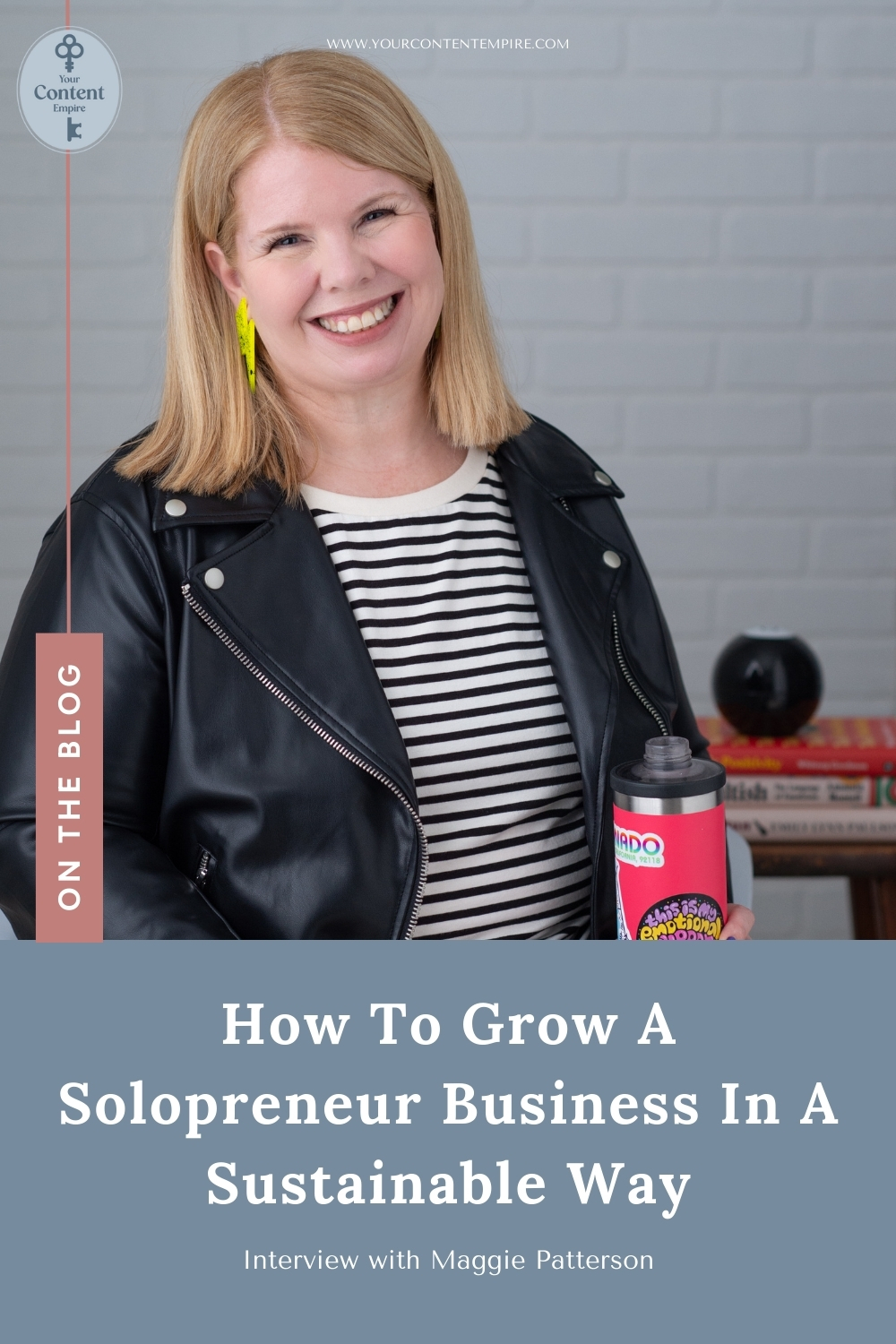
What if everything you've been told about growing your business is completely backwards? I'm talking to Maggie Patterson today—she just published her first book that's going to make some people very uncomfortable. Because while everyone's pushing you to hire before you're ready and scale at all costs, Maggie's over here with the receipts showing that 80% of businesses are actually one-person operations.
And honestly? Her take on why the ‘cult of scale' is poisoning solopreneurs had me taking notes like crazy. This conversation is going to challenge everything you think you know about business success – because what if the goal of business is to have a really boring but dependable one, you can run by yourself and that leaves more space for your life?
Besides writing her first book, Staying Solo®, Maggie is the creator of BS-Free Business®. With 20 years of experience as a successful entrepreneur in client services, Maggie helps service business owners build what she proudly calls a “boring business”—strategically small, sustainable, and designed to fit their lives without the constant hustle.
A podcaster and writer, Maggie is a vocal advocate for humane business practices rooted in respect, empathy, and trust. She hosts two podcasts, Staying Solo and Confessions of a Micro Agency Owner, and co-hosts the consumer advocacy podcast Duped: The Dark Side of Online Business.
So let’s dive into this conversation and expose her content strategy!
Want to listen on the go?
Links Mentioned:
Full Transcript – Maggie Patterson EXPOSED Interview
Hailey: I was thinking the other day that I came across your work like 11 years ago, and I believe you were doing storytelling. The offer that I first got from you was Story Brewery, which is—
Maggie: No, Content Brewery.
Hailey: Content Brewery, but I think there's a story version of it too, or maybe it applied to—
Maggie: There was Story Distillery and then Content Brewery.
Hailey: That's what I'm mixing up. Yeah, it's been a long time and a lot has happened. I was thinking about how you got into supporting solopreneurs and service providers. What did that evolution look like? Where did that initial spark come from and how did it turn into what it is today?
Maggie: It's really interesting. I'd been freelancing for a really long time doing corporate work. I mean, I'm 20 years into this, but at that point I was about 13 years in. I was what they would say is a very experienced freelancer. So I started doing, after kind of falling into the online world, a lot of content-related things. But the questions that kept coming up with my clients were really interesting. They'd be like, “Oh, I need you to write my sales page copy.” And I'd be like, “Okay, what are your offers?” “I don't know. How should I price this?” They would not have all that information. So that was going on, and my clients—I kept kind of falling into this consulting role because I had so much marketing and business experience.But then the other thing is I had this group of peers who were like, “I don't understand how you're running your business. How are you making the money you're making? How are you not working all the time?” And I was like, “Alright, I'll tell you.” And I just kind of fell into it. So I really started working a lot with my fellow solopreneurs, and then over time, some of them grew. I started working with micro agency owners, and from there it's just kind of evolved into really specializing in people who don't want to grow a massive team, but they want a business that works for their capacity and works for their life. I'm really able to come in and spot those places for them and be like, “Hey, how about you just consider X, Y, and Z and not overcomplicate it?”
Hailey: I love that. It's kind of like give the people what they want.
Maggie: Yes, exactly. Because a lot of people just make things up in isolation, and we all know how that goes.
Hailey: Yeah, nowhere. Exactly. Okay, well shifting gears to content—and I really like these interviews. I want to just talk to really interesting people and get all the inner workings and expose their content strategies and how those things work, because I am so curious and I want to know. So shifting gears to content, how does it currently work in your business? What are you putting out on a regular basis? And I'm sure that's gone through as many evolutions as you have in the online business world.
Maggie: Yeah, so I actually started being an OG blogger for corporate clients back when blogs were first starting. So I've always had a blog in some way, shape, or form for the various iterations and spin-outs of my business. But right now I have three podcasts. And don't try this at home, everyone—I do, I am not a solopreneur. I do have a team that helps me. So I am the talent for the podcasts. I have the Staying Solo podcast, which is geared towards people who do not want to grow a big team. They just want to stay solo and have a very uncomplicated, simple, sustainable business. I also have—well, we work in seasons—Confessions of a Micro Agency Owner, really honing in on the leadership and operational challenges of being a micro agency. And like you've lived that life, Hailey, you know it's not as easy as everyone makes it out to be on the internet. And then I also co-host Duped, which is a consumer advocacy podcast, really looking at deceptive practices in online business. I am really and truly the talent for all those. So I do all the front end, like topic development and research and writing, and then I hand it off. I record it, and then I never see it again.
Hailey: Oh, that sounds like kind of a dream, right? Someone else handling all of the publishing and distribution side of things?
Maggie: Well, I mean, the reality is that I've always said I've had the same podcast editor since I started a podcast 11 years ago. And if I had to edit my own podcast, there would be no podcast because I am a writer first and foremost.
Hailey: I love that. So I mean, with that—and we can even take a focus there on topic development and the side of the stuff that you do—but what does a typical, and I know you work in seasons, so this probably varies from season to season, but what does a typical week or month of content creation look like from you, from idea to publish? Well, the parts that you are hands-on with.
Maggie: Yeah, so I'll use the Staying Solo podcast because that's the one that has the most episodes. So we take basically a short break over the summer, a short break over the winter holidays type thing. But we're producing 40-plus episodes a year usually, so it is pretty aggressive. I tend to work in batches for that podcast. So I will generally have a week where I don't have a lot of client calls and I'm like, “Okay, I'm going to really sit down this week and do all my writing.” But before that, I'm really observing what's coming up with my clients. What am I hearing from my peers? I do a lot of really active listening. When I'm on social media, I'm taking screenshots and making notes, and really seeing kind of how the conversation is shifting so that my content can constantly be evolving with that. What was relevant 11 years ago with that very first podcast is totally different now. So right now I'm in the process of—I am not writing episodes, I'm going to start next week. But I'm outlining topics, I'm researching, I am pulling in third-party sources. I'm really trying to curate what that editorial focus is going to be so that I have a really tight, specific episode and I'm not going down all the ADHD rabbit holes that I would like to.
Hailey: Yeah. Do you—what does that specifically look like? Do you, is it kind of like almost a journal? Like, “Okay, what did I see today?” and capturing that? Is it in the moment as you come across it? Do you have kind of a routine around it?
Maggie: I've got—I will say I have become more regimented about this over time. So this year, my thing is I use a Notion database, and I periodically basically dump all my—it's like my content idea bank. So I will dump my screenshots in there with some notes. Sometimes it's notes on my phone, sometimes it's a screenshot. Sometimes it's something that came up in a client conversation. So I'm trying to do a better job of documenting those. And then when it's time, I'm able to sit down and kind of sift through it. And sometimes this is where I will use AI. I'm like, “Hey, I have all these topics, like, can you help me think this through in terms of what is a logical flow? Where are the holes of what I might be missing?” And sometimes it's dead wrong and I'm like, “Absolutely not.” But sometimes there is a gem in there when I'm like, “Yeah, that is actually a really good point I hadn't thought of.”
Hailey: I love how you said “to create a really tight episode.” Do you have any tips for anyone who'd like to tighten their content up? Like how do you give it a focus? Do you have a framework, or does it have to answer these questions? Or like is there any kind of rhyme or reason, or is it just like you've been doing this for 20 years and you could do it in your sleep at this point?
Maggie: No, I think it's a really good question, especially for podcasting, because the thing I see a lot of people doing is they get behind a mic, they're doing a solo episode, and they just meander. So how do you bring it back to: what is the problem in this episode I am trying to solve for my audience? And more importantly—and this is something I learned from Jeremy Enns, who's a podcast coach—what is the problem my show is trying to solve? There's so many podcasts out there without an audience because they're not actually solving a problem. What is the job of the episode? What is the job of the show to be done for your listener? And getting really narrow on your listener. When I decided to focus—like refocus what was formerly the BS-Free Service Business Show and really make it about staying solo—I had to get really, really specific about, yes, my audience might be smaller, but I can speak exactly to the heart of what they're thinking, what they're feeling, what they're experiencing. And that's why I tend to do really well with people just listening to my podcast for a year, and then they're like, “Hi, I want to work with you.”
Hailey: They're sold already.
Maggie: I literally have been on sales calls and they're like, “I just wanted to make sure you were a real person. Send me the payment link.” And I'm like, “Can we talk first before you try to pay me money?”
Hailey: Yeah, yeah. Oh yeah. I think that is really good advice. I have the same thing, it's probably the same with going live as well, like on live video. I get into it and I'm like, “Where is this even going?” And I have to check out a little bit because I just can't even follow it.
Maggie: Yeah. I find I'm not really a video watcher, and I think one of the reasons I won't watch a lot of video is because I'm like, “What is your point?” If you're stretching a point that could be made in 10 minutes to 40 minutes because you are meandering, that's not for me. I'm never going to be your watcher for that.
Hailey: No, I don't have enough time and live video. I can't make it like three times speed. Can't listen to it really quickly too. Exactly. Yeah. Okay, so let's talk about solopreneurs and how they might apply some of these practices or routines you have around content, maybe specifically podcasters, right? Since that's kind of your bread and butter. When it comes to content, what do you think are the key differences for them and how they might approach content? Because like you said, right at the top, “Don't try this at home, kids,” right? You have a team supporting you, but for a solopreneur, what—I don't want to say should, but like what could their potential content routines or strategy look like?
Maggie: So I think the very first thing is to zoom out and understand, like what I said a couple minutes ago: am I doing a podcast because I want to do a podcast, or am I doing a podcast or writing a blog post or creating YouTube content, whatever it is—what is the purpose of that for my audience and how is that tying into my business? So many times I see people planning their podcast based on, or their content in general based on, the whims of what they're interested in. It's like, no, how is that supporting your offers and leading to sales? This is not a pop culture fun podcast where you're going to have a sponsor. This has a very specific role in your business, and I think it's so much better to be very—especially in the beginning—very specific, very controlled, and even just doing one season at a time versus being like, “I'm going to produce an episode every single week.” Because your audience, no matter what platform you're on, they have so many choices. So many choices, and so much of what is out there is not good quality. So if you can be really thoughtful and intentional and actually have them be like, “Oh my God, you're in my head,” that's going to go a long way to creating that stickiness and really loyal listeners. And if you think about it as a solopreneur—you know, about services or something else—coming back to the fact that you don't need a wide audience, you don't need to be the most popular, you don't need to be even charting on Apple. You can literally create a very narrow audience of really aiming for—across everything is like, what are my thousand true fans? You don't even need that big. 500, 100, whatever it needs to be for your business, but really speaking to those people versus trying to be palatable, trying to be for everyone. When you're for everyone, you're for no one.
Hailey: Yeah, yeah. I try to remind myself of that. Yeah. Do you feel like—I'm thinking about private podcasts and if that could be a good strategy for solopreneurs, if we think about the trust building that—I don't know, what drew you to podcasting in the first place? Was it like, yeah, because you're a writer first and foremost, which is very easily applicable—it's just the vehicle that the writing goes into. But what do you think about the private podcast specifically for solopreneurs? Could that be—
Maggie: I think you have to understand: is this appropriate for my audience? So creating a private podcast—great if you work with other entrepreneurs who understand what that is. But I will sometimes get people who work with corporate clients and they've been kind of turned around with all the online business stuff and they're like, “I need a massive email list.” I'm like, “Whoa, directors of marketing? No, no, no. You could just meet them at events. You need like four of them a year.” So really, if you're going to do a private podcast, is this something that's going to be applicable to my audience? But I do think they're really powerful. I've done a number of them over the years. Sometimes it's just a limited series. Sometimes I am able to get more hands-on in my teaching. And it is a really great vehicle because for good quality, thoughtful content, people will be very willing to opt in. I'm going to say something you probably said to your clients a million times, Hailey: you've got to play to your strengths. If you're a writer, writing and then maybe podcasting, if you can make that work for you. If you are more of a speaking type person, great. Do a video. I'm never someone who's going to be jazzed about it. There's a reason I don't have a YouTube channel. I did it at one point and I was like, “This takes me way too long. This is not my zone of genius.” So I think as a solopreneur with your marketing, figure out actually what matters. Don't try to do all the things and then play to your strengths.
Hailey: Yeah. And it sounds to me like going back to that question of what is the purpose of this and what are my people actually thinking about and talking about right now, not 11 years ago or whenever—keeping that idea bank really fresh.
Maggie: And here's something that's really interesting that I discovered last year as a longtime podcaster. I have a full blog post for every episode, much like you do, Hailey, and you know what I've discovered? 50% of people read it. Don't listen.
Hailey: Yeah, I'm the same.
Maggie: So never discount how your audience might be interacting with that content and try to make it stretch as far as you can, so it's applicable to most learning styles.
Hailey: Especially if you're doing seasons, right? You could go through and here's the podcast version that I'm going to put it in like a written form. You could get like a year out of that content, or even more.
Maggie: Yes. Yeah.
Hailey: I love that. Speaking of things I loved, I loved your email this week around the pressures of marketing because, you know, we got bills to pay, but also feeling like the world's on fire. And so feeling weird about marketing, whether that's internal or external pressure of like, how comfortable—how do you, yeah. How do you feel, like, how do you recommend that people navigate that pressure of showing up or not showing up? Because it feels like it's only going to get worse.
Maggie: I agree with you wholeheartedly. It is probably going to get worse before it gets better, and I mean, we are living in a time of what they call poly-crisis. You know, every single day if you open the news, there is something, and it's not just the political situation in the US. It is something is on fire, literally. There's a conflict, you know, in another part of the world. There's always something. So, and I think anyone who's done business over the last five years, there has always been something. There's always been something. So I think what's interesting, what I am really observing is there's this one group of business owners who are just like heads down trying to ignore this, living in fantasy land, and it comes across as being very checked out. I don't see them really living their values. Like, how can I say? I am in favor of doing business humanely when I won't acknowledge that the world is not treating people humanely. So I think you've got to embody those values in your business, but you also need to make money. So I think acknowledging it and adjusting to the moment, picking your timing, and also realizing—and this is a conversation I've been having for the last year with clients behind the scenes—is the business tactics have shifted. Your audience's capacity has shifted. So many things are changing, and what maybe worked for you a year or two ago in your business is probably going to have to be reinvented or changed up. You know, it might be like with an offer, you might need to shrink that offer and sell it to more people so it's at a more palatable price point. Maybe you need to switch things up. I know you've done a lot of changes. I am in the process of doing—like, I'm literally doing a weekly journal called “What are the changes happening?” so that, because I want to see that process over the next six months or a year. I'm 20 years into this, and the only thing that has been constant for me is constantly tweaking and refining. So I'm doubling down on what I know works and then everything else is up for discussion. And I think having the courage to do this now versus a year from now when it's frankly too late. And I don't want to scare people, but if you're not getting the leads, you're not getting the referrals, you've got to do something.
Hailey: I think about like, you mentioned like stuff has always been happening. It feels like it's happening more. I don't know if that's just that we have more awareness, but it almost feels like even five years ago, we would grind to a halt online and acknowledge this stuff because it felt impossible not to. And now it feels like every day you'll be acknowledging something and pushing forward anyways, perhaps or not, I guess.
Maggie: Yeah, yeah. And I think you have to pick and choose your moments. And I think the other thing I really—as much as I want people to continue to sell and do business—I do think there is this toxically positive pocket of the internet that's like, “Yeah, but we need to feed our families.” But they're also the people that are talking about being a bajillionaire. Most business owners are not even making a hundred thousand dollars a year. Most business owners are literally, like right now, their actions dictate how their business survives and how steady it's going to be. And can I buy the cheese at the grocery store or can I put my kid in camp? I want people to do business the way they need to do business, but also being cognizant of the bigger backdrop they are doing business in, because people will react, they will drop you. You know, if your values are out of alignment, people are going to spot that. I saw a few things this week that I was like, “Oh,” like very jarring. You cannot say you're about one thing and then do another. People will notice.
Hailey: Yeah, yeah. Hopefully, hopefully they notice. I love your idea of journaling all the changes. I think about like, you know, this year's felt like a dumpster fire when it comes to business and what's working, and I feel like the quicker you are to adapt—like double down on what works, but be quick to adapt. I feel like it's only because of the changes that I made to my business, kind of like revamping it, because in December, January, I'm like, “I don't even know if this business is going to survive.” And like—
Maggie: Yeah, I remember that conversation with you.
Hailey: And because of those shifts and changes, it's like—I don't want to say it's better than ever, but it's pretty good. But it's only because I was like, “I'm going to be a complete effing beginner again.” And I'm like willing to kind of change up and adapt and like as somebody who white-knuckles change and hates it, I've got to keep a journal of this time because—
Maggie: And when I say journal, I'm like writing it out on my Kobo with my stylus. I'm doing it in writing and then I will transfer it all to digital. And then I want to look at what the patterns are. Like what have I learned? And I mean, eventually I want to bring people behind the scenes because I think it's so easy to resist the change and be stagnant, but you've got to be willing to change it up.
Hailey: Yeah. We're going to talk about your book, but that could be a great second book topic too. These—yeah. Do you think that your relationship with content has changed over time?
Maggie: Yes and no. I mean, my relationship with content is healthy, yet complicated. Because I think it's the whole thing of like, there is that act of faith, right? When you create something and sometimes something will be like, you're like, “This is the best thing I've ever created” and it doesn't land the way you want. And it, you know, there's a bit of a blow to your ego. So, you know, there is a little ego involved, I will admit. But I also think I just do not put too much stock in other people's opinions. I only really care about the people that I am actually speaking to because like for example with the Duped podcast, I have taken some real heat on that podcast. There's a lot of people that don't like how we do things or that we do this or we don't do that. And like quite frankly, it's not for them. Please take a seat.
Hailey: Yeah. Or like unsubscribe. Don't listen. No one's forcing you to.
Maggie: And that's the thing I think everyone needs to recognize, whether it's social media or a podcast or an email list—not everything is for you and that's okay.
Hailey: Do you feel like—I think this is interesting right around, like, I feel like social media is really interesting. I'll put out a lot of posts and it won't get a ton of outwardly visible traction or results, but the conversations that it's driving in direct conversations, it's like—you could have very easily stopped doing it because it was not getting that outward show of support or results or reach, right? But if you didn't, then it wouldn't do this thing. So yeah, reach and results is just a whole other side of that.
Maggie: I think we need to think about dark social more and more, right? I don't think we talk about dark social nearly enough. Some of the best results I've ever received from social were on posts that did not have a lot of outward engagement, and it's because people were scared to comment on it, but they wanted to talk to me behind the scenes about it. And I also said to a client yesterday, and I think this is something to just really remember in this specific moment, is I am really noticing people as they're scrolling aren't even necessarily liking things the way they used to. But they're saving it and then they're DMing you or they're having a conversation with you later, or like, I save a ton of stuff. I go through it, I look at it and I think—so you have to remember there's those outward, you know, likes and comments. There's way more to social media, and I think paying attention to like, maybe those didn't get results, but did I get a client from it? Great. It did its job because the vanity metrics aren't really its job.
Hailey: Yeah. Like unsubscribing from the vanity metrics and letting that dictate your strategy, I think. Yeah. Underlying message there, underlying takeaway for me anyways. You just wrote a book, we're going to talk about it in a second here, but I'm curious specifically about writing the book. How do you prioritize content and creating content when you are pouring so much creative energy into such a big project, whether it's the book or whether it's a new season of the podcast? Like you do big projects, right? How do you balance your creative output?
Maggie: Okay, so this is where we're going to have a little bit of a confession. I work really fast. And I feel like I need to acknowledge that because I have—because literally I've been writing since I could actually physically write like in first grade, right? So my brain works really fast and I tend to do a lot of—I don't even recognize I'm doing a lot of background work. I literally fall asleep thinking about lines of copy. And then I wake up in the morning, I'm like, “There it is.” And it flows out my fingers. So I mean, I am—that is a gift. It is a talent, I take it. But you know, one of the things with the book is I had to carve out a lot of time, and I was very realistic about the timeline. I was very specific. I did a number of writing retreats. I literally—I live in Ottawa, I went downtown. I got an apartment hotel, and I literally had a list like, “These are the things you have to write in the next three days. This is the research you have to do. You're allowed to go for a two-hour walk.” It was very structured because otherwise I would've just been like, “I'm going to the mall, I'm going to Sephora. It'll be fun.” The other part of it is though, and I will say this is a bit of a cheat code for anyone who's created a lot of content, is I had an existing framework. I had existing podcast episodes and blog posts that I was able to pull a lot of things from. Some of the people I referenced in the book, I was pulling stuff out of interviews I did with them. So if you have a body of work, you've already got a jumpstart on your book. And the biggest work was doing the research to wrap it around all of that, to have a coherent book versus just being like, “Here's my framework, peace out.”
Hailey: It's great. Which would've been good anyways, but that surprised me about writing a book is I built it up in my head so much and really it was exactly like, “Here's the list of things I need to write.” It's kind of like a bunch of blog posts put together. It doesn't need to be as complicated as we make it. That wrap-up piece and how it all fits together is the real work of it, not the individual sections. It's more the tying together.
Maggie: Yeah. One of my beta readers said it was interesting. She was like, “You're”—because I kind of set up the book as like, there's the why, how we got here, what you need to know, and that's the first three chapters. And she said, “I already know all this.” And I said, “Yeah, but you know all my work.” And I was basically like, “If you understand why entrepreneurship and solo entrepreneurship and the culture around this and fake influencers, just skip to chapter four, that's fine.” But a lot of people need that context for the book to stand alone. And I think that's the thing we have to remember is the book is meant to be an entry point for brand new people to your world. So making sure that it is cohesive and complete is really important. And a lot of work went into making sure that, you know, that scaffolding around it made sense.
Hailey: Yeah. I love what you said around—to just circle back to what you said about background work, I do something similar where it's like business journaling. At the end of the day, if I'm working on a big project, I will free write on it for like five minutes a day for two weeks before I'm actually working on it. So that when I—I'm like, “This came together so fast,” but it's because I've been thinking about it in little bits and chunks. So like half—
Maggie: Yeah, I wrote my sales page in like 90 minutes the other day. And then I went to sleep and I woke up and I was like, “Oh, that line's wrong.” Rewrote it, done, off to the designer. That's not normal, but it's because I thought about it for however many days beforehand.
Hailey: Yeah. The mental load of the task—so much of that heavy lifting has already been done. So that's one part. And second part is it doesn't need to be as dramatic as we're making it too. And the stuff doesn't live forever.
Maggie: And I mean, you know this, when you first start podcasting, when you first start blogging, when you first start doing it, I think you're like, “Oh my gosh.” And it's just like you're putting in the reps, you're doing the practice. You need to get better at that because it's not going to be easy for everyone. It's only easy for me now because I've been doing it for a million years.
Hailey: Yeah. This is probably—I was really excited to ask you this question, but what is your favorite piece of content that you've ever created, and why was it your favourite? Impossible.
Maggie: Yeah, it's impossible. But I will say, and this is really like a cornerstone piece of content. I don't know if it's my favorite, but it's the one I reference back to the most. There's actually two. There's one essay I wrote like five years ago on the dark side of online business. And it's funny, I see people having those conversations now and I literally just want to be like, “Here's the link. Here's the link from 2020.” But there's another one I wrote that I feel like had a really big impact on my audience and really kind of became a linchpin in my work—talking about the cult of scale and how—and this was before everyone descaled their business. Please note, I like to think I'm a bit of a trendsetter on that—but I was basically like, this shiny outward facade is not actually what's happening in people's businesses. So please stop thinking when you're sitting here making $5,000 a month that you're magically going to hit, you know, a hundred thousand dollars a month because you're working with Coach X, Y, Z. It's much more complex than that. And you've got to decide: is that what I want for my business? Understand your margins might take a hit. Do you want to be a leader? Are you willing to sacrifice your pay? There's a lot of things that go into truly scaling a business. And I've lived that life having worked with a lot of startups. A lot of people in online business have not had that experience. And it pisses me off that everyone makes it like it's so easy. It's like, no, it's actually—hate to tell you—it's going to be work.
Hailey: People think that that work is not important, but it's like that slow down to speed up, like being so intentional about your business model, about your business decisions. I'm realizing more and more how yes, that stuff can shift and change and it should shift and change as your life changes and your situation changes. But slow down to speed up, because otherwise you'll be going backwards.
Maggie: And I don't think people think enough about what they want. They're seduced by the lifestyle, but the most successful and happy business owners I know—and it's probably true for you too—is they're not big names. They're doing the work behind the scenes. It's very satisfying and it's very profitable. They don't necessarily have a big team, but you know what? They're crushing it.
Hailey: They're in it for the right reasons, I feel like too. Yes. Comes down to a lot of times. Do you have a favorite template or system that you can share with us that makes content easier for you?
Maggie: Oh, it's my Notion content calendar. Because once everything's in the idea stage, then once I lock it into the content calendar, that it's happening. My next six topics and I'm like, “It's locked in. There's no changing these up now. We are giving the names to the designer and you are doing these episodes. It's happening.”
Hailey: Did you design your own Notion—
Maggie: Yes.
Hailey: —content calendar? Yeah. So it's completely customized to your brain.
Maggie: And it's very simple, but it's like, you know, is this episode in research? Is it in pre-production? Is it produced? Is it released? You know, we've got all the things. I'm like, what's the lead magnet going to be? You know, what, are there any specific links we need to include? I'm able to make notes for my team so everyone knows—that's the hub of where everything is. So please don't ask me what's going on at the end of this.
Hailey: Yeah. What do you—we talked a little bit about dark social and, you know, content that gets results, even if it doesn't look like it gets results. But how do you know, how do you know when content is working? What does the feedback loop look like for you?
Maggie: It's either one of two things: “Oh my God, you're in my head,” or “I've been saying, or I haven't been able to put this into words like that.” To me, I'm just like, I've obviously hit a nerve, and/or when people are like, “I need you in my life.” I literally will get DMs and people are like, “I don't know you. I've never—but I need you in my life.” I'm like, I've obviously hit a nerve in the right—you know, the best possible way. It's like, you know what, even if you never buy from me, it's like I'm doing my job here because I'm engaging you and obviously it's helping you.
Hailey: What a simple content strategy. My goal is just to get in their head, and when I hear that feedback. A-okay, I'm doing it.
Maggie: Exactly, exactly.
Hailey: It can be that simple.
Maggie: I mean, honestly, I'm not going to perform for the algorithm or downloads. We track our metrics. I look at them, I don't really—I know what the results are in the business in terms of, you know, retention, revenue, lifetime customer value, all that stuff. So that's the stuff that actually matters at the end of the day.
Hailey: I agree. So shifting gears to talking about the book finally, it tackles the idea that business growth and real income require—yeah. It tackles the myth, I would say, that business growth and real income requires scaling and hiring a bunch of people. How do you think that the book debunks this myth and what growth might look like for a solo business owner?
Maggie: So the one thing that was really interesting to me as I dug into the research of this book is that if you look at the US—and that's the market I pull from because it's the most studied entrepreneurship market—we have these images of like the sharks and like your business has to be brick and mortar. The image of entrepreneurship is like, “Oh, I'm starting a big thing.” 80%—80%, Hailey—of businesses in the US are one-person businesses. So we talk so much about having a team and it being big and it making millions and, you know, seven figures, eight figures, all this stuff. But the reality is very, very, very different. And that is an underserved market in the subset of the wider entrepreneurship market. And so much of the content that is directed at the audience always hangs on the pain point, like, you're not good enough, you're not good enough, or you're not good enough by people who are trying to sell them basically products that are not actually going to help them. So I want to be the flip side to say, “Hey, these people are poisoning you and I'm going to be the antidote over here. And it doesn't have to be this hard.”
Hailey: Yeah, and I mean, you have these people who grew these massive teams and businesses and then you see them like laying them off and descaling kind of en masse, especially this year with, yeah, I mean, the elephant in the room, AI, right?
Maggie: Yeah, and I think nobody talks about that side of it, or it's framed as a, like, “I made this strategic choice,” and it's like, no, you got ahead of yourself. I remember like 2022, listening to people being like, “I have a formula on when I should hire.” What? I'm like, “You're talking about people, you're talking about their livelihoods, like maybe slow down.” Because you don't know what you're getting into and there was an inevitable crash for a lot of those people. And I mean, I don't love to see it because there's people involved. People have mortgages and bills and everything else and it's really unfortunate, but you know, it is a bit of a cautionary tale that there's a lot to be said for choosing a business that is very simple, very sustainable, and works for you and the capacity you have for not just your business, but your life.
Hailey: Yeah. I remember when an OBM was a status symbol in the online business world. Yeah. Oh, probably still, yeah. In some way, shape or form, but I think that is, yeah, becoming detangled.
Maggie: Well, I think right now people are—there's a lot of people kind of re-spinning what success should look like. And I think that conversation's important, but at the same time, they're still missing the point. Which the point is, is that everybody has very specific needs, a set of needs from the business. So like, how much money do you need to make? How much time do you actually have? What capacity do you have? Are you disabled? Are you neurodivergent? You know? Are you caregiving? Do you have small children? Do you have aging parents? There's a lot of elements there that we still don't talk about. We talk about life-first business. What does that even mean? Of course, it should be life first. I'm more interested in: how do you build the business to actually serve you in your real life? And if it doesn't work for your real life, it's not actually working, even if it's working on paper and money-wise.
Hailey: Yeah. I love your focus on energy management too in the book and having that be a factor in what business ends up looking like for you. How did you come up with the Staying Solo framework and can you give us a teaser of what it is? I mean, people should go and read the book immediately, but a teaser.
Maggie: Yeah. So the Staying Solo framework really came from—and I mean, Hailey, you've worked with me in the past—there's nothing new here that I've said. It's all the things I've been saying forever, but—
Hailey: You need to hear it a million times. Let me say that.
Maggie: And then I've just formalized it into this framework where I'm talking about what is your salary and how much are you going to pay yourself? So many people are just paying themselves the leftovers. And I'm like, “Hello? The point of the business is to pay you. This is not a hobby. So what are we doing here? The seasons in your business. So how are you approaching how you're planning? Your space? Like what is your actual capacity and your energy? And we talk so much about time management. We don't talk about energy management. We don't talk about all these other factors that go into it. A lot of my clients have other things going on that cause them to and require them to be really, really capacity conscious. And I have ADHD, I have to manage things, otherwise I'm an introvert. Otherwise things become really messy and I start to hate a lot of things and that's not what I want to do. So really looking at your capacity, looking at your systems and not systems like you need to have a 40-step funnel. What are those underpinning basic systems that get you out of decision fatigue and let you show up and do the job you're supposed to do efficiently? What else? Support. I think that's a really big one for solopreneurs. So many people think, “Oh, I need support and I'm going to hire a coach,” and it's like, no, no, no. That may be skills development. That might be help at home. It might be just like, I used this example with a client the other day. I said, “You hate doing meal prep. Buy precut fruit if you can afford it, save yourself that 30 minutes a week or whatever it is.” Sometimes support is going to be very different. Sometimes it's going to be going to therapy, so getting support, because I think a lot of times people think, “Oh, I'm a solo business owner. I don't have a team.” No, no, no, no. I mean, you don't have employees. You should absolutely have some sort of support system, whether that's business friends, your therapist. A community you're in. There should be other things scaffolding you and your business because entrepreneurial loneliness and isolation is very, very real. And that's when we start to be very stressed. Depression can be very real, and I don't think we recognize that nearly enough.
Hailey: Yeah, I think that's what I—kudos to you for how you structure the book. I think it did a really good job of giving practical strategies and the framework, but also talking about some of the things like loneliness as a solopreneur that might come up. Or what does support look like? Because you're not all on your own as a solopreneur. So thinking through these other things too, what do you think are—for someone who is listening to this, maybe they have a team and they want to scale down, or maybe they are staying solo, but they feel like it's not quite working for them and they need some kind of Staying Solo framework to overlay on top of that, what would you say is either the most important step for them to get started or the 101 or step zero for them in terms of just a baseline?
Maggie: Yeah. I would say there's two things that, you know, assuming you know you're being paid the way you want to, your business is working, you have experience. What I tend to see with more seasoned solo business owners is they either need to really look at space like. Am I taking appropriate rest? Am I building this to my capacity? If you're an introvert in calls all day, why are you building all of your packages so there's a million calls? There's ways to get more creative about how you're going to do this. And I'm not saying you're never going to speak to anyone on Zoom again, but there are ways to do that. So really looking at all the space elements of it. And then the other part is absolutely looking at your strategy. Because one of the things I see a lot of really seasoned, really amazing, you know, especially done-for-you creatives doing is they're undercharging for their work. They're not doing enough marketing so they can charge appropriately. Their positioning might need to evolve. The audience they're speaking to needs to evolve. They need to start getting paid for the strategy work they're actually doing. And that's why there's literally two chapters on strategy in the book, because I'm just like, “This is the unlock for so many people.” It's a big unlock for me, and I see it all the time with my clients.
Hailey: Yeah, we talk a lot about hidden labor in relationships, especially hetero relationships. But there's so much hidden labor in our client relationships a lot of times happening too.
Maggie: You know, I think that's a really good point. It's something I have conversations with my clients about. They're like, “How do you have the client load you have, and you seem unbothered when I come to you crying?” And I'm like, “I don't know. It's just a skill and it's a skill I've had to cultivate around understanding where my scope starts and finishes with my clients because I need to take care of me if I'm actually going to be able to show up and do what I say I'm going to do for my clients.” And then also understanding that every single person I work with has agency. They get to make decisions. And there's times when I'm just like, literally like, “I think this is a topic you should discuss with your therapist.” Because this is not emotional labor for me to do because that's not in my scope or I'm not equipped and where am I qualified to do that for you?
Hailey: Yeah, exactly. Especially as people pleasers and wanting to help, knowing where that scope is—where you're not equipped to really deal with that—I think is so important.
Maggie: Yeah, and I feel like that is a really important boundary for people to establish. We talk about all the different boundaries, but if we can't tell a client like, “Hey, no, that's not what I'm here to do,” or “I am not the expert on this”—that's a boundary. We're wearing ourselves down, and that's not going to be effective for anybody.
Hailey: No. This is a big question or, yeah, I think I know how you're going to answer this, but I'm not sure, so you might surprise me here. How do you think solopreneurs should measure the success of their strategy? If there's like, you know, we can pay attention to a million different metrics, right? Is there one health indicator or a couple health indicators, metrics-wise that they should be paying attention to?
Maggie: Like literally the most—you know, there's two: the top line revenue of am I getting paid? Am I getting paid the way I want to get paid? You know, is my business financially healthy? Because that can tell you a lot of things. It can tell you if your pricing is off. It can tell you if your scope is off. It can tell you if your budget is needing realignment. So many times people are like, “I want to make more money.” And I'm like, “Hold on, you just told me you're making X. Why do you want to make more money?” And then we get into the budget. I get in there with people and I'm like, “What is all this? You don't need 90% of this crap. I just gave you a raise. Get rid of this. And you don't need to make more money.” So really understanding: what salary do I need to, and really walking through that and what do I need to be bringing out of the business and planning around that accordingly. The other one is really around your energy. If you are on that one-way ticket to being over it or resentful all the time, that's a sign that something in the business needs to change. You cannot live in a state of “Next week will be better. Next week will be better.” If your calendar looks like Tetris, you don't have time. You're working nights and weekends, you've got to make meaningful changes. And a lot of times those are small changes, but people resist them so, so much.
Hailey: Yeah. They're tough. They're tough to—I took my work email off my phone and it felt—it's something I struggled with for years, but once I did it was so small, but it unlocked so much. Why am I looking at email when I can't answer it or when I don't have the space to answer it?
Maggie: Or like, you know, for me, I have no push notifications on anything.
Hailey: Yeah, that's a good one too. For the book, I'm going to put the link to the book down below, but is there anything—is there anything else you wanted people to know about this book? If you had the one liner or the log line of the book, which, you know, for nonfiction doesn't really make a whole lot of sense, but I'll put the link down below for people to check out. What should they know about it?
Maggie: So what people should absolutely know about the book is it is not meant to be necessarily a sit down and read—and you know, read, I know you read it all pretty quickly, but—
Hailey: Once I got in, yeah. I was like, I crushed it.
Maggie: It's, you know, the subtitle is “your guide” and it's meant to be a guide. I want people to keep it on their desk and be like, “Having a boundary issue,” you know? It's meant to be—once you kind of get through the setup—it's meant to be a reference. And I think one of the things I think is really important: you're reading the book, you don't have to take and try to change all six pillars in your business right away. That is a recipe for disaster. Read the book, figure out what's that one thing that you actually need to be diagnosing now because you are a solo business owner. You only have so much time and energy. If you're doing services, you only have limited time to work on the business. And the other thing I'll just add is one of the things I did do with the book is I created a companion private podcast, which is—there's eight different stories about people and their solo service businesses, so people can check that out. I created a vanity link for you, Hailey, which is—oh, I love it. Okay. I'll put it below—slash YCE. So you know, you can go to that and subscribe to that. Because I think it's a really good way to ground some of what we're talking about in the book in actual stories and be like, “Oh, that's interesting.” My client Emily, who's like, “This is how I sold strategy and this is how it impacted my business.” That's a whole chapter in the book. So you see how those things get implemented.
Hailey: I love that. Because so often you're reading the book, you're like, “But what does this look like?” Right. Theory is one thing. Seeing it in practice is quite another.
Maggie: And I am very—I'm a very, very nosy person, so I was like, “I want to talk to people about their businesses.” Because I don't really do interviews on my show. So I was like, “All right, I'm going to ask all the nosy questions.”
Hailey: That's why I've added these interviews to my content strategy. Because I'm a nosy person and I want to know. Yeah. I am right there with you. Okay. What is one thing about content creation that you wish you could go back in time and tell yourself when you were just starting out?
Maggie: Oh, I mean, for the podcast, absolutely. I don't need to do nearly as many interviews as I did. My solo episodes are way more popular—
Hailey: And they're way more important for your work and your business goals. Yeah.
Maggie: Like why am I—I mean, I do a lot of interviews and I'm always grateful, but I'm also just like, you know what? Maybe you should do fewer interviews.
Hailey: Yeah, I'm like—anytime I go into a client strategy and they have a podcast and they love it and they're doing interviews, I'm like, “These ones aren't moving the needle forward on your business.” Right. And we have evidence of that and data for that. Yeah. Okay. So I have this little quick-fire round, a few questions. What first comes to mind for you for any of these things, but what is the content skill that took you the longest to master?
Maggie: Oh, it's definitely around pacing in my voice for the podcast.
Hailey: Yeah. If you weren't creating content for your business, what would you still create just for fun, if anything?
Maggie: I would have a pop culture podcast. Like probably a reality TV podcast.
Hailey: Yeah, we need that. We need those takes. I remember at one time we talked about the Housewives in the online business world and where there's those synergies.
Maggie: Oh, so much. I could—I literally, if I was going back to school, I would probably write a thesis on that.
Hailey: Yeah. One habit that you'd recommend to every business owner who creates content.
Maggie: Leave yourself enough time for the ideation and exploration and don't take it so seriously.
Hailey: So good. Yeah. Who—I can't wait to hear this because I want, I need to find more people's content, but biggest content crush right now and someone we should check out.
Maggie: My friend Nailah King. She specializes in customer stories, but she's just so thoughtful and she really talks about doing things slowly and intentionally and respecting your capacity, and I just—I absolutely adore every—that is an email I can't wait to read when it lands in my inbox.
Hailey: Her content is so good. Yeah. More to check it out.
Maggie: Yeah. She's a writer, right? You could tell she's a writer and in a world of AI-generated slop, it's so refreshing.
Hailey: I ask everyone this question because I'm curious: in one sentence, content should be blank.
Maggie: Easy.
Hailey: And it can be. Yeah. Thank you so much, Maggie. This has been so fun picking your brain and getting a behind-the-scenes look at not just the book, but how content works in your business.
Maggie: Thanks so much, Hailey.