“As an entrepreneur, I've learned to surround myself with people who have skills that I lack. FB ads and email funnels were something I knew I wanted to be doing in my business but I had no idea where to start. I put it off for a while because it was outside my comfort zone, and it wasn’t until I found Hailey that I felt confident moving forward with them. Hailey took the reigns and created a system for me that was not only profitable, but really helped me create more space in my day to work on the things that are in my zone of genius!”
Lauren Bongiorno Diabetic Health Coach
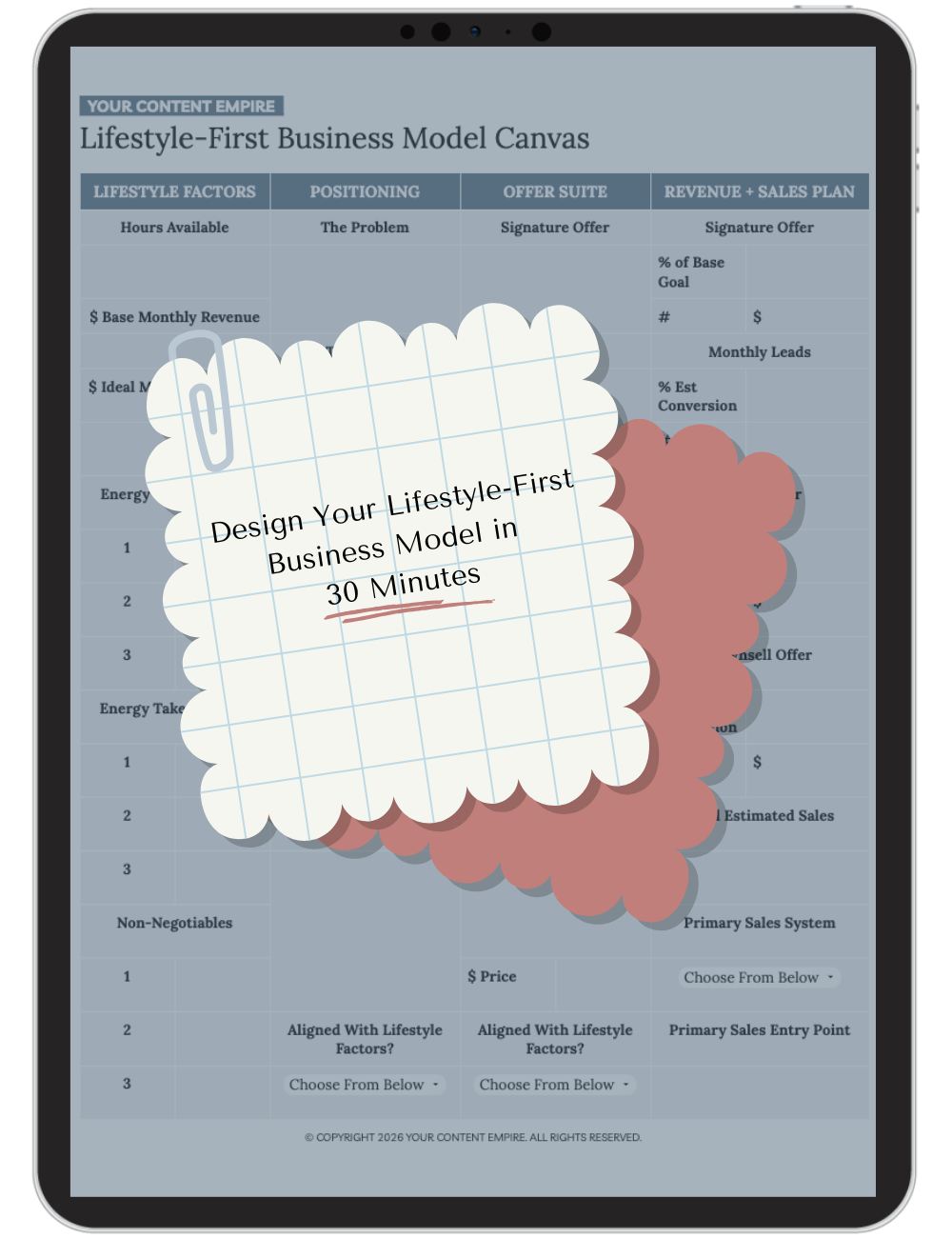
Click Here to Design Your Lifestyle-First Business Model with My Free Template
Here Are the Support Systems That Are Going to Help You Scale in 2026
There's one thing separating the business owners who are going to scale this year from the ones who stay stuck at the same revenue level and it has nothing to do with their strategy.
It's not their offer. It's not their content. It's not their funnel or their email list or their pricing. It's support.
Specifically, the kind of support that turns a good plan on paper into real momentum in practice. And most business owners are missing at least two or three pieces of it without even realizing it.
I see most business owners with solid strategies who are still stalling out because they're trying to execute entirely alone. No real peer support. No delegation that actually frees them up. No one in their corner who truly gets it. And they keep looking at their strategy trying to find the problem when the problem has nothing to do with the strategy at all.
Today I'm walking you through the five support pillars I believe every business owner needs to scale sustainably this year. And I've built in a quick audit for each one so by the end of this episode you'll know exactly which pillar to focus on first.
Prefer to watch instead?
Want to listen on the go?
When most people hear the word “support” in a business context they immediately think of hiring a VA or maybe joining a mastermind. And yes, those things matter. But the kind of support I'm talking about today goes a lot deeper than that.
Support is anything that increases your capacity to execute. Anything that takes weight off your plate, sharpens your thinking, stabilizes your nervous system or frees up your time and energy for the work only you can do.
And when you look at it that way, support stops being a nice-to-have and becomes one of the most strategic things you can invest in. Here's why.
First, support is a capacity multiplier. You can only execute as far as your foundation will hold. And if that foundation is cracked or if you're running depleted, even the best strategy in the world hits a ceiling.
Second, you are often the bottleneck in your own business. Not because you're not capable but because you're carrying more than any one person should be carrying alone. Support is what changes that equation.
And third, everything else in your business performs better when the person running it is properly supported. Your strategy, your systems, your content all of it gets better when you're not doing it alone.
So I've identified five pillars of support that come up again and again when I'm working with business owners who are trying to scale. And what's interesting is that most people have one or two of these in place but are missing the others entirely. And it's usually the missing ones that are creating the most drag.
Support Pillar #1: A Coach
The first pillar is having a coach or strategic mentor in your corner.
We are often way too close to our own businesses to see them clearly. The things your coach catches that you simply cannot see from inside your own head are often the biggest unlocks.
It's not that you're not smart enough to figure things out on your own. You absolutely are. But having someone equally invested in your success who can see the whole picture, give you honest feedback and hold you accountable to what you said you wanted? That's an accelerant. Full stop.
And I want to normalize this because I think there's a tendency to see coaching as something you graduate out of once you know enough. I work with a coach for at least six months every year. I do this work professionally for other people and I am still way too close to my own patterns and blindspots to see them clearly without outside perspective. If anything, the more you build the more valuable that outside perspective becomes.
Now for each of the five pillars I've put together a quick five question audit. The format is simple: I'm going to read five statements and I want you to answer true or false to each one. Just keep a mental tally or grab a pen. At the end of all five pillars we're going to add up your scores and your highest number is going to tell you exactly where to focus first.
So for Pillar 1, here's your audit:
I want you to answer true or false to these statements:
I often feel like I'm going in circles with a problem and can't get out of my own head about it.
I make most of my big business decisions without a real sounding board.
I've had the same goal on my list for more than two quarters without meaningful progress. I find it hard to stay accountable when things get busy or uncomfortable.
I haven't had a significant mindset shift or business reframe in the last six months.
Count your trues. The more you have, the more a coaching relationship could be the missing piece for you.
Support Pillar #2: A Peer Circle or Biz Bestie
The second pillar is having at least one person in your corner who is actually doing this too.
And I want to draw a really important distinction here because this is not about having people who love you and support you. Your partner, your family, your best friends – they love you. They want the best for you. But they cannot give you what someone in the same trenches can.
Real peer support is not standing in a room full of people giving you their thirty second elevator pitch while you smile and wait for your turn to give yours. That's performance. And that's not what we're talking about. Genuine peer support means someone you can be completely honest with about the hard stuff. The revenue dips. The self-doubt. The pivots. Someone who can do the same with you.
This could be a mastermind, a small peer group or even one trusted biz bestie who's at a similar stage in their business. And the reciprocity matters. When you show up for someone else going through the hard parts of building a business it sharpens your own thinking. You see patterns more clearly from the outside. You remember things you've already figured out. You become more generous with what you know. It makes you a better business owner and a better human.
The audit for this pillar:
When something hard happens in my business I don't really have anyone to process it with who truly understands.
I often feel isolated or like I'm the only one dealing with what I'm dealing with.
The networking I do feels shallow and doesn't lead to meaningful connection.
I've never been part of a group that felt like genuine community.
I hold back from sharing the full truth of what's happening in my business because I don't think people would understand.
Three or more trues here means finding your people is a priority.
Support Pillar #3: Delegation (Your Human Team AND Your Silent Team Member)
This one is about getting the right things off your plate so you can focus on what only you can do. I want to offer a reframe here because most people approach delegation as “what can I hand off” which keeps them thinking small. The better question is around your zone of genius: what are the things that only you can do? The things that require your specific expertise, your voice, your judgment? Everything else is a candidate for delegation.
But here's where I want to expand how most people think about delegation: you don't only have a human team. You also have what I call your silent team member.
Your silent team member is your tech stack. Your automations. Your systems. At this stage of your business your tools might be doing more heavy lifting than a human hire could. And that counts as delegation.
So when you're thinking about what to delegate, you're thinking about two categories: what can a person take off your plate and what can a system or automation handle without you touching it at all.
Now here's how I actually figure out what to delegate every quarter. I track my time for a full week using BeFocusedPro. Then I score each task on three things: enjoyment, strategic value and energy cost. And then I sort everything into one of four buckets: keep, systemize, delegate or delete.
I did this exercise recently with a client who was convinced she didn't have enough in her budget to hire help. She thought delegation was something she'd get to eventually. When we actually tracked her time and ran it through this process we found 18 hours a month of tasks she was doing that had zero business reason to be on her plate. Admin that could be templated. Scheduling back and forth that could be automated. Formatting and uploading that a VA could handle in a fraction of the time. 18 hours. That's not a small number. That's essentially an extra two and a half work days every single month she was giving away to tasks that didn't need her. Once she saw it that clearly the decision to get help wasn't hard at all anymore.
The audit for this pillar:
I regularly spend time on tasks I don't enjoy and know someone else could handle.
I do the same repetitive tasks week after week with no system in place.
I've thought about getting help but tell myself I can't afford it or don't know where to start.
The bottleneck in my business is almost always me.
I don't have a clear picture of how I actually spend my time each week.
Three or more trues means your time and energy are the biggest thing standing between you and your next level.
Support Pillar #4: Life-Sourcing
We spend a lot of time talking about what to delegate inside your business. But what about your life?
The lifestyle-first approach I teach means looking at the full picture. Not just your work calendar but your whole life. And sometimes the biggest unlock for your business capacity is getting help with something that has nothing to do with your business at all.
This is actually referred to as “life-sourcing.” Outsourcing but for your life outside of work. And this one tends to land especially hard for women because research consistently shows that even in households where both partners work full time, women are still carrying the majority of the domestic and mental load. The planning, the managing, the remembering. It's exhausting in a way that's hard to quantify but very easy to feel. And it absolutely affects your business.
For me personally, that's cleaning. My husband handles cooking. Those are real hours and real energy that I get back every single week that I'm not pouring into tasks I don't need to be doing.
What would an extra three to five hours a week and significantly less mental load make possible for you?
This doesn't have to be expensive. Start small. Start with the thing that bothers you most or drains you the most.
The audit:
There are tasks in my personal life I dread every week that someone else could easily handle.
I regularly arrive at my desk already tired because of everything I've managed before I even open my laptop.
I feel guilty about getting help with things outside of work like I should be able to do it all.
My personal responsibilities regularly spill into my work hours.
I've never thought about outsourcing something in my personal life as a business growth strategy.
Even one or two trues here can matter more than you might think. The hours you spend on things you don't need to be doing are obvious. But it's the mental load that really costs you – the low hum of everything that needs to get done that runs in the background all day even when you're technically working.
Support Pillar #5: Nervous System Support
I don’t think this one gets talked about enough in the business space. And I think it might actually be the most important one on this list.
Your capacity to handle growth is directly tied to how regulated and supported you are underneath it all. Your ability to make clear decisions, show up consistently and lead your business through hard seasons all depends on what's happening beneath the surface.
Your nervous system capacity is a business asset. I want you to hear that. This is not some soft skill. This is strategic.
When you're not feeling like yourself it shows up everywhere. In how you show up for clients. In the decisions you make or avoid. In how you handle the weeks where everything feels hard.
What does nervous system support look like? It's different for everyone.
Whatever actually helps you feel grounded and stay steady under pressure. The key is that you're not waiting until you're in crisis to seek it out. Proactive support is how you stop the burnout before it starts.
The audit:
When things get stressful I tend to spiral, shut down or make reactive decisions.
I regularly push through exhaustion or anxiety rather than addressing what's underneath it.
I don't have a consistent practice or support system that helps me stay regulated.
The emotional weight of running a business often feels like something I'm just carrying alone.
I've thought “I should probably talk to someone about this” and never followed through.
If you're nodding along to any of these, this pillar might deserve your attention first.
The Full Audit Results
Okay. Now go back through each pillar and add up your true scores.
You should have a number out of five for each one. Your highest score is your biggest gap. And your biggest gap is where to focus first.
This isn't about having all five pillars perfectly in place overnight. It's about being honest with yourself about where you're running unsupported right now and making one intentional move in that direction.
Extra Tips And Things To Keep In Mind
A few things I want you to sit with as you look at your audit results.
Tip 1: Support is not optional if you want to scale sustainably.
I hear business owners say all the time “I'll get support when I can afford it” or “I'll hire help when things calm down.” But here's the thing: things don't calm down without support. Support is often what creates the calm.
The business owners I know who are scaling sustainably and enjoying their businesses are not doing it alone. They've intentionally built support structures around themselves and they treat that as a non-negotiable.
Tip 2: Your support needs will evolve and that's expected.
The coaching relationship you need right now might look different in a year. The delegation that makes sense today might need to expand as you grow. The nervous system support that works for you might shift over time.
This audit is a snapshot of this season. You might want to come back to it every quarter and reassess. Your needs are not static and your support structure shouldn't be either.
Tip 3: Getting support is not a sign that you can't handle your business.
This one is for the high achievers who have been white-knuckling it and calling it independence. Getting support is not weakness. The most capable business owners I know are also the most intentional about building the right support around themselves. The two things are not in conflict. In fact they're deeply connected.
Tip 4: Start with your highest-scoring pillar but don't ignore the others.
Your audit gives you a clear priority. But I want you to have a plan for all five over time. Even the pillars with low scores deserve your attention eventually. Think of this as a rolling priority list, not a one-and-done checklist.
What's The Next Step? Start Here ↓
Now if you're reading this and thinking “I need all five of these and I don't know where to start.”
Inside Your Signature Scaling System, my coach-sulting partnership, one of the very first things we do together is look at where you're running unsupported. Because I've learned over years of working with business owners that you can hand someone a perfect strategy and it still won't move if the foundation isn't there.
We work through your business model, your capacity, your support gaps and your scaling strategy together in a three or twelve month partnership. This is personalized strategic guidance built around your actual life, your actual capacity and your actual goals.
I’m Hailey and I help business owners who are tired of the hustle-harder advice build content systems that actually sell. No performative posting. No chasing algorithms. Just strategic, sustainable growth. More about me + my approach →
Stop guessing. Start scaling. This one-page template helps you design a business model that supports both your revenue goals and your actual life.
Browse By Topic
Scaling
Sales
Content
All Posts
Search The Blog
FREE TEMPLATE
The Lifestyle-First Business Model
Design a business model that supports both your revenue goals and your real life. This one-page template walks you through your lifestyle factors, positioning, offer map, revenue plan, and sales strategies so you can finally stop guessing and start scaling with clarity.
What if the thing standing between you and scaling your business isn't finding the perfect strategy? What if it's actually your personality? Okay, I'm being a little dramatic. It’s not like you need a personality transplant. But something I see a lot when working...
What would you do if two of your main income streams started declining at the same time? That's the situation one of my long-time customers (a legacy blogger) found herself in and when I looked at her business model I found something a lot of people in her situation...
I’m going to say something that might sound a little counterintuitive but hear me out: A complicated business is the fastest path to getting nowhere. And if you’ve been stuck in design-mode or build-mode but not really getting started with putting your content and...